
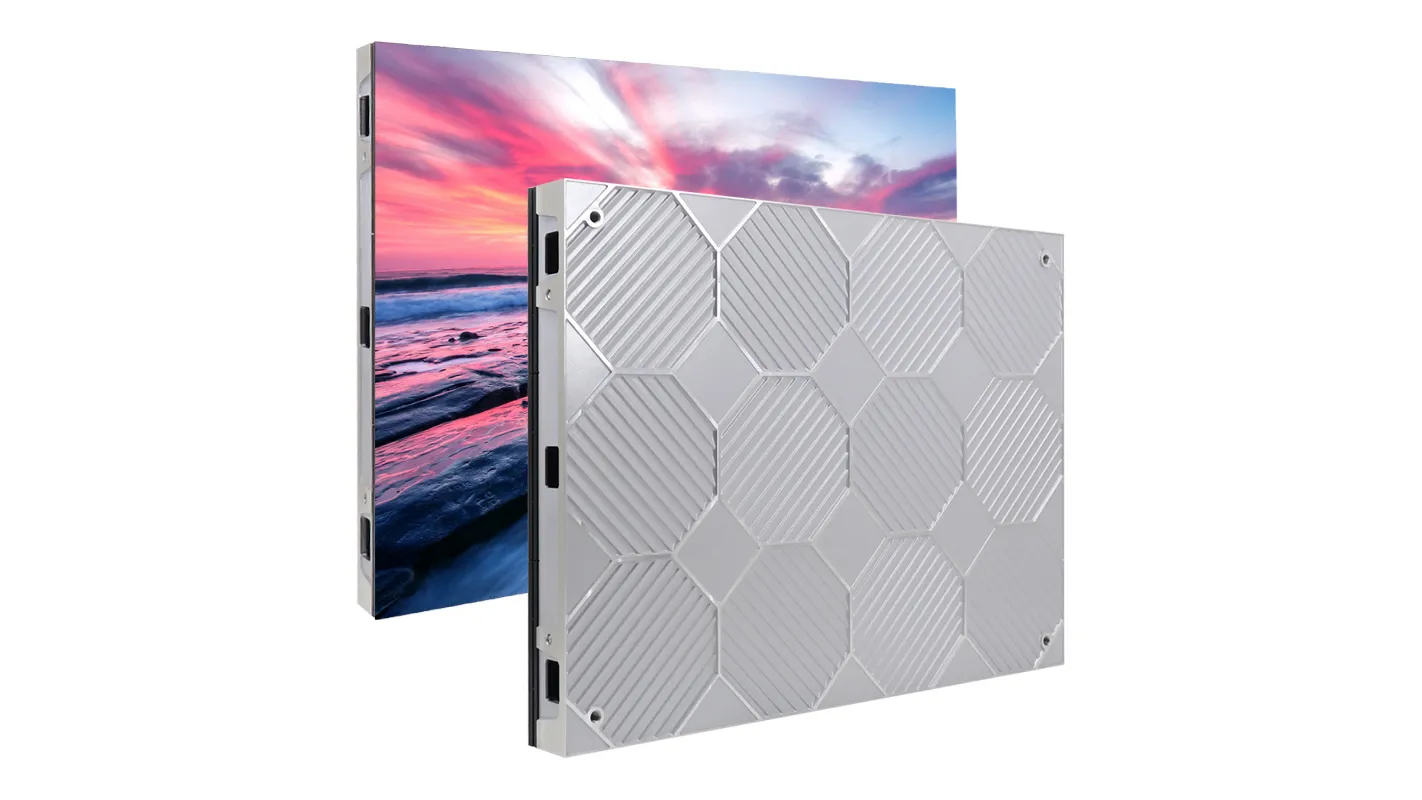
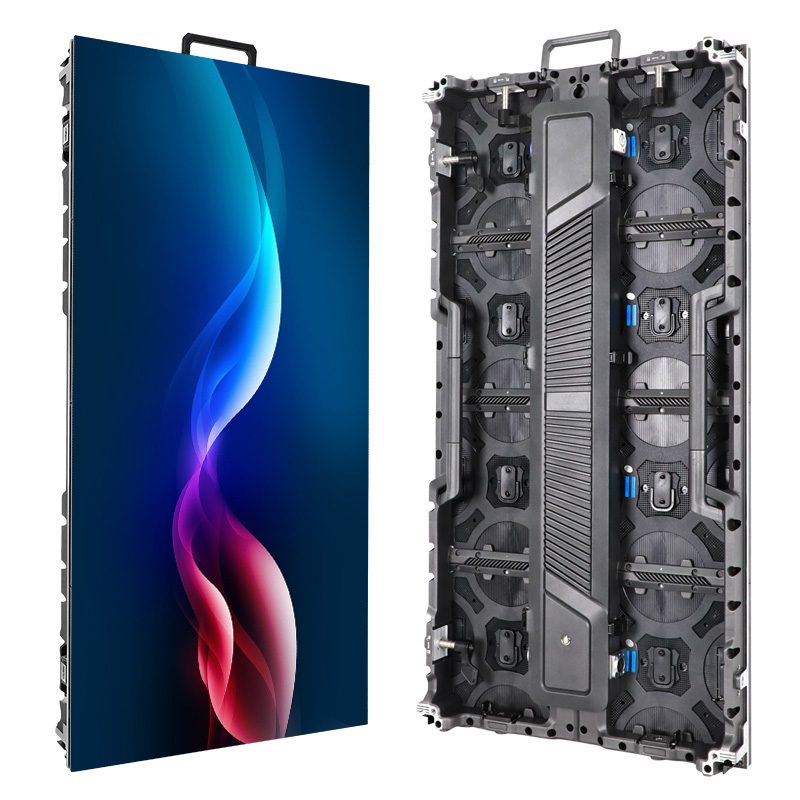
LED display supplier selection starts with verifiable project evidence. The best LED display manufacturers in China are those that can demonstrate the right screen configuration, repeatable production quality and usable service support for your project. Compare suppliers with the same project brief, sample tests, itemized quotation and acceptance checklist. A rental company buying cabinets for weekly events needs different evidence from an AV integrator specifying a permanent boardroom wall.
For distributors and project contractors, the purchase includes more than LED modules and cabinets. You also need a workable pixel canvas, compatible control hardware, accessible replacement parts, documented acceptance criteria and a clear division of installation responsibilities. A low screen price can lose its advantage when those items arrive late or remain undefined.
This guide explains how to compare LED display manufacturers in China using an evidence-based scorecard. It includes a small, unranked supplier comparison, explains where EagerLED’s documented product options can fit, and gives you practical checks for quotations, factory verification and order handover.
Editorial disclosure: This article appears on an EagerLED website. Supplier descriptions use publicly available manufacturer information checked on October 14, 2026; they are not independent factory audits. The scoring method below is a suggested procurement tool, and no manufacturer has been assigned a fabricated score.
1. What Makes an LED Display Manufacturer the Best Fit?
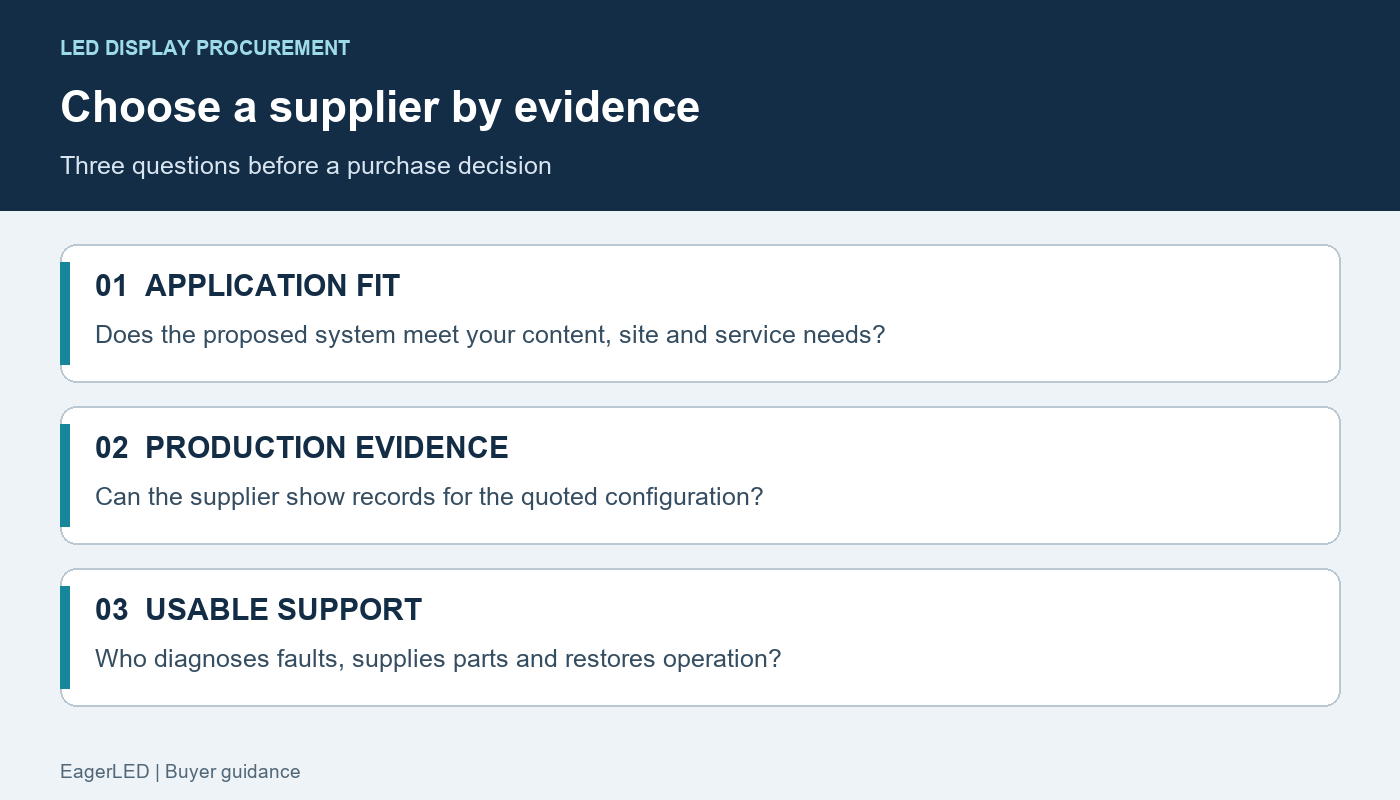
The best LED display manufacturer for your project should satisfy three tests: the proposed display meets your application, the supplier can demonstrate repeatable production quality, and the service plan works where the screen will operate. Brand recognition is useful background, but it does not establish those conditions for a particular order.
Separate the manufacturer, the contracting seller and the installation partner. They may be the same organization, or three different businesses. Ask who approves engineering changes, who invoices the equipment and who provides field support. Buying directly from a Chinese LED display factory does not automatically include installation, electrical design or local replacement stock.
A trading company can offer valuable sourcing and local support; an actual factory can still be unsuitable for your specification. Evaluate the responsibilities and evidence rather than accepting either label as a guarantee. Ask which processes the LED display manufacturer performs itself and which components or services come from partners.
For a fair selection, apply the same brief and acceptance requirements to every candidate. Request a bill of materials (BOM) that identifies the major components and their approved revisions. Compare current, named product configurations instead of general promises such as “high quality” or “premium LEDs.” Keep unresolved issues visible. An unanswered requirement should remain an open risk rather than quietly becoming an assumed capability.
2. Define Your LED Screen Project Before Shortlisting
LED display manufacturers can give more useful recommendations when they receive the same physical and operational constraints. Send screen dimensions, installation drawings, audience positions, content examples and the destination country. State whether the screen will be installed permanently, transported repeatedly or recorded on camera. Ask each LED display manufacturer to identify any missing information before preparing its proposal.
Describe ambient light and weather exposure precisely. A screen behind shop glass is different from an exposed outdoor billboard, even when both face a street. Include available power, ventilation, structural restrictions, cable routes and maintenance access. Photographs help suppliers identify questions, but they do not replace an engineering survey.
| Application | Main purchasing priority | Evidence to request |
|---|---|---|
| Rental and staging | Repeated handling, cabinet alignment and rapid repair | Assembly demonstration, approved rigging details, flight-case plan and spare compatibility |
| Indoor fixed installation | Readable content, low-brightness image quality and service access | Native pixel layout, sample content test and full component removal procedure |
| Outdoor advertising | Daylight visibility, environmental suitability and safe servicing | Model-specific environmental documentation, thermal review and mounting requirements |
| Retail glass installation | Visibility through glass, cable concealment and replacement access | On-site viewing assessment, transparency explanation and mounting drawing |
| Broadcast or virtual production | Camera compatibility, timing and color consistency | Camera tests with the proposed panels, processor, firmware and operating settings |
Distinguish essential requirements from preferences. A front-service wall with no rear corridor has an access requirement that cannot be traded away for a lower price. A particular cabinet finish may be optional. Giving suppliers that distinction prevents attractive proposals from missing the actual installation constraints.
Also state what you can support locally. A distributor with trained technicians and stocked modules can accept a different service arrangement from a venue with no display engineer. Your capacity to diagnose faults, configure receiving cards and replace parts should influence both the supplier shortlist and the purchase package.
3. LED Display Supplier Selection Scorecard
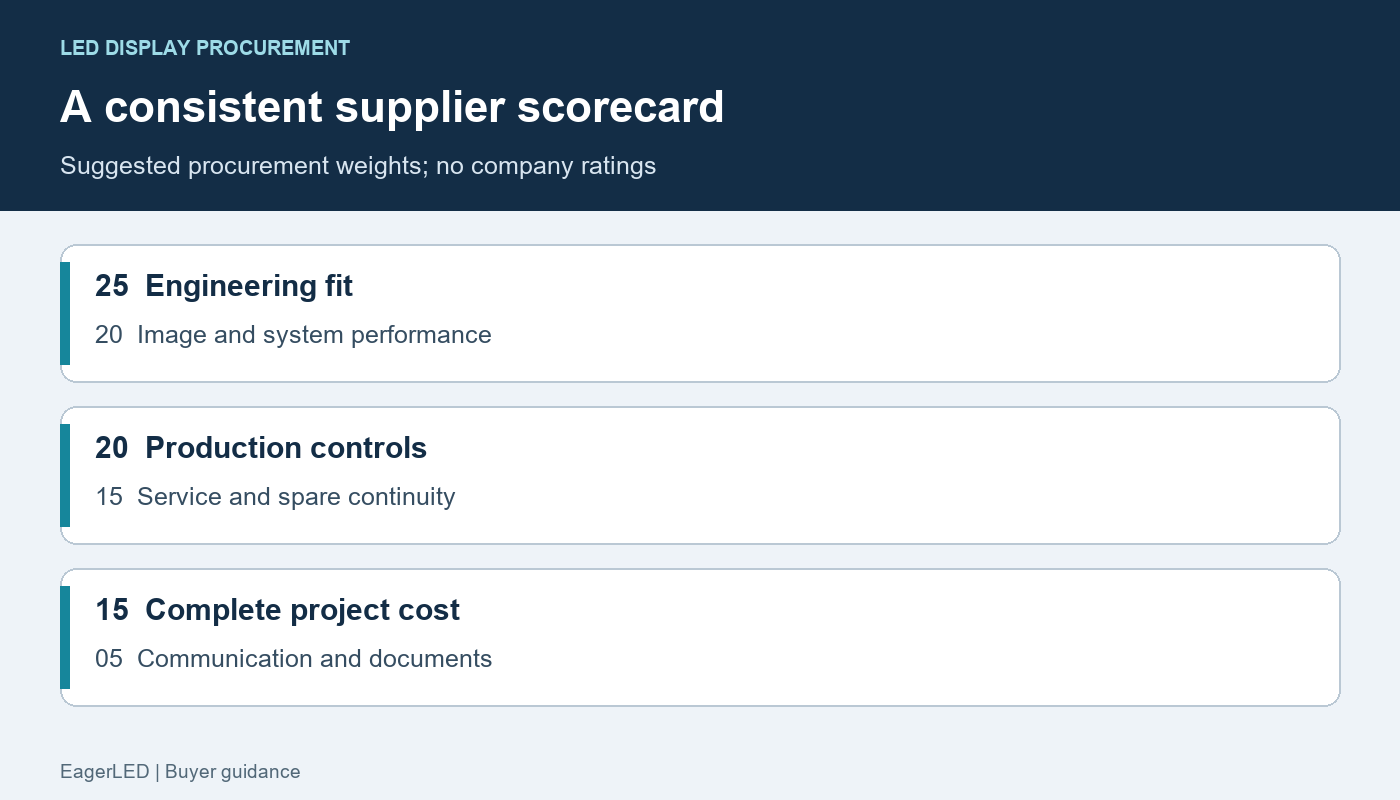
Use this scorecard for LED display supplier selection: compare documented performance against your project requirements, rather than assigning a universal manufacturer ranking. Set the weights before collecting quotations. The example below totals 100 points; adjust it to your project, then use the same version for every candidate.
| Criterion | Suggested weight | Evidence required |
|---|---|---|
| Application and engineering fit | 25 | Approved layout, named model and resolution of site constraints |
| Image and system performance | 20 | Sample tests at the agreed brightness, content and camera settings |
| Production and inspection controls | 20 | Traceable records, inspection plan and handling of nonconforming units |
| Service and parts continuity | 15 | Replacement procedure, compatible spare list and written support scope |
| Quote completeness and lifecycle cost | 15 | Itemized supply scope and documented exclusions |
| Communication and document control | 5 | Consistent revisions, named contacts and clear technical responses |
Score each criterion from zero to five, then multiply the score by its weight divided by five. For example, an application-fit score of 4/5 contributes 20 of the available 25 points; add the weighted results for a total out of 100. A useful internal interpretation is: zero means no usable evidence; one means an unsupported claim; three means relevant documentation; five means the requirement is demonstrated and accepted. These definitions are your purchasing rules, not independently measured manufacturer ratings.
Use pass-or-fail gates alongside the score. Missing mandatory project documentation, unresolved service access or an unverified seller identity should block approval even when other scores are strong. A high average cannot fix a critical failure.
Keep a short reason next to each rating, with a document revision or test record. If two LED display manufacturers finish close together, compare the unresolved risks and the practical cost of addressing them. That discussion usually reveals more than another decimal place in the spreadsheet.
4. Compare Chinese LED Display Suppliers by Project Fit
For a wider company shortlist, see our Chinese LED display manufacturer comparison. This guide focuses on supplier evaluation and procurement rather than a top-ten ranking. The following examples help buyers understand different product portfolios. They are presented alphabetically, without rank, market-share claims or assumed price tiers. This is a limited comparison of LED display manufacturers, not an exhaustive directory or a statement that any company will meet your specific tender.
| Supplier | Published portfolio evidence | Potential project fit to assess | Question before approval |
|---|---|---|---|
| Absen | Indoor, outdoor and rental displays; support and training resources | Commercial installations and rental systems needing a defined regional support route | Which partner, parts location and service terms cover this exact order? |
| EagerLED | Rental cabinets and front-service indoor systems, with published model pages and factory information | Distributors, rental companies and integrators seeking factory configuration discussions | Which BOM, spare parts and acceptance records will accompany the quoted configuration? |
| ROE Visual | Touring, broadcast, virtual-production and fixed-installation products; processing platform information | Camera-facing and event applications needing coordinated panel and processor evaluation | Can the offered combination be tested with the intended cameras and workflow? |
| Unilumin | Professional, commercial, DOOH, rental and creative display categories | Projects needing comparison across several display applications | Which product family, engineering scope and regional service arrangement apply? |
Portfolio sources: Absen’s product and support overview, ROE Visual’s products and markets, and Unilumin’s product categories. The project-fit column is a purchasing inference from those portfolios, not a verified performance comparison.
01. Where EagerLED’s Documented Options Can Fit
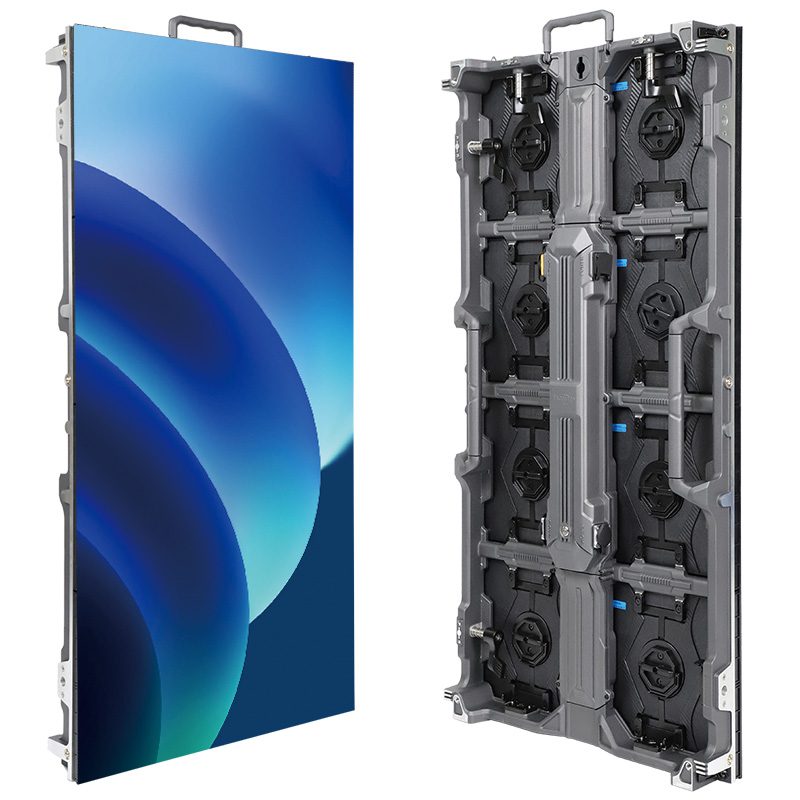
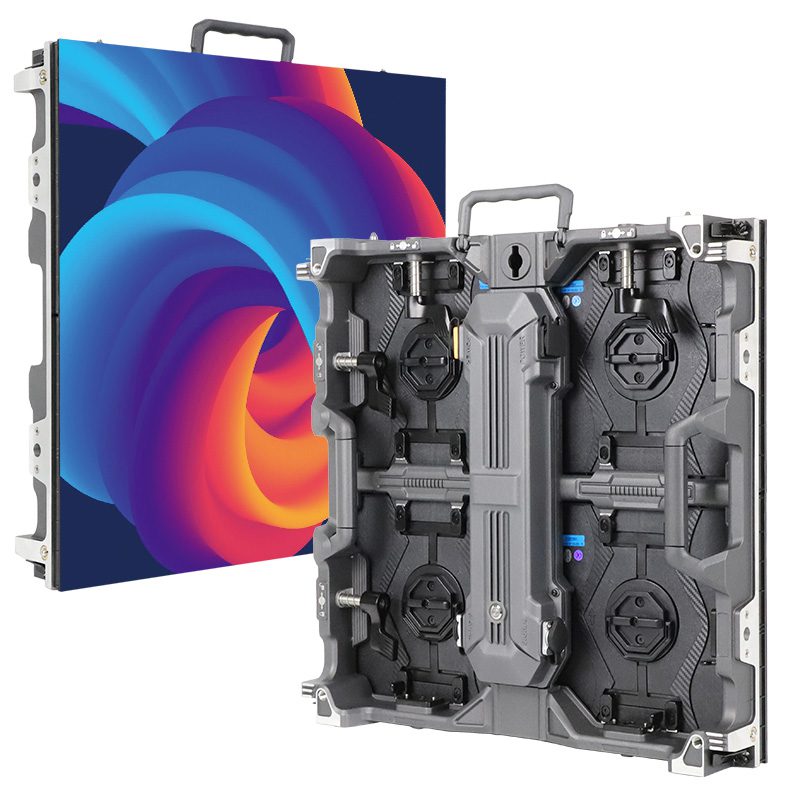
EagerLED’s practical advantage to evaluate is the ability to start with identifiable product families and discuss a project-specific configuration. Its EA1000H9 rental cabinet page describes a 500 × 1000 mm format and service-oriented cabinet features. Its EA640F2 indoor display page describes a 640 × 480 mm front-service cabinet. These documented options give buyers concrete starting points for rental and space-constrained indoor applications.
The advantage is relevant only when the selected configuration matches the job. Verify module removal, power-supply access, receiving-card access and spare compatibility on the quoted version. A shared product name or module dimension does not establish that all variants can exchange parts.
02. When to Widen the Comparison
For specialized filming, demanding local support obligations or unusual architectural installations, compare additional LED display manufacturers and qualified integration partners. Ask all candidates for equivalent tests. This guide does not establish that EagerLED offers the lowest price, the strongest camera performance or the widest local support network.
A supplier that cannot demonstrate a critical function should remain outside the final shortlist until it resolves that gap. EagerLED should pass the same evidence requirements as every other Chinese LED display manufacturer you consider.
5. Check the Specifications That Affect Real Performance
LED display manufacturers often quote the same headline terms while offering different operating results. Check the complete system and the settings behind each number. Your purchasing document should describe how performance will be observed, not merely repeat a brochure.
01. Pixel Pitch, Resolution and Content
Pixel pitch is the distance between adjacent pixel centers, normally expressed in millimeters. Smaller pitch increases pixel density for a given area, but it also changes the cost and processing requirements. Do not select pitch from viewing distance alone: small text, detailed graphics, ambient light and audience expectations all matter.
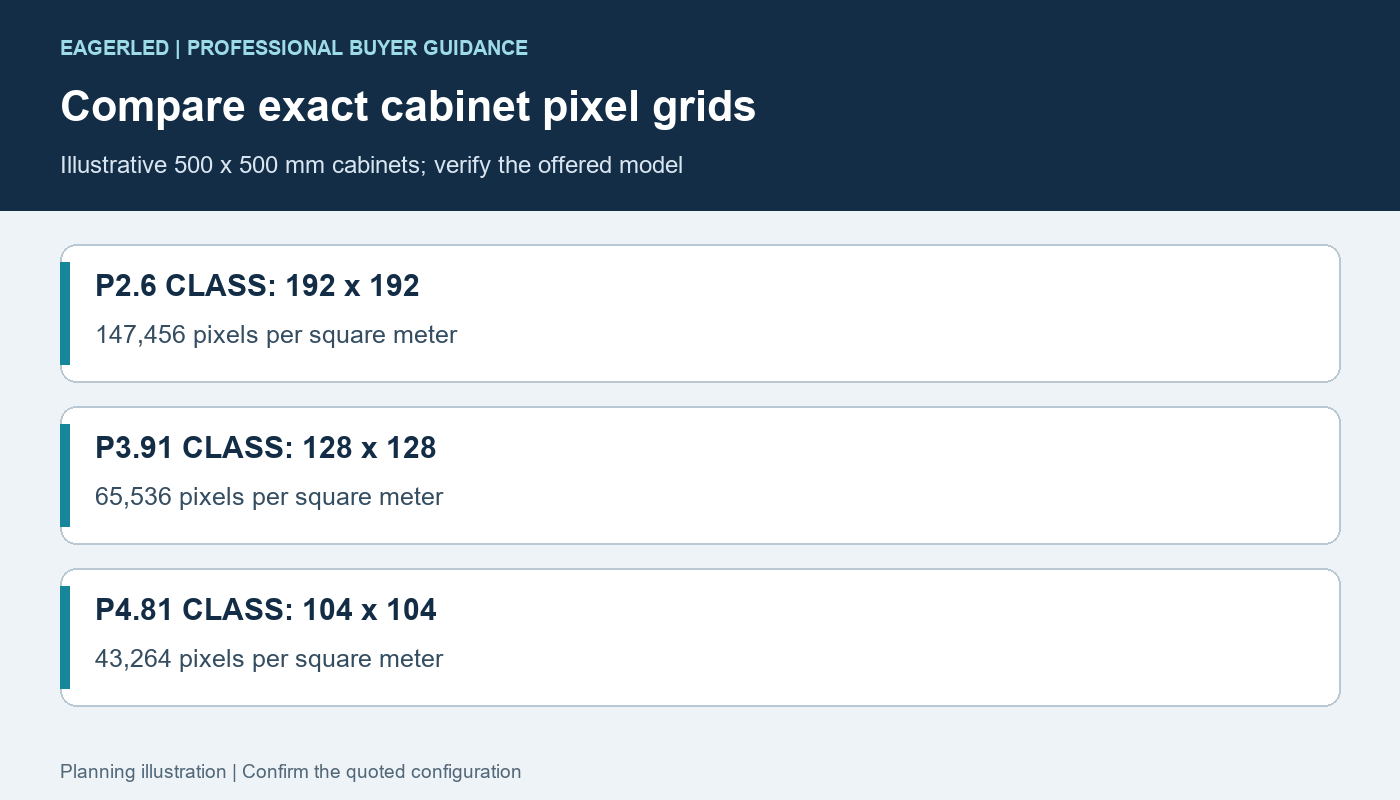
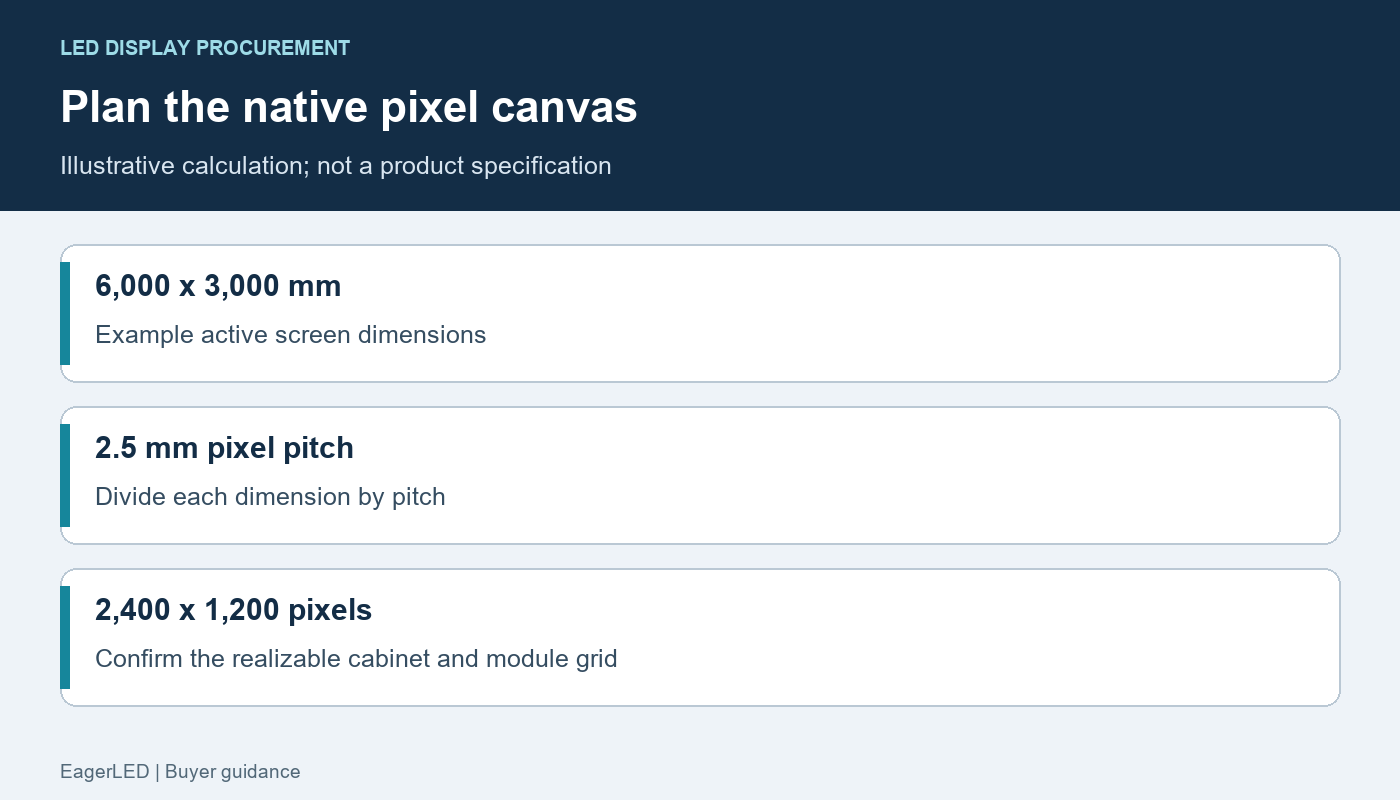
For an idealized 6,000 × 3,000 mm active area at exactly 2.5 mm pitch, dividing each dimension by pitch gives 2,400 × 1,200 pixels. This is a calculation example, not a product specification. Actual cabinet and module grids determine the realizable dimensions and pixel count. Ask the LED display manufacturer for the final native canvas and a mapping drawing before artwork is approved. Our LED screen resolution guide explains the display-resolution planning process.
02. Brightness, Refresh and Camera Behavior
Brightness is commonly stated in cd/m², also called nits. Compare the usable, calibrated setting for your venue rather than assuming the largest maximum is best. Inspect white balance, shadow detail and uniformity at the brightness you will operate.
Display refresh rate is different from video frame rate. A high refresh specification alone does not guarantee clean footage. Camera shutter settings, scan behavior, processor timing and the panel electronics can affect visible artifacts. Camera-facing projects should include tests of the actual system with representative content and intended cameras.
Ask shortlisted suppliers to identify the processor, receiving cards, firmware versions and configuration files used in their demonstration. Otherwise, a sample may perform well under settings that are absent from the delivered package. Useful technical context is available in Brompton’s explanation of camera and LED refresh timing.
03. Packaging, Protection and Maintenance
SMD refers to surface-mounted packaged LEDs; COB mounts LED dies directly on a substrate. GOB generally describes protective encapsulation applied over a module, often using SMD LEDs. These terms describe different aspects of construction and do not form a simple quality ranking.
Compare optical appearance, cleaning instructions and repair procedures for the proposed module. An encapsulated surface may change how technicians repair damaged pixels. Front-service modules also do not prove that every internal part can be replaced from the front. Require a complete removal demonstration, including access after the display is mounted.
For outdoor use, request the exact environmental ratings and supporting documents for the assembled configuration. Face protection does not establish rear protection, connector protection or suitability for every climate. LED display manufacturers should also explain ventilation, thermal limits and the installation conditions assumed in their design.
6. Compare Quotes and Total Project Cost
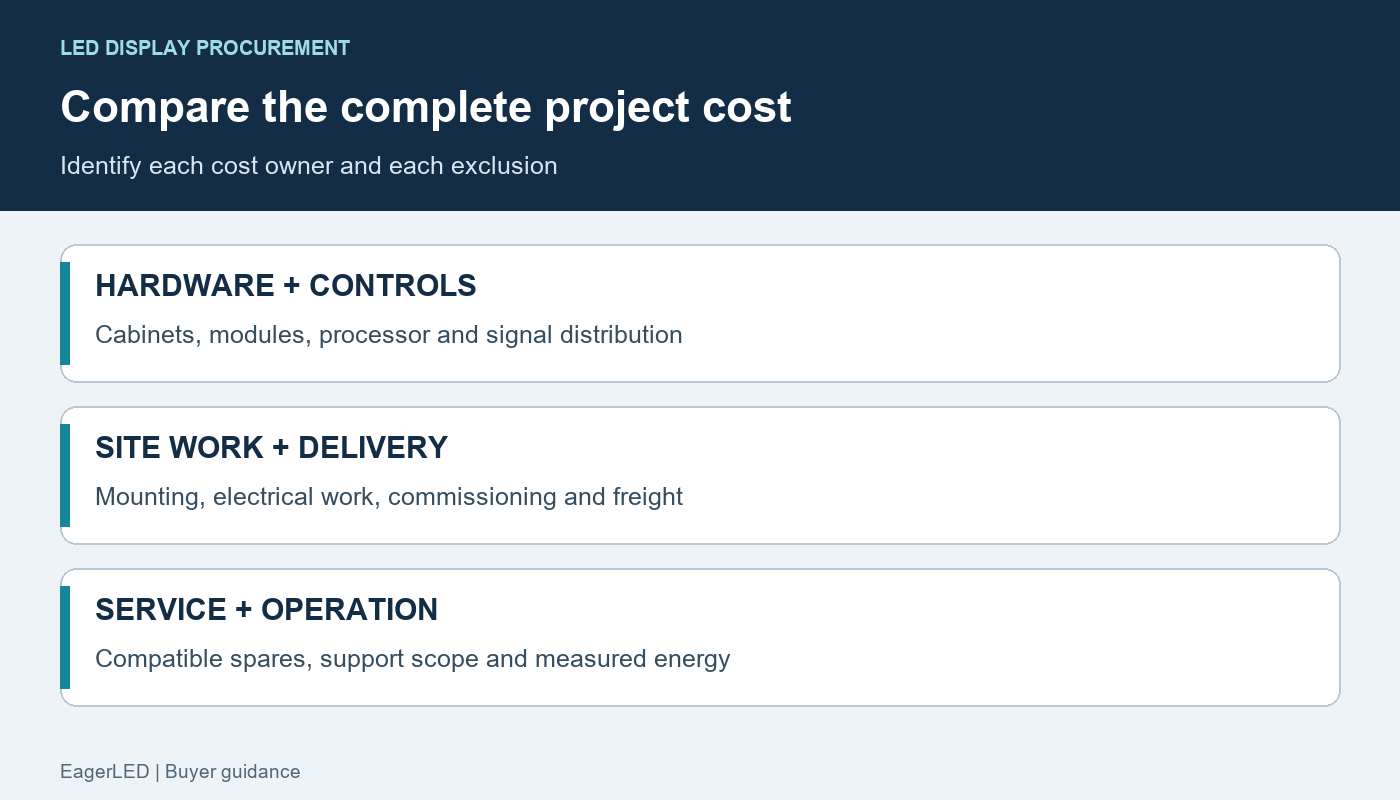
Quotes from LED display manufacturers become comparable only after the supply scope is aligned. A price per square meter may cover cabinets alone or a much larger package. Confirm what the figure includes before using it to set a project budget.
| Cost line | What to specify | Common missing item |
|---|---|---|
| Display hardware | Quantity, pitch, cabinet model, module version and component list | Unapproved substitutions or different brightness configurations |
| Control system | Processor, receiving cards, software and required signal distribution | Extra outputs, converters or redundancy hardware |
| Mechanical and electrical scope | Included frames, mounting accessories, cables and power interfaces | Site structure, distribution equipment and installation labor |
| Service package | Spare quantities, compatibility, training and support responsibility | Local labor, replacement shipping and diagnostic equipment |
| Delivery | Packing, freight responsibility, destination and agreed delivery basis | Handling, insurance and destination charges |
Use a total-cost worksheet with separate entries for supplied equipment, logistics, site preparation, installation, commissioning, spares and operation. Leave unquoted entries visibly open. Do not fill the gaps with invented market prices. Ask your logistics and installation partners for the actual project costs they control.
Operating energy requires a defined assumption. For example, measured average power in kilowatts multiplied by operating hours gives energy in kilowatt-hours. Calculate that scenario using your intended brightness and content; a brochure’s maximum power figure is useful for electrical planning but does not represent every hour of operation.
Give suppliers the same list of accessories and spares. If one offer includes compatible receiving cards and calibration data while another excludes them, compare the completed packages. The lower starting price is not necessarily the lower cost of an operational wall.
7. Verify Factory Capability and Quality Control
Begin by checking the contracting company’s identity and the production location it proposes. Request a live walkthrough or an independent inspection where appropriate. Factory photographs are useful context, but they do not demonstrate that your order will follow the process shown.
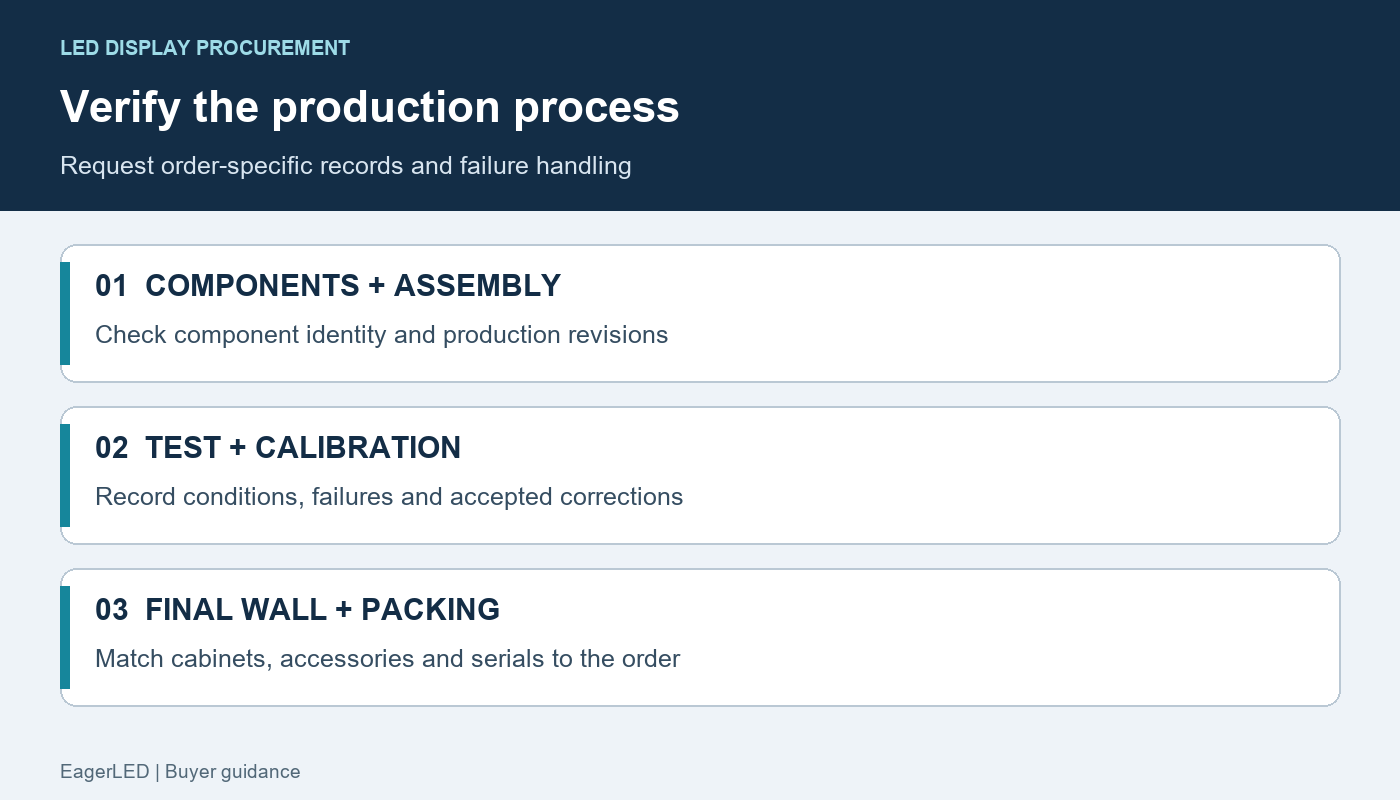
Ask suppliers to walk through incoming inspection, assembly, functional testing, calibration, final wall assembly and packing. Discuss how failed units are isolated, repaired and tested again. A quality process should explain both normal production and what happens when a unit fails.
EagerLED publishes a quality-control overview and factory information. Treat these as supplier-described processes. Request the inspection plan, records and acceptance results for your selected configuration rather than assuming every public claim applies to every model or order.
Burn-in or aging tests can expose some early faults, but a stated duration does not prove lifetime reliability. Record the test conditions, tested quantities, interruptions, failure results and retest procedure. Photographs of an illuminated wall cannot establish long-term failure rates.
For project compliance requirements, identify the exact model, document issuer, tested scope and applicable installation conditions. Have the responsible project specialist confirm the documentation needed for your destination. Generic logos and unrelated certificates are inadequate evidence; this guide does not claim any supplier holds certification for your proposed system.
Check production continuity as well. Ask how the LED display manufacturer controls BOM revisions and handles unavailable components. Agree that substitutions affecting performance, serviceability or compatibility require your documented approval.
8. Turn Your Shortlist into a Controlled Purchase
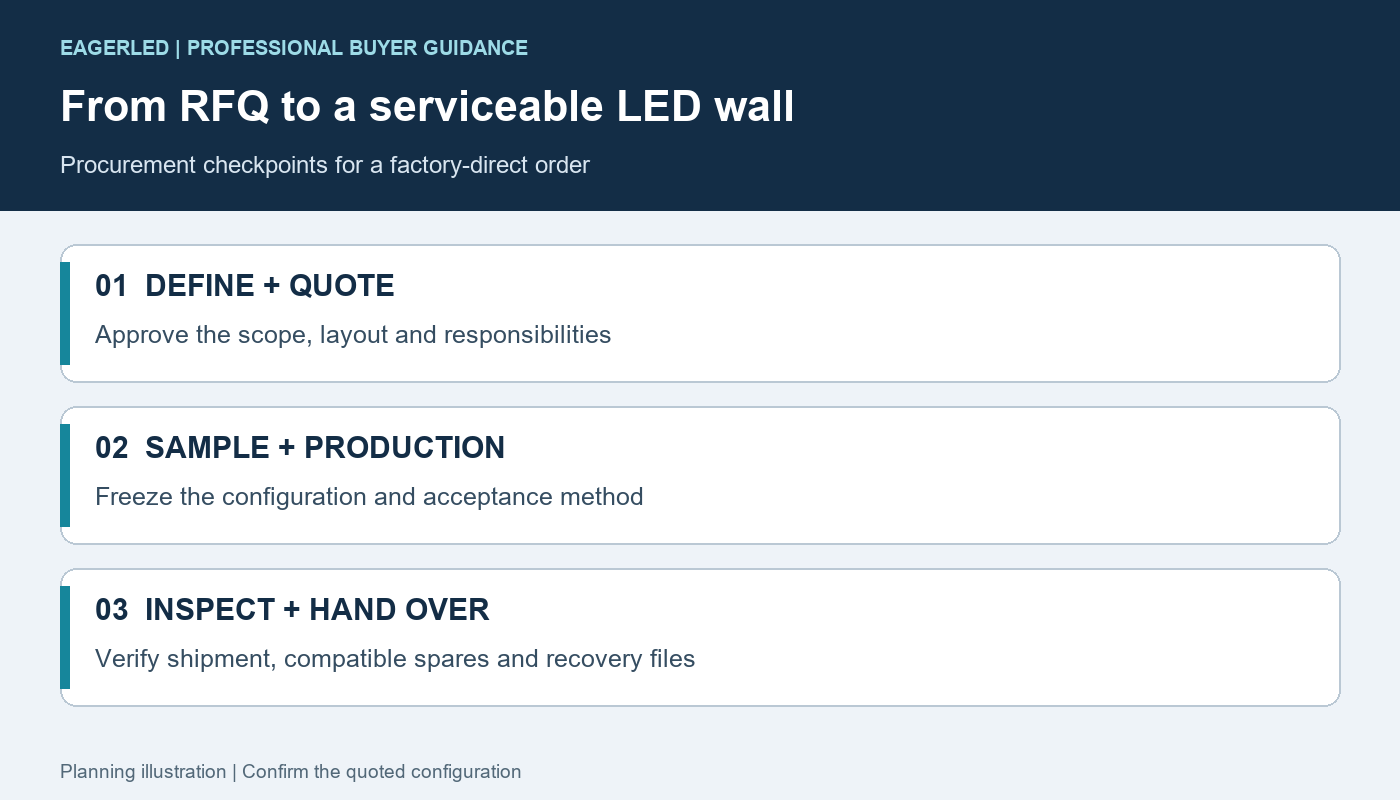
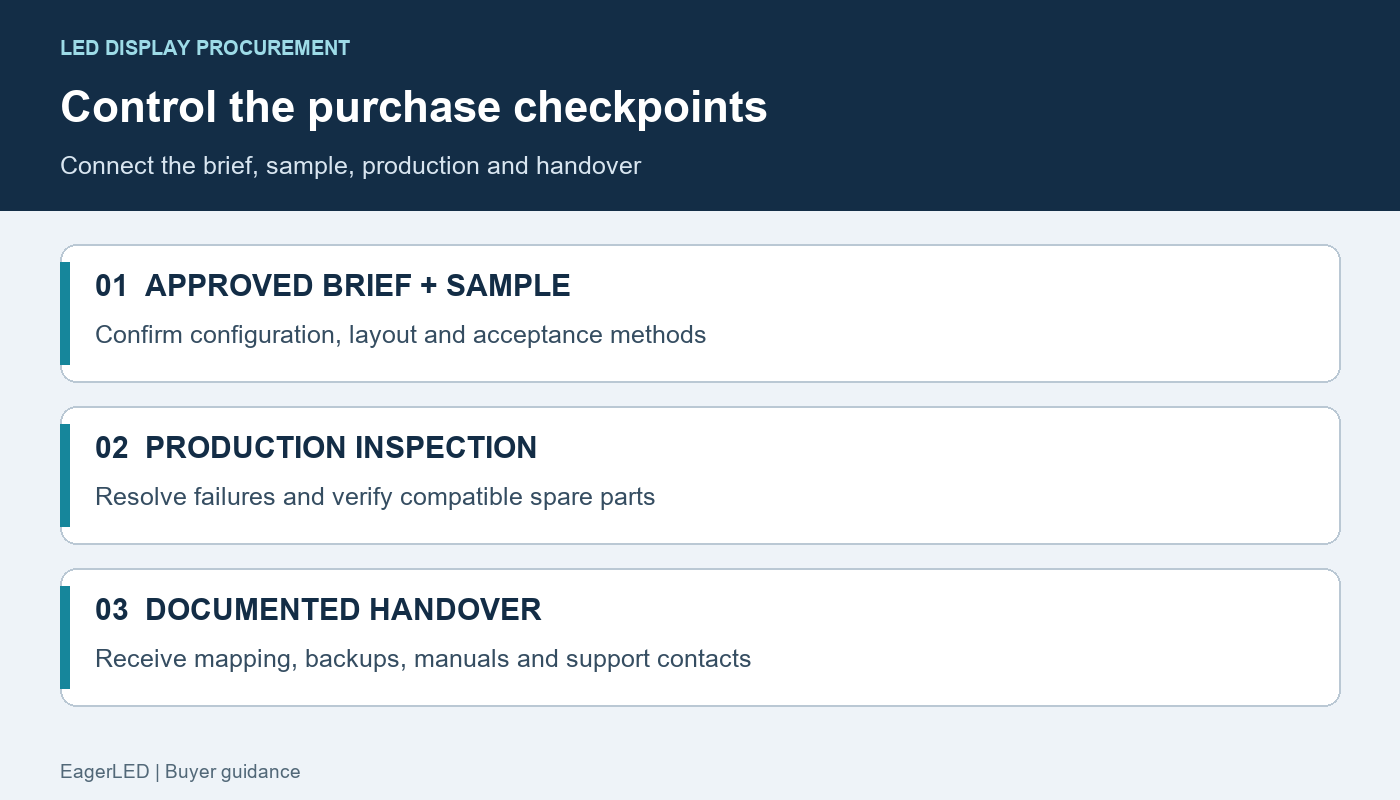
The final purchase should connect the quotation, approved sample, component list and acceptance plan. LED display manufacturers should identify the document revisions governing production, including cabinet quantities, pixel layout, control configuration and spare-parts schedule.
| Check | Practical acceptance method | Handover record |
|---|---|---|
| Image consistency | Inspect test patterns and real content at agreed operating settings | Settings, observations, defect thresholds and corrective actions |
| Cabinet alignment | Assemble the agreed test wall and inspect seams and fit | Layout, accepted tolerances and inspection photographs |
| Serviceability | Remove and replace the specified modules and internal parts | Tools, procedure, access requirements and spare compatibility |
| Control and recovery | Verify mapping, restart and agreed recovery behavior | Configuration backups, firmware versions and connection drawings |
| Packing and inventory | Match cabinet IDs, accessories and spare quantities to the packing list | Serial list, package labels and transport-condition instructions |
Agree measurable defect thresholds instead of vague “perfect image” promises. Define who inspects, how disagreements are resolved and which results must be corrected before shipment. Inspection does not replace supplier accountability; it creates a record both parties can use.
Request manuals, configuration backups, calibration information, cabinet mapping and compatible spare-part references. Keep an offline copy with your technical team. For EagerLED models, the published specification downloads are a starting point; the approved order documents should state the final configuration.
Document warranty scope and service logistics. Clarify how a fault is reported, which party diagnoses it, what replacement route applies and which costs remain with the buyer. Distinguish acknowledgment of a support request from restoration of a working screen.
Send a consistent request for quotation to the finalists. If EagerLED is on your shortlist, share that brief through the project inquiry page. Ask for an itemized response and the same evidence you require from other LED display manufacturers. Approve the supplier when the technical and commercial gaps are resolved.
9. LED Display Supplier Selection FAQs
01. Can I place a small trial order before buying a full wall?
Ask whether the supplier offers a sample module, cabinet or representative test assembly, and request written scope and cost. A single module cannot demonstrate cabinet alignment or a complete control system. Ensure the trial uses the intended production components and record which observations still require a larger test.
02. Can cabinets from different manufacturers be mixed?
Do not assume so. Matching external dimensions or pixel pitch does not establish compatibility of locks, connectors, electronics, scan configuration or calibration. Even products from one LED display manufacturer may have incompatible revisions. Obtain a written compatibility assessment and test the actual combinations before combining inventories.
03. How should distributors discuss OEM branding?
Define the requested branding scope: cabinet labels, packaging, manuals or interface customization. Confirm which changes are available and whether they affect documentation, support or component identification. Preserve traceability to the original model and production revision so technicians can order the right parts later.
04. What if my contractor names a different receiving card?
Have the contractor and supplier confirm compatibility before production. Ask for the exact card model, firmware, loading limits and panel configuration. A familiar control-system brand is insufficient evidence that a different card will work with the selected module and required operating settings.
05. How can I plan an expansion without visible color differences?
Discuss expansion early and ask about compatible reserve modules, component continuity and recalibration. Future stock may differ in LED bins or electronics. No LED display manufacturer should promise an invisible match without defining the conditions and testing method. Consider reserving compatible parts with the original order when expansion is likely.
06. What should be included in remote commissioning?
Define the sessions, language, working hours, connection requirements and deliverables. Specify whether assistance covers cabinet mapping, configuration loading, test patterns and troubleshooting. Your local team still needs access to the equipment and responsibility for safe site work. Confirm how sessions are arranged if delivery or installation is delayed.
07. Who should control passwords and configuration backups?
Assign ownership to the operator or designated integration partner. Arrange a controlled handover of accounts, software access and validated backups. Keep model and firmware records with the files, and agree how later changes are approved. Avoid relying on a salesperson’s personal device as the only source of recovery information.
08. Does a longer advertised LED lifespan guarantee uptime?
No. Component lifespan estimates do not guarantee a complete system’s availability. Power supplies, connectors, control hardware, heat, installation and maintenance also affect operation. Compare LED display manufacturers on repair access, parts availability and recovery procedures rather than converting a lifespan claim into a promise of uninterrupted service.
10. Conclusion
The best LED display manufacturers in China are those that can demonstrate a fit for your specific project and support the delivered configuration. Start with the application, use a consistent scorecard, test the actual system and compare complete quotations. Keep mandatory requirements separate from negotiable preferences.
EagerLED’s documented rental and front-service indoor product options make it a supplier worth evaluating for relevant distributor and integration projects. Apply the same checks to EagerLED and every alternative: approved specifications, traceable production, accessible spares and clear handover responsibilities. Choose the LED display manufacturer whose evidence resolves your project’s risks before the order is released.
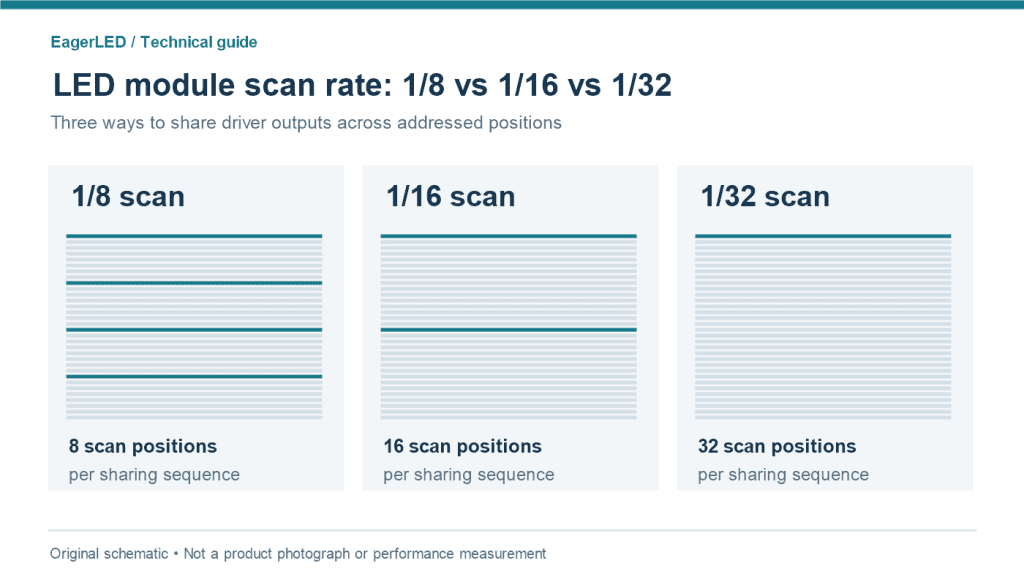 LED Module Scan Rate: 1/8 vs 1/16 vs 1/32
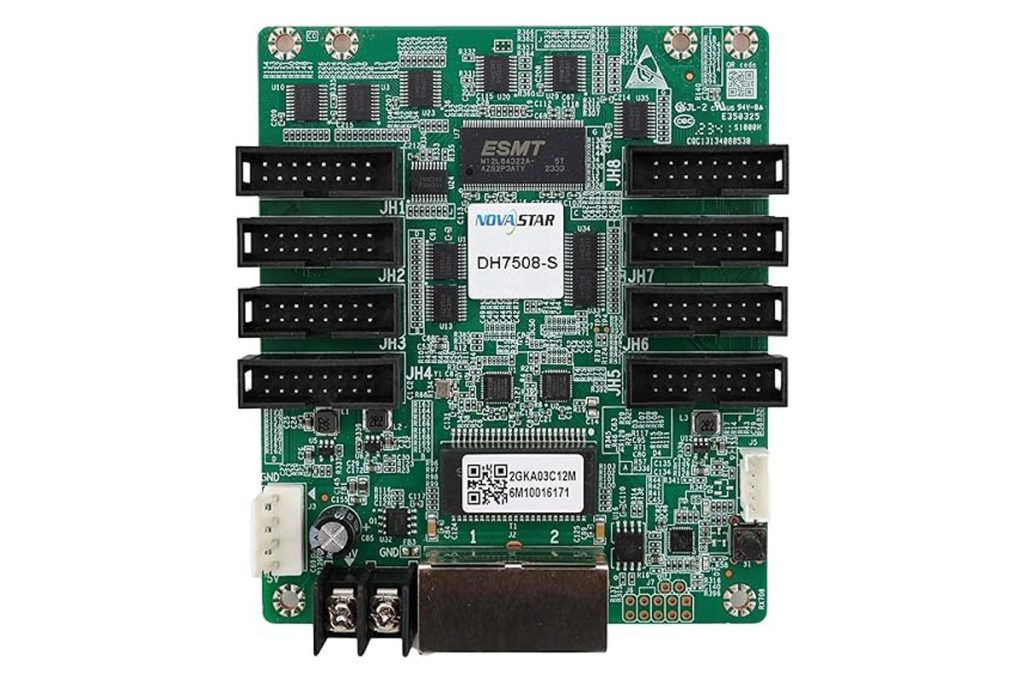 LED Receiving Card Explained: Inside the LED Cabinet