
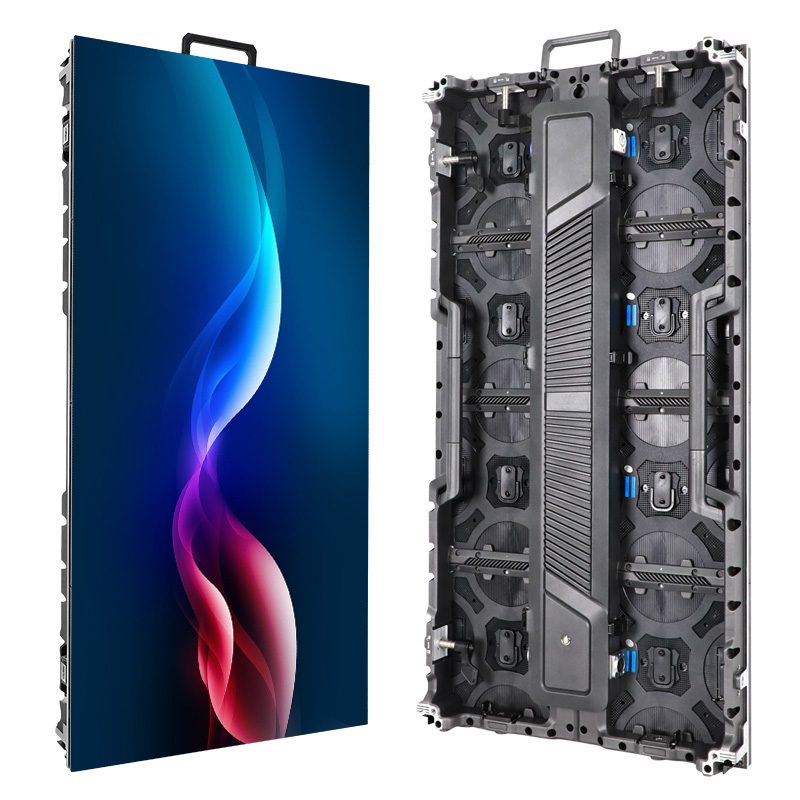
LED poster vs LCD poster: the better choice depends on viewing distance, ambient light, content detail, installation format, and service plan. Choose a direct-view LED poster when you need modular sizing, bezel-free multi-screen layouts, outdoor-ready brightness, or front-service modules. Choose an LCD poster when viewers stand close, 4K text detail matters, the screen size is fixed, and the lowest initial hardware cost is the priority.
The most important finding in this LED poster vs LCD poster comparison is that technology labels alone do not decide brightness or image quality. For example, the indoor EagerLED EA1920iP5 is rated at 600-800 cd/m², while Samsung lists 700 nits for its 55-inch QHC LCD signage display. For outdoor use, the EagerLED EA1920OP2 reaches 5,000 cd/m². Compare actual model specifications, not generic claims.
LED poster vs LCD poster: quick decision
- Choose LED: scalable video walls, high-impact motion, outdoor or bright-window models, and module-level service.
- Choose LCD: close-range menus, directories, detailed text, a fixed 43-65 inch format, and a tighter initial budget.
- Do not buy by technology name alone: compare brightness, pixel density, operating rating, ingress protection, warranty, and content system.
Table of Contents
- 1. LED Poster vs LCD Poster: Quick Answer
- 2. What Is an LED Poster?
- 3. What Is an LCD Poster?
- 4. LED Poster vs LCD Poster: 10 Key Differences
- 5. LED Poster vs LCD Poster Comparison Table
- 6. Which Poster Display Fits Each Application?
- 7. How to Compare Cost and ROI
- 8. Buyer Checklist Before You Request a Quote
- 9. LED Poster vs LCD Poster FAQ
- 10. Conclusion: Which Poster Should You Choose?
1. LED Poster vs LCD Poster: Quick Answer
In a typical LED poster vs LCD poster decision, an LED poster is the stronger commercial advertising tool when the display must scale, move between venues, remain visible in demanding light, or form a seamless video wall. An LCD poster is usually the more efficient choice for close viewing, small text, static information, and a fixed indoor installation.
That answer needs one qualification: neither category has one universal brightness, resolution, lifespan, or power figure. A premium high-brightness LCD can outperform an entry-level indoor LED poster in a storefront window. Likewise, an outdoor direct-view LED poster can be many times brighter than a standard indoor LCD. The correct LED poster vs LCD poster comparison must use the datasheets of the exact models being quoted.
| Buying priority | Usually choose LED poster | Usually choose LCD poster |
|---|---|---|
| Close-range text and menus | Possible with fine pitch, but confirm pixel density | Strong fit because 4K panels provide dense pixels |
| Seamless multi-screen canvas | Strong fit; cabinets join without LCD bezels | Visible bezel lines unless using specialist video-wall panels |
| Outdoor deployment | Choose an outdoor-rated, high-brightness model | Requires an outdoor-rated unit or engineered enclosure |
| Lowest initial purchase cost | Usually higher | Usually lower |
This first LED poster vs LCD poster matrix is a starting point. The sections below explain the technical trade-offs and the questions a supplier should answer before you compare quotations.
2. What Is an LED Poster?
An LED poster is a tall digital display that uses direct-view light-emitting diodes as the visible pixels. It is not the same as a consumer “LED TV,” which is normally an LCD panel illuminated by LED backlights. In an LED poster, the LED modules themselves form the image.
01 Direct-View LED Construction
Direct-view construction makes an LED poster modular. A cabinet contains replaceable LED modules, receiving cards, power supplies, a controller, and a frame. The module grid determines pixel pitch and native resolution. This construction is central to the LED poster vs LCD poster difference: LED cabinets can join into a wider canvas without a bezel crossing the content.
Modularity also changes maintenance. With a front-service LED poster, a technician can remove a failed module from the viewing side. The whole poster does not automatically need replacement. However, the supplier should stock matching modules from the same production batch because LED color can vary between batches.
02 Verified Indoor LED Poster Example
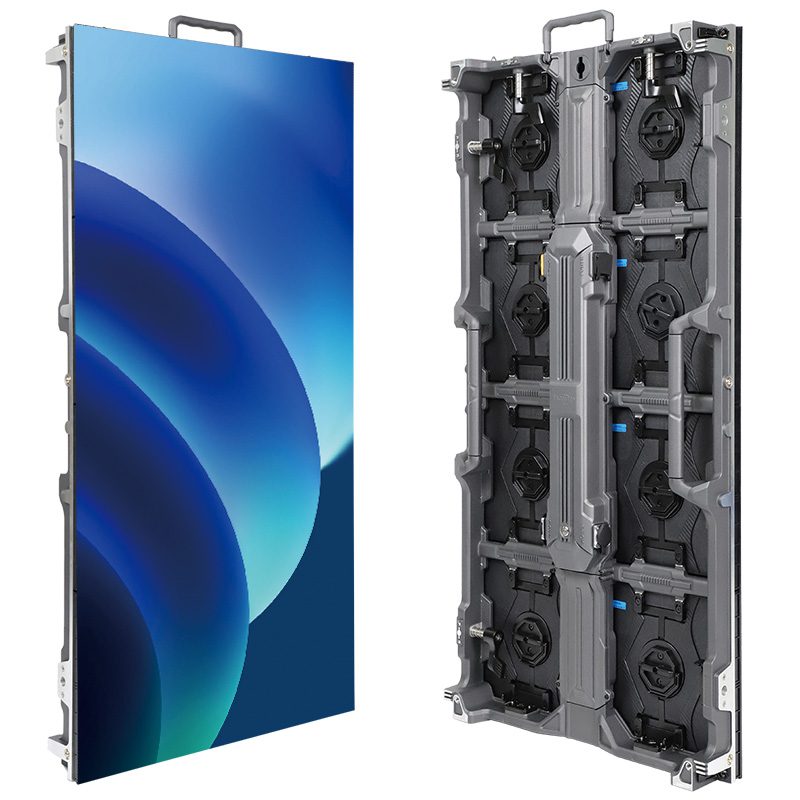
The EagerLED EA1920iP5 provides a useful real-model reference. Its display measures 640 × 1920 mm and offers P1.25, P1.53, P1.86, P2, and P2.5 pixel pitches. EagerLED specifies 600-800 cd/m² brightness, a refresh rate of at least 3,840 Hz, and a 140-degree viewing angle. Its dual-sided frame folds to reduce storage volume by up to 50%, and front-service access uses 320 × 160 mm modules.
Those figures show why a buyer should avoid vague claims in an LED poster vs LCD poster quote. Pixel pitch changes resolution. Brightness changes suitability for ambient light. Refresh rate affects how cleanly the display appears on camera. Cabinet weight and service access affect labor and transport.

03 Verified Outdoor LED Poster Example
Outdoor performance requires a different model. The EagerLED EA1920OP2 is rated at 5,000 cd/m², at least 3,840 Hz refresh, and IP65 protection on both front and rear. It offers P1.86, P2, and P2.5 options in a 640 × 1920 mm double-sided cabinet. This is a valid outdoor LED poster vs LCD poster reference because the enclosure and brightness are specified for the intended environment.
Never move an indoor LED poster outside because its picture looks bright indoors. Outdoor deployment requires an appropriate ingress-protection rating, thermal design, wind assessment, safe power distribution, and a structure approved for the location.
3. What Is an LCD Poster?
An LCD poster is a commercial liquid-crystal display installed in portrait orientation, usually with an integrated or external media player. The liquid crystals control light from a backlight behind the panel. The screen is manufactured at a fixed size and native resolution, commonly Full HD or 4K.
01 LCD Panel Construction
Because an LCD poster uses one factory-made panel, it provides high pixel density at close range. A 55-inch 4K panel has 3840 × 2160 pixels regardless of whether it is mounted in portrait or landscape orientation. This makes small type, menus, directories, QR codes, and detailed product photography look crisp when viewers stand nearby.
The fixed panel is also the main limitation in the LED poster vs LCD poster comparison. You cannot change its physical dimensions or add another screen without creating a seam. A damaged panel is normally the costliest component to replace, even though media players, power boards, and other parts may be serviceable.
02 Verified Commercial LCD Example
Samsung lists its 55-inch QHC commercial signage display at 700 nits, a 4,000:1 contrast ratio, 178/178-degree viewing angles, and 8 ms response time. These numbers disprove the simplistic claim that every LCD poster is dim or has a narrow viewing angle. In a fair LED poster vs LCD poster test, this LCD should be compared with an indoor LED model designed for the same space.
Samsung also markets specialist high-brightness LCD signage. Its OMD Series announcement specified 2,500 nits and a 5,000:1 contrast ratio for high-ambient-light applications. Outdoor use still required a custom weatherproof enclosure. This is another reason to compare model with model rather than repeating a technology stereotype.
03 When an LCD Poster Is the Practical Choice
An LCD poster works well for a reception directory, meeting-room schedule, restaurant menu, museum label, or product catalog where viewers are close and the display remains one fixed size. It is also easier to source in standard 43-inch, 49-inch, 55-inch, or 65-inch classes, although actual availability varies by manufacturer and region.
For these cases, the LED poster vs LCD poster decision often turns on whether modularity adds real value. If you will never splice screens, move the unit, or expose it to demanding light, paying for direct-view LED may not improve the visitor’s outcome.
4. LED Poster vs LCD Poster: 10 Key Differences
The following LED poster vs LCD poster factors should appear in every technical review. Ask both suppliers to state the test conditions and rated values so that the comparison uses the same units.
01 Display Technology
A direct-view LED poster produces the image on an array of LED pixels. An LCD poster controls a backlight through a liquid-crystal layer. The practical result is not that one technology always looks better; it is that LED is modular while LCD is a single high-density panel.
Decision rule: choose LED when physical scalability and module service matter. Choose LCD when a fixed, dense-pixel panel solves the job.
02 Brightness and Ambient Light
Brightness is measured in cd/m², commonly called nits. Compare typical brightness, not only a peak value. Also confirm whether automatic brightness control is included, because a screen that is suitable at noon may be uncomfortable after dark.
In the verified indoor examples above, the EagerLED model is 600-800 cd/m² and the Samsung QHC is 700 nits. The outdoor EagerLED model reaches 5,000 cd/m², while Samsung’s specialist OMD LCD was specified at 2,500 nits. Therefore, the honest LED poster vs LCD poster conclusion is simple: environment-specific models matter more than the category label.
03 Resolution, Pixel Pitch, and Viewing Distance
LCD resolution is stated as a fixed pixel grid, such as 3840 × 2160. LED resolution is calculated from display dimensions and pixel pitch. A 640 × 1920 mm LED poster at P1.25 works out to approximately 512 × 1536 physical pixels; at P2.5, it is approximately 256 × 768. These calculations explain why an LCD poster often renders small text more sharply at arm’s length.
For LED, select pixel pitch from the closest realistic viewing distance and the smallest content detail. Review a full-resolution sample at that distance. For LCD, check font size, glare, and portrait-mode content scaling. The LED screen resolution guide provides a deeper planning method.
04 Contrast and Black Level
Direct-view LED can switch individual pixels off, which supports strong perceived black levels. LCD backlights can leave residual light, although panel type, local-dimming design, ambient light, and surface treatment change the result. Published contrast ratios are useful only when measured under comparable methods.
Judge the LED poster vs LCD poster options with the actual campaign content. Dark luxury creative, bright menus, fine white text, and saturated video expose different weaknesses. A showroom test is more reliable than a single contrast number.
05 Viewing Angle
Do not assume LED always has the wider angle. The verified EA1920iP5 is listed at 140 degrees, the outdoor EA1920OP2 at 160 degrees, and the Samsung QHC at 178/178 degrees. The useful angle also depends on brightness loss, color shift, mounting height, and the path people take past the screen.
Map the audience approach angles before choosing. In a corridor, a double-sided poster may matter more than the nominal viewing angle. In a compact lobby, a high-quality LCD panel may remain readable from every relevant position.
06 Size, Aspect Ratio, and Seamless Splicing
An LCD poster comes in a fixed panel size and aspect ratio. Direct-view LED cabinets can work alone or join to create a larger canvas. This is one of the clearest LED poster vs LCD poster advantages for LED because adjacent LED modules do not create the black bezel line associated with ordinary LCD panels.
That flexibility affects content production. If several LED posters will form one screen, define the final pixel canvas before designing video. Use the screen aspect ratio guide and LED screen dimension guide to align creative files with the installed display.
07 Installation and Portability
Both technologies can be floor-standing or wall-mounted when the enclosure supports it. LED poster systems often add quick locks, front service, wheels, flight cases, or folding frames for rental and event work. The EA1920iP5, for example, weighs 55 kg and folds for storage; the outdoor EA1920OP2 weighs 58.2 kg.
Those weights mean “portable” does not mean effortless. Plan door widths, lift access, floor loading, tipping protection, cable routing, and the number of operators. In an LED poster vs LCD poster proposal, installation hardware and labor should be priced alongside the screen.
08 Content Management and Connectivity
USB playback is available on many products in both categories. Cloud publishing, Wi-Fi, scheduling, split-screen layouts, monitoring, and multi-location control depend on the media player and content management system, not only on whether the screen is LED or LCD.
Samsung’s Ronald Gazzola described the goal as creating “new smart signage experiences that drive business results” while enabling easier content management through software partners. For the buyer, the useful question is operational: can one authorized person update every screen, confirm playback, and recover from a failed download without visiting the site?
09 Maintenance and Downtime
Front-service LED modules can reduce repair scope because a technician may replace one module, receiver card, or power supply. An LCD poster has replaceable electronics too, but panel damage commonly leads to full-panel replacement. LED maintenance can be faster only when spare modules, calibration data, trained technicians, and access are available.
Ask the LED supplier how many spare modules are included and whether they come from the same batch. Ask the LCD supplier about panel availability and turnaround time. The practical LED poster vs LCD poster winner is the system that can be restored within your acceptable downtime.
10 Initial Cost, Energy, and Total Cost
LCD usually costs less upfront for one standard-size indoor display. Fine-pitch LED pricing rises as pixel pitch becomes smaller because more LEDs and tighter manufacturing tolerances are required. Outdoor-rated enclosures, double-sided cabinets, flight cases, and controllers also change the LED price.
Energy use must come from the exact datasheet. Compare typical and maximum watts at the same brightness, then multiply by operating hours and the local electricity rate. A credible LED poster vs LCD poster total-cost model also includes mounting, media players, content licenses, spares, labor, downtime, transport, and expected replacement.
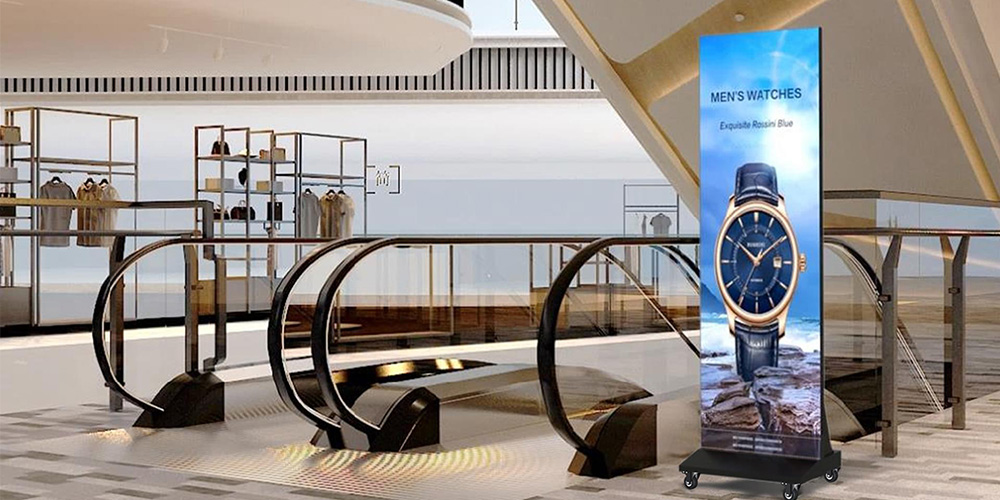
5. LED Poster vs LCD Poster Comparison Table
This LED poster vs LCD poster table separates general tendencies from model-specific facts. Use it to shortlist a technology, then replace every range or relative statement with the selected product’s datasheet value.
| Feature | LED poster | LCD poster | What to verify |
|---|---|---|---|
| Image source | Direct-view LED pixels | Liquid-crystal panel with backlight | Exact model architecture |
| Brightness | Indoor example: 600-800 cd/m²; outdoor example: 5,000 cd/m² | QHC example: 700 nits; specialist OMD example: 2,500 nits | Typical brightness and dimming control |
| Pixel detail | Depends on pitch and cabinet dimensions | Often Full HD or 4K at fixed size | Native pixel grid and closest viewing distance |
| Viewing angle | Verified examples: 140-160 degrees | QHC example: 178/178 degrees | Color and brightness at real approach angles |
| Screen size | Modular and scalable | Fixed panel size | Final physical and pixel canvas |
| Multi-screen seam | Bezel-free LED module joins | Visible bezels on standard panels | Mechanical alignment and calibration |
| Outdoor option | Available with high brightness and IP-rated enclosure | Available as specialist signage or with engineered enclosure | IP rating, temperature, wind, and brightness |
| Service method | Module and component replacement | Board service; panel damage may require panel replacement | Spares, warranty, response time |
| Initial price | Usually higher, especially at fine pitch | Usually lower for one standard indoor screen | Like-for-like installed quotation |
| Best fit | Visual impact, scaling, events, bright-window or outdoor models | Close-range detail, fixed indoor signage, lean budget | The audience task and site conditions |
The comparison table also exposes a common purchasing mistake: a standard indoor LED quote and an outdoor LCD quote are not equivalents. Match environmental rating, usable brightness, screen area, control hardware, warranty, and installation scope before judging the LED poster vs LCD poster price.
6. Which Poster Display Fits Each Application?
01 Retail Stores and Shop Windows
For a shop window, measure ambient light at the actual screen position and at the brightest time of day. An outdoor or window-facing LED poster can provide strong impact and scalable creative, but a specialist high-brightness LCD may also work when close-range 4K detail is important. The LED poster vs LCD poster winner depends on glare, distance, required brightness, and whether several units will become one canvas.
Inside a store, LCD often suits detailed product catalogs and price lists. LED is compelling for large motion graphics, brand launches, and campaigns designed to catch attention across an aisle. Test your real artwork, not a supplier demo reel.

02 Exhibitions and Temporary Events
LED poster systems with wheels, folding frames, flight cases, quick locks, and front service are designed for repeated setup. Several cabinets can show independent messages or synchronize into one wider image. LCD kiosks can still be effective when the content is detailed and each screen stays separate.
For events, include transport volume, setup crew, spare parts, controller configuration, and rehearsal time in the LED poster vs LCD poster comparison. A lighter purchase price can disappear if the unit is difficult to pack, protect, or restore during a live event.
03 Corporate Lobbies, Hotels, and Restaurants
LCD is often the practical choice for directories, schedules, meeting-room information, and menus viewed from a few feet away. LED earns its premium when the lobby needs a large architectural canvas, a bezel-free brand wall, or changing event layouts.
Hotels and restaurants should also assess noise, heat, brightness after dark, and content workflow. The best LED poster vs LCD poster result is the display that staff can update reliably without disturbing guests or requiring a technician for routine changes.
04 Airports and Transportation Hubs
Transport environments need long operating hours, remote monitoring, clear sightlines, and rapid recovery. AVIXA’s Minneapolis-Saint Paul International Airport case study describes direct-view LED, LCD, and other display formats managed as a coordinated system rather than treating one technology as the answer to every location.
“Digital displays allow us to maximize the use of overhead space at our exit escalators, which was previously used to hang printed messages,” said Eduardo Valencia, Chief Information Officer for the Metropolitan Airports Commission. His point is useful beyond airports: start with the communication problem and available space, then make the LED poster vs LCD poster decision.
7. How to Compare Cost and ROI
A purchase price comparison is incomplete. Build a three-year or five-year total-cost model for each LED poster vs LCD poster option, using written supplier inputs rather than assumed lifespan claims.
01 Calculate Installed Cost
Add the display, controller or media player, mount or floor stand, shipping, duties, installation, power work, network setup, content software, commissioning, and training. If multiple LED cabinets must be calibrated into one canvas, include that service. If an LCD needs a weatherproof enclosure, include the enclosure, cooling, and structural work.
02 Calculate Operating Cost
Use rated typical power at the planned brightness and daily schedule. Multiply watts by operating hours and the local electricity price. Add software subscriptions, network service, preventive cleaning, and scheduled inspections. Do not assume an LED poster or LCD poster is always more energy efficient; size, brightness, content, and model design determine consumption.
03 Price Downtime and Repair
Record warranty length, exclusions, spare-parts location, remote diagnostic capability, technician response time, and the cost of keeping a spare unit. For LED, ask for matching spare modules and calibration support. For LCD, ask whether the manufacturer can still supply the panel model during the planned service period.
The final LED poster vs LCD poster ROI should be expressed as cost per usable operating year and cost per campaign update, not just purchase price. If a centrally managed display replaces frequent print production and site visits, document those avoided costs with your own invoices and labor records.
8. Buyer Checklist Before You Request a Quote
Send the same requirements to every vendor. This prevents one LED poster vs LCD poster proposal from looking cheaper simply because it excludes necessary hardware or service.
01 Site and Audience
- Indoor, window-facing, semi-outdoor, or fully outdoor location
- Measured ambient light and expected operating hours
- Closest and typical viewing distance
- Approach directions, mounting height, and required viewing angle
- Available floor area, wall structure, access route, and power
02 Display and Content
- Physical display dimensions and portrait aspect ratio
- Native pixel resolution or LED pixel pitch
- Typical brightness, contrast, refresh rate, and dimming control
- Smallest text, QR code, product image, and video requirements
- Single screen, independent screens, or synchronized large canvas
03 Operations and Maintenance
- USB, Wi-Fi, LAN, or cloud publishing workflow
- User roles, scheduling, remote status, and playback confirmation
- Front or rear service access and required clearance
- Included spares, same-batch LED modules, warranty, and response time
- Training, documentation, packaging, and transport equipment
04 Safety and Environmental Rating
- Ingress-protection rating for the actual exposure
- Operating temperature and humidity range
- Wind, tip-over, rigging, and structural requirements
- Electrical certification required in the installation country
- Automatic brightness schedule for day and night
05 Proof Before Purchase
Ask for a live test with your own content at the expected viewing distance. Check gradients, skin tones, small text, motion, camera performance, fan noise, reflections, side-angle visibility, startup recovery, and remote updates. A documented acceptance test turns the LED poster vs LCD poster choice into a measurable procurement decision.
9. LED Poster vs LCD Poster FAQ
These LED poster vs LCD poster questions cover the points buyers most often need to resolve before requesting a final quotation.
01 Is an LED poster better than an LCD poster?
An LED poster is better for modular expansion, seamless multi-screen images, outdoor-ready configurations, and module-level service. An LCD poster is better for close-range 4K detail, a fixed standard size, and lower initial cost. The correct LED poster vs LCD poster answer depends on the installation rather than one technology being universally superior.
02 Is an LED poster the same as an LED-backlit LCD?
No. A direct-view LED poster uses LED modules as the image-forming surface. A product commonly called an LED TV is generally an LCD panel with LED backlighting. Clarifying this terminology prevents an inaccurate LED poster vs LCD poster quotation.
03 Which poster display is brighter?
It depends on the model. The indoor EagerLED EA1920iP5 is rated at 600-800 cd/m², while Samsung’s QHC commercial LCD is rated at 700 nits. The outdoor EagerLED EA1920OP2 reaches 5,000 cd/m². Use typical rated brightness and site measurements for a fair LED poster vs LCD poster test.
04 Which poster display gives sharper text?
At close range, a 4K LCD poster usually renders small text more sharply than a conventional LED poster because it has a denser fixed pixel grid. Fine-pitch LED can improve detail, but cost increases as pitch decreases. Test the smallest real text and QR code at the intended viewing distance.
05 Can an LED poster or LCD poster be used outdoors?
Only when the exact product and installation are rated for outdoor exposure. The EA1920OP2 specifies 5,000 cd/m² and IP65 protection on front and rear. A standard indoor LED poster or LCD poster should not be exposed to rain, direct weather, or unplanned heat.
06 Can several poster displays form one screen?
Several LED poster cabinets can align into a bezel-free canvas when the model, controller, and mounting system support splicing. Several LCD posters can synchronize content, but ordinary panels leave visible bezel lines. This is a major LED poster vs LCD poster distinction for large creative displays.
07 Which poster display is easier to maintain?
A front-service LED poster can be easier to repair at module level, but only when matching spares and trained support are available. LCD electronics can also be serviced, while a damaged LCD panel may require panel replacement. Compare the written service-level agreement, not only the hardware design.
08 Is an LED poster more expensive than an LCD poster?
Usually, yes, especially for fine-pitch LED. However, a complete LED poster vs LCD poster budget should include mounting, enclosure, media player, software, transport, spares, energy, maintenance, downtime, and replacement. Request like-for-like installed quotations before deciding.
10. Conclusion: Which Poster Should You Choose?
Choose an LED poster when your project needs a scalable canvas, bezel-free splicing, high-impact motion, outdoor-rated options, or front-service modules. Choose an LCD poster when viewers stand close, detailed 4K content matters, one fixed screen is enough, and initial cost carries the most weight.
The decisive lesson from this LED poster vs LCD poster guide is to compare real specifications under real site conditions. The verified examples show overlapping indoor brightness and very different outdoor capability. They also show that LCD can offer a wider stated viewing angle while LED offers physical modularity. A balanced decision therefore starts with the audience task, then tests brightness, pixel density, service access, content control, and total cost.
EagerLED offers indoor and outdoor LED poster configurations with pixel-pitch, brightness, cabinet, and control options for different sites. Review the LED poster display range, prepare the checklist above, and request a model-specific proposal. For broader technical questions, visit the LED screen FAQ.
Final LED poster vs LCD poster recommendation: use LED for modular visual impact and environment-specific performance; use LCD for fixed-format, close-range detail and budget efficiency. Require a live content test and a complete installed-cost quotation before signing off.
 How to Choose the Best 16:9 Aspect Ratio LED Display
 Wedding LED Screen Rental Guide: Sizes, Cost & Setup