
Table of Contents
Static posters no longer decide who walks into a store. Retailers competing for foot traffic now treat the window itself as a media channel, and the LED transparent screen is the format that makes it possible. A LED transparent screen plays video and animation on glass while keeping the products behind that glass fully visible.
That single property changes the economics of a storefront. You do not surrender merchandising space, you do not need to build a new structure, and you can change the message every hour. This guide explains how a LED transparent screen works, which specifications actually decide performance, what a transparent LED display costs in 2026, how to design content for see-through glass, and how to avoid the installation and maintenance mistakes that shorten its working life.
1. What Is a LED Transparent Screen?
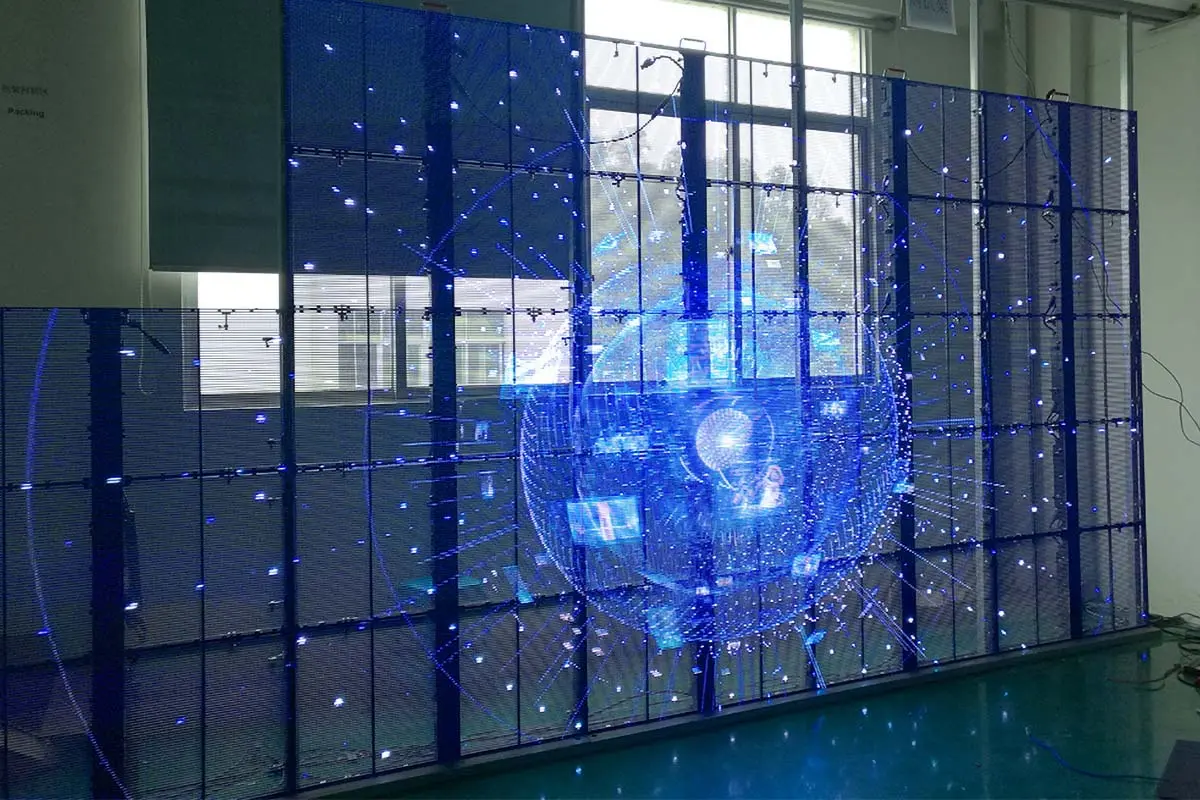
A LED transparent screen is a see-through LED display assembled from slim LED light bars or a transparent LED film. The pixels sit on narrow strips instead of a solid opaque panel, so a large share of the surface remains clear. Viewers see the digital content and the products behind it at the same time, which a conventional opaque LED video wall cannot do.
Unlike a standard LED cabinet, the panel is normally mounted directly onto existing glass. It adds no bulky structure, blocks very little daylight, and keeps the storefront readable from the street. Transparency rates run from roughly 45% on high-resolution indoor models to more than 90% on film-based versions.

01 How a LED Transparent Screen Works
Three layers cooperate inside the panel:
- Emitting layer. SMD or COB LEDs are soldered onto slim horizontal bars and spaced so that light and sight lines pass between them.
- Transparent substrate. A PET film or an aluminium or PC bar carries the circuitry. Film-based products are often under 3 mm thick and weigh under 6 kg per square metre.
- Drive and control layer. A sending card, receiving cards and a video processor split the incoming video signal. The same chain that drives any LED wall works here, so an existing Novastar, Colorlight or Linsn system can run a transparent LED display.
Because the pixels on a LED transparent screen are spaced far apart, the display uses fewer LEDs per square metre than an opaque screen. That cuts heat and power draw, and it also means the pixel pitch is comparatively large: most storefront models sit between P1.9 and P10.
02 Key Specifications and Terminology
Buyers comparing quotes for a LED transparent screen normally face the same short list of parameters. Knowing what each one controls makes it far easier to judge whether two prices are genuinely comparable.
| Parameter | Typical range | What it decides |
|---|---|---|
| Transparency rate | 45% – 90% | How much of the view and daylight passes through the panel |
| Pixel pitch (P) | P1.9 – P10 | Sharpness and the minimum comfortable viewing distance |
| Brightness | 1,200 – 5,500 nits | Legibility against ambient and direct light |
| Cabinet / bar size | 500 x 125 mm up to 1000 x 500 mm | Installation granularity on irregular glass |
| Weight | 5 – 14 kg/m² | Whether existing frames and glass can carry it |
| Refresh rate | 1,920 Hz and above | Flicker-free capture on camera and live streams |
| Grey scale | 14 – 16 bit | Colour gradation and detail at low brightness |
| IP rating | IP31 – IP65 | Indoor, semi-outdoor or fully outdoor placement |
| Power consumption | 120 – 350 W/m² average | Running cost and heat load |
| Lifespan | 100,000 h to 50% brightness | Replacement and budget planning |
Table 1. Typical LED transparent screen specifications. Ranges vary by supplier and should be confirmed against the current datasheet.
2. Why Retailers Choose a LED Transparent Screen for Storefront Windows
Retailers rarely replace a window display for novelty alone. A transparent LED display wins storefront projects because it solves four commercial problems at once: it keeps merchandise visible, it survives daylight, it uses space that already exists, and it costs less to run than an opaque screen of similar brightness.
01 Dual Visibility Without Losing Daylight
An opaque LED screen turns a window into a wall. A transparent LED display keeps both layers alive, so shoppers read the campaign and the product at the same time. That overlap creates curiosity, and curiosity is what converts a passer-by into a visitor.
Daylight matters just as much. Because a LED transparent screen lets natural light through, interiors stay bright and inviting and the store does not need extra lighting to compensate. For glass-fronted units in malls and shopping streets, that alone often justifies the LED transparent screen outlay.
02 Brightness and Contrast in Daylight
Brightness decides whether a LED transparent screen is readable at noon. A window facing direct sun needs 4,000–5,500 nits; a shaded or north-facing window performs well at 1,500–2,500 nits. Pair high brightness with an anti-reflective coating so reflected sky does not wash out the image.
Contrast on glass is created by content as much as by the panel. Bold shapes and strong colour separation read far better on a see-through display than fine gradients or thin text.
03 Space and Energy Efficiency
A transparent LED display mounts onto glass that already exists, so it consumes no floor area and no merchandising space. Nothing has to be moved and the window keeps its original function.
Energy use is lower than most buyers expect. Typical storefront products draw 120–350 W/m² on average content, below an equivalent-brightness opaque LED wall, which reduces both electricity cost and the heat load on air conditioning.
3. LED Transparent Screen Applications Across Retail Formats
The same display behaves differently in different retail environments. Pixel pitch, transparency and content style all shift with the store type, the distance shoppers stand from the glass, and whether the screen faces inward or outward.
01 Fashion Stores and Flagship Windows
Fashion runs on movement and mood. A transparent LED display on a flagship window lets the campaign play across the glass while mannequins stay fully lit behind it. Brand films, seasonal drops and runway footage all perform well, and the transparency keeps the merchandising story intact.
Most fashion windows use indoor LED transparent screen models at P3.9 to P6.25 with 3,000–4,500 nits, because shoppers view them from two to five metres.
02 Automotive Showrooms
Car showrooms are the strongest showcase for a LED transparent screen, because the vehicle behind the glass is the hero. It lets dealers run a walk-around video, highlight trim levels or promote a finance offer without ever hiding the car.
Automotive glazing is usually large, so modular cabinets help: sections can be added or removed as the vehicle line-up changes.

03 Electronics Retailers and Pop-Up Shops
Electronics retailers use a LED transparent screen for product launches, specification animations and interactive tutorials. Pop-up shops and mall activations favour film-based products because they are light, removable and reusable at the next location.
For temporary sites, choose a model with quick-lock mounting and a media player that accepts a USB update, so staff can redeploy it without calling a technician.
04 Retail Application Matrix
| Retail format | Recommended pixel pitch | Transparency | Content that performs | Primary goal |
|---|---|---|---|---|
| Flagship fashion window | P3.9 – P6.25 indoor | 55% – 75% | Brand films, seasonal drops, runway loops | Foot traffic and brand recall |
| Automotive showroom | P5 – P8 indoor | 60% – 80% | Walk-around video, trim walk-throughs, offers | Lead generation |
| Electronics and mobile retail | P2.5 – P4 indoor | 50% – 70% | Product tutorials, specification animations | Product education |
| Pop-up shop and mall activation | P6.25 – P10 film | 80% – 90% | Campaign loops, countdowns, QR prompts | Short-term awareness |
| Street-facing storefront | P8 – P10 outdoor | 70% – 85% | Time-limited offers, weather-triggered content | Walk-in conversion |
| Lobby and interior glass | P1.9 – P3.9 indoor | 45% – 65% | Wayfinding, brand films, live data | Experience and orientation |
Table 2. Matching a LED transparent screen to the retail format. Pixel pitch and transparency should always be confirmed against real viewing distances on site.
4. LED Transparent Screen Specifications: Pixel Pitch, Transparency and Brightness
Three numbers decide whether a transparent LED display looks impressive or disappointing: pixel pitch, transparency rate and brightness. They trade against each other, so the right combination depends on where shoppers stand and how bright the location is.
01 Pixel Pitch and Viewing Distance
Pixel pitch is the distance between LED centres, measured in millimetres. A smaller pitch means more LEDs, a sharper image and a higher price per square metre. The rule of thumb for any LED transparent screen that the closest comfortable viewing distance in metres is roughly the pitch value in millimetres. A P6 panel reads cleanly from about six metres.
| Pixel pitch | Best viewing distance | Typical use | Transparency |
|---|---|---|---|
| P1.9 – P2.5 | 2 – 3 m | Lobby glass, boutique interior windows, close-range brand content | 45% – 60% |
| P3.9 – P4 | 4 – 5 m | Mall storefronts, electronics retail, indoor brand films | 50% – 70% |
| P6.25 | 6 m | Fashion flagship windows, showroom interiors | 60% – 75% |
| P8 | 8 m | Showroom glazing, mid-size street storefronts | 70% – 80% |
| P10 | 10 m and beyond | Street-facing windows, large-format exterior campaigns | 75% – 90% |
Table 3. Pixel pitch against viewing distance for a LED transparent screen. Half the pitch value gives the distance at which an image looks fully smooth.
02 Transparency Rate Versus Brightness
Transparency and brightness pull in opposite directions. Every additional LED or wire on the substrate improves resolution and brightness but removes transparent area. A display that claims 90% transparency will almost always be a film product with a large pixel pitch, best suited to viewing from ten metres or more.
For a retail window viewed from two to five metres, a LED transparent screen at 50–70% transparency is usually the better compromise: the merchandise stays visible, and the image still holds up in daylight. Decide which of the two matters more, then specify the panel around that decision.
03 Indoor, Outdoor and Semi-Outdoor Models
Position decides the enclosure. Indoor products generally use an IP31 to IP40 rating with passive cooling. Semi-outdoor versions behind a canopy move to IP54 with higher brightness. Fully outdoor installations facing rain and direct sun need IP65, 5,000 nits or more, and a sealed power and data path.
Do not fit an indoor LED transparent screen into an outdoor position to save cost. Moisture ingress and UV exposure are the two fastest ways to destroy a see-through display.
5. LED Transparent Screen Price and ROI
Price is the question every retail project starts with, and the honest answer is a range rather than a number. The display is priced per square metre, and that rate moves with pixel pitch, brightness, IP rating, cabinet type and the amount of custom glass mounting required.
01 Price Ranges by Project Size
| Project size | Typical budget (USD) | What is normally included | Ongoing annual cost |
|---|---|---|---|
| Small window, 2 – 4 m² | USD 3,000 – 10,000 | Indoor panels, media player, basic mounting, commissioning | USD 300 – 800 |
| Medium storefront, 5 – 15 m² | USD 10,000 – 30,000 | Higher-pitch indoor or semi-outdoor panels, control system, structural fixings | USD 900 – 2,500 |
| Large or outdoor, 16 – 40 m² | USD 35,000 – 90,000 | IP65 outdoor panels, steel or aluminium support, video processor, sensors | USD 2,500 – 6,000 |
| Flagship or multi-site rollout | USD 90,000 and above | Custom engineering, CMS licence, content templates, staff training | Project-specific |
Table 4. Indicative 2026 LED transparent screen budget ranges. Structural work, content production and CMS licensing are frequently quoted separately.
02 Running Costs and Payback
Running cost for a LED transparent screen breaks into four lines: electricity, content production, CMS or media player licensing, and maintenance. Electricity is the smallest and most predictable. A 10 m² screen at 200 W/m² average and eight hours of daily operation consumes roughly 5,800 kWh a year, which most retailers can model precisely from their local tariff.
Payback is usually argued from foot traffic and conversion rather than from advertising revenue. The simple comparison is cost per thousand impressions against printed window graphics that must be reprinted every campaign. Once content is templated, the display carries a marginal cost per campaign close to zero, which is what makes the multi-site business case work.
6. How to Design Content for a Transparent LED Storefront Display
Content is where most transparent LED display projects succeed or fail. A layout that looks excellent on a monitor can disappear on glass, because the background behind the screen keeps moving and changing brightness. These four rules prevent that.
01 Keep Visuals Simple Against a Live Background
The background behind a LED transparent screen is unpredictable: daylight shifts, people walk past, and merchandise changes colour. Design for that. Use a single idea per frame, large typography and high-contrast colour combinations. Avoid thin outlines, fine gradients and busy textures, which break up against whatever is behind the screen.
A practical test is to place the layout over a photograph of the actual window at midday and at night. If the message is still readable in both, the content will work on glass.
02 Synchronize Digital Content With Physical Products
The advantage of a LED transparent screen is the overlap between screen and merchandise, so use it deliberately. If a mannequin wears a red coat, run the campaign for that coat beside it. If a specific vehicle sits on the showroom floor, play its walk-around video behind it.
Synchronised content increases dwell time because shoppers compare the digital message with the physical product rather than choosing between them.
03 Schedule Content by Time, Weather and Foot Traffic
The display can change message by the hour, and the highest returns come from matching the audience in front of the glass. Morning commuters respond to coffee, breakfast and productivity content; lunchtime traffic to quick-service offers; evening footfall to lifestyle and entertainment. Weather triggers work well too — umbrellas and jackets on wet days, sunglasses and cold drinks in heat.
Most cloud control systems for a LED transparent screen, day-parts and API triggers. Build the calendar once, then let it run.
04 Optimize Viewing Angles and Viewer Attention
Install so that the LED transparent screen sits close to eye level for pedestrians, and check the viewing cone from both directions along the street. Glass reflects, so angle the screen slightly where possible or specify an anti-reflective surface.
Attention is limited to a few seconds on a passing shopper. Keep the core message visible for at least three seconds per loop, and place time-sensitive offers with a visible countdown so the reason to enter the store is obvious.

7. Installation, Structural and Technical Considerations
The panel is lightweight, but it is still a permanent installation on a building facade or a shop window. Confirm these three areas before signing the order.
01 Glass, Frame and Mounting Options
The panel can be fixed to existing mullions, hung from a top rail, or mounted on a dedicated frame set slightly back from the glass. Glass-mounted installations need a structural check on the glass specification and on the fixing points, since wind load on a street-facing facade acts on the whole assembly.
Weight is rarely the limiting factor: at 5–14 kg/m², the display usually loads the structure less than a comparable opaque cabinet.
02 Power, Data and Control Infrastructure
Plan the power and data route before the LED transparent screen arrives. Each cabinet chain needs a local power feed sized to the panel rating, and data is normally daisy-chained between cabinets with a spare line for redundancy. A dedicated circuit is strongly preferred, because a shared circuit tripping at night leaves the window dark during peak trading hours.
Confirm the control chain: media player, sending card, receiving cards and, where multiple windows are involved, a cloud CMS that can push a single schedule to every screen on the estate.
03 IP Rating, Cooling and Environmental Protection
Match the IP rating to the position, and provide ventilation behind the panel. Even sealed panels generate heat, and a fully enclosed cavity with no airflow will shorten the life of the power supplies. Dust, pollen and salt air all need to be considered in the cleaning schedule, and coastal sites should expect a higher specification.

8. LED Transparent Screen vs Transparent OLED vs LED Film
Three see-through technologies compete for the same window, and they are not interchangeable. The comparison below shows where each format wins.
| Factor | LED transparent screen | Transparent OLED | Transparent LED film |
|---|---|---|---|
| Maximum size | Effectively unlimited, tiled from cabinets | Limited to panel sizes, currently around 55 in | Large rolls, cut and joined on site |
| Transparency | 45% – 90% | Around 38% – 45% | 80% – 95% |
| Brightness | 1,200 – 5,500 nits | 150 – 400 nits | 800 – 4,000 nits |
| Best viewing distance | 2 m and beyond, pitch dependent | Under 2 m | 5 m and beyond |
| Daylight performance | Excellent outdoors with high-nit models | Poor in direct light | Good with high-brightness versions |
| Curved or irregular glass | Possible with flexible cabinets | Rigid flat panels only | Best option for curves and cut-outs |
| Service model | Front or rear module replacement | Panel replacement, higher unit cost | Film section replacement |
| Typical use | Storefronts, showrooms, facades | Premium indoor boutique displays | Glass retrofits and rental activation |
Table 5. See-through display technologies compared on the factors that decide a retail installation.
For a storefront that must stay readable in daylight and scale to a large window, a LED transparent screen remains the practical choice. Transparent OLED suits short viewing distances and controlled light. Transparent LED film wins when the glass is curved, listed, or must not be drilled.
9. Maintenance, Lifespan and Warranty
The panel has no moving parts and no consumable lamps, so maintenance is mostly inspection and cleaning. Planning it properly is what keeps availability high over a ten-year horizon.
01 Cleaning and Inspection Routine
Clean the LED transparent screen and the glass behind it on a fixed schedule, normally monthly on a street-facing window and quarterly indoors. Use a soft microfibre cloth and a non-abrasive cleaner, and never spray directly onto the panel. Check mounting fixings, cable glands and power connectors at the same time.
02 Firmware, Spare Parts and Downtime Planning
Keep the media player and control firmware on the supplier’s supported release, and hold a small spares kit: two power supplies, one receiving card, one spare cabinet or film section and a set of data cables. With front-serviceable cabinets, a failed module can be swapped in minutes rather than days.
03 Lifespan and Warranty Expectations
Most LED transparent screen products are rated to 100,000 hours to 50% brightness, which is roughly eleven years at eight hours a day. In practice the power supplies and the mechanical fixings age faster than the LEDs. Expect a two to three year warranty on the panel itself, and negotiate five years on structure and installation where the supplier offers it.
10. Common Challenges and How to Solve Them
Most problems are predictable, and all of them are cheaper to solve at specification stage than after installation.
| Challenge | Why it happens | Practical solution |
|---|---|---|
| Upfront cost is difficult to approve | Budget holders compare the display with printed vinyl, not with a decade of campaigns | Present cost per campaign over five years and include the reprint cost it replaces |
| Content production becomes the bottleneck | Every campaign is designed from scratch | Build three reusable content templates and train in-house staff on them |
| Washed-out image in strong sun | Brightness spec too low or the glass reflects the sky | Specify 4,000 nits or more and add an anti-reflective coating |
| Glare and reflections at night | Interior lighting aimed at the glazing | Reshade interior lights and dim the LED transparent screen with an ambient-light sensor |
| Staff cannot update the screen | No owner was assigned to the display | document the playlist process and keep a one-page operating guide |
| Content clashes with brand rules | Marketing and store teams work separately | Lock brand fonts, colours and safe margins into the LED transparent screen templates |
| Flicker on camera | Refresh rate too low for broadcast or social capture | Specify 1,920 Hz or higher refresh on the LED transparent screen |
Table 6. Common challenges on retail projects and the countermeasures that resolve them.
11. FAQs About LED Transparent Screens
These are the questions buyers ask most often before ordering. Each answer reflects what actually decides the outcome on a retail installation.
01 What exactly is a LED transparent screen?
It is a see-through LED display built from slim LED bars or a transparent film. The LEDs sit on narrow strips with clear gaps between them, so shoppers see the video and the products behind the glass at the same time. Unlike an opaque LED video wall, it is designed to preserve the view rather than replace it.
02 How much does a LED transparent screen cost?
Pricing is per square metre and depends on pixel pitch, brightness, IP rating and mounting complexity. As an indicative 2026 range, a small indoor window of two to four square metres usually costs USD 3,000 to 10,000, a medium storefront of five to fifteen square metres falls between USD 10,000 and 30,000, and a large or outdoor project of sixteen to forty square metres generally runs from USD 35,000 to 90,000. Always compare quotes on the same specification sheet.
03 Can a LED transparent screen be used in direct sunlight?
Yes, provided the brightness specification matches the position. A screen facing direct sun needs 4,000 to 5,500 nits and an anti-reflective surface. Indoor models rated at 1,200 to 2,500 nits will look washed out in direct light, which is the most common cause of disappointment on storefront projects.
04 Is a LED transparent screen suitable for a small retail store?
Yes. The display scales down well. A single small window with one or two square metres of display is a viable entry point, and modular cabinets let a small store expand later. The economics work best when the store changes campaign content frequently, because the display then replaces repeated printing and installation costs.
05 Can I control a LED transparent screen remotely across multiple locations?
Yes. A cloud content management system lets you publish to every screen on the estate from one dashboard, with per-store scheduling, playlists and approval workflows. Most systems accept video, image, text and live data feeds, and support time-of-day and API triggers.
06 How long does a LED transparent screen last?
Typical panels are rated to 100,000 hours to 50% brightness, which is roughly eleven years at eight hours per day. Power supplies and fixings usually need attention before the LEDs do, so budget for a small spares kit and a two to three year panel warranty.
07 What pixel pitch should I choose for a LED transparent screen?
Match the pitch to the closest viewing distance. As a rule, the pitch value in millimetres equals the comfortable viewing distance in metres: P4 suits shoppers at four metres, P6.25 at six metres and P10 at ten metres or more. A smaller pitch improves sharpness but reduces transparency and raises the cost.
12. Conclusion
The LED transparent screen has moved from novelty to standard retail infrastructure. It keeps the storefront doing its original job, showing product to the street, while adding a media layer that can be changed by the hour. For fashion windows, car showrooms, electronics retail and mall activations, that combination is difficult to match with any other display format.
Get the specification right and the rest follows. Match pixel pitch to viewing distance. Match brightness to ambient light. Match the IP rating to the position. Then invest in a small set of strong content templates so the display never sits on the same loop for a month.
Retailers planning a project can review the indoor transparent LED display, the outdoor transparent LED display and the transparent LED film options, or compare the wider retail LED display range before finalising a specification.
 Stadium Screens: Unlocking New Revenue Streams & Fan Experiences
 What Is MIP Technology & Why It Matters For LED Displays ?