
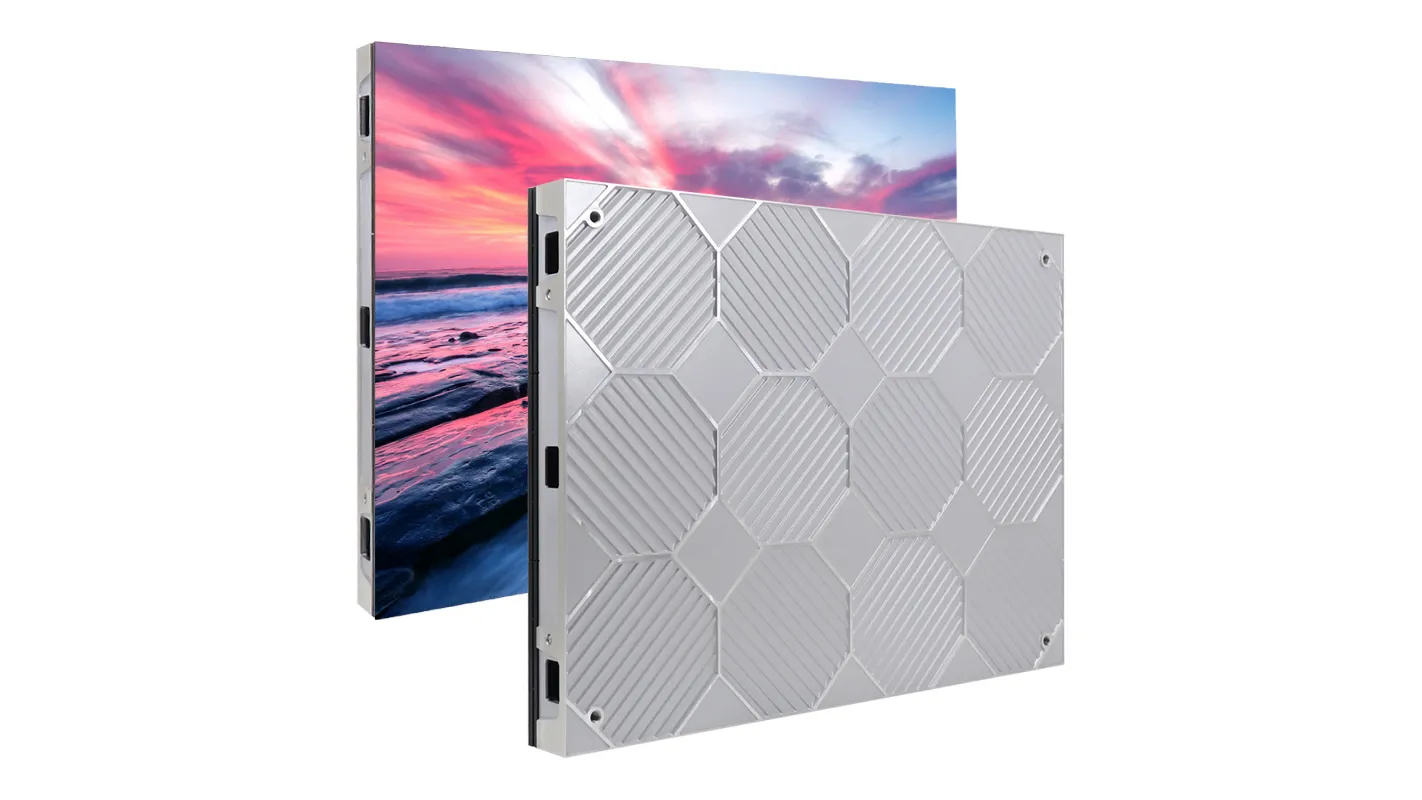
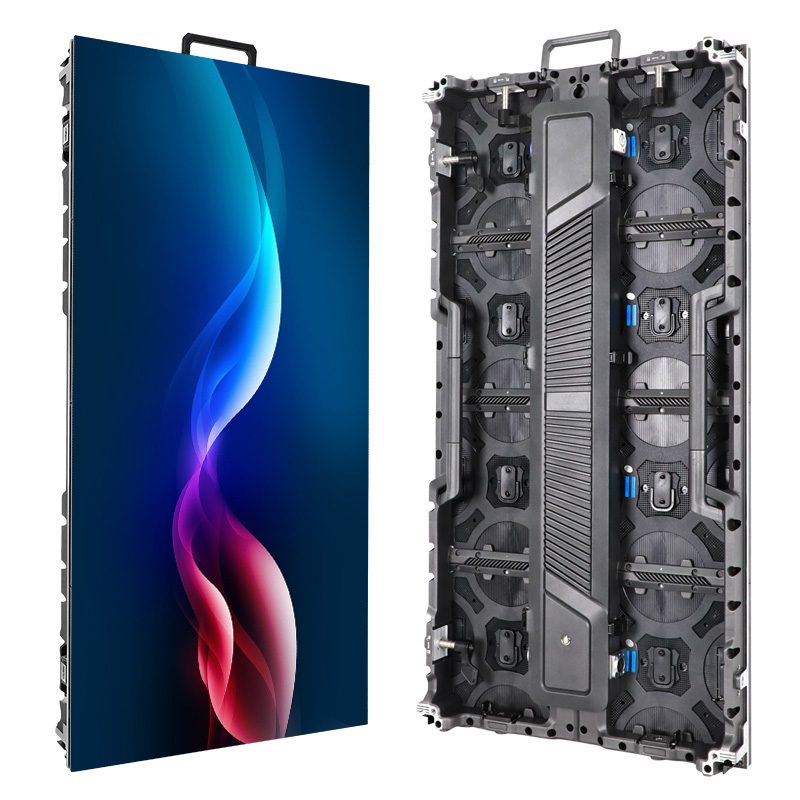
Outdoor LED displays must stay readable and reliable through rain, dust, sunlight, temperature changes, and routine servicing. For buyers, distributors, and AV integrators, the challenge is choosing a screen that delivers the required image quality without creating avoidable maintenance costs. GOB LED modules are one option for improving protection at the display surface.
GOB, short for Glue on Board, adds a protective encapsulation layer over the LED face of a module. In a suitable design, this layer helps shield vulnerable components from contamination and incidental contact. However, GOB modules do not automatically make an entire LED display suitable for outdoor installation. Cabinet sealing, thermal management, connectors, and material durability still require separate evaluation.
The business case depends on the project. A screen installed near pedestrians or handled repeatedly may benefit more from additional surface protection than a billboard mounted beyond public reach. Buyers also need to consider how encapsulation affects appearance, repair procedures, and replacement-part planning.
This guide explains where GOB modules for outdoor LED displays can add value, which limitations deserve attention, and what to verify before placing an order with EagerLED or another LED display supplier.
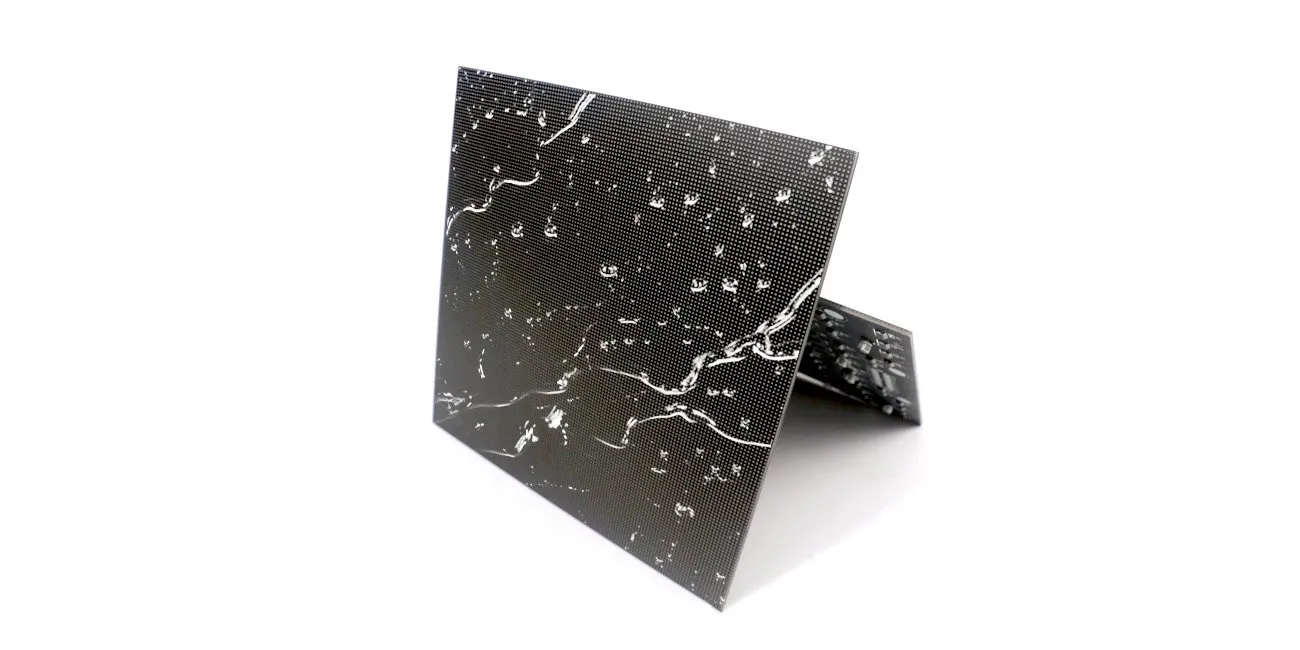
1. What Are GOB LED Modules, and How Do They Work?
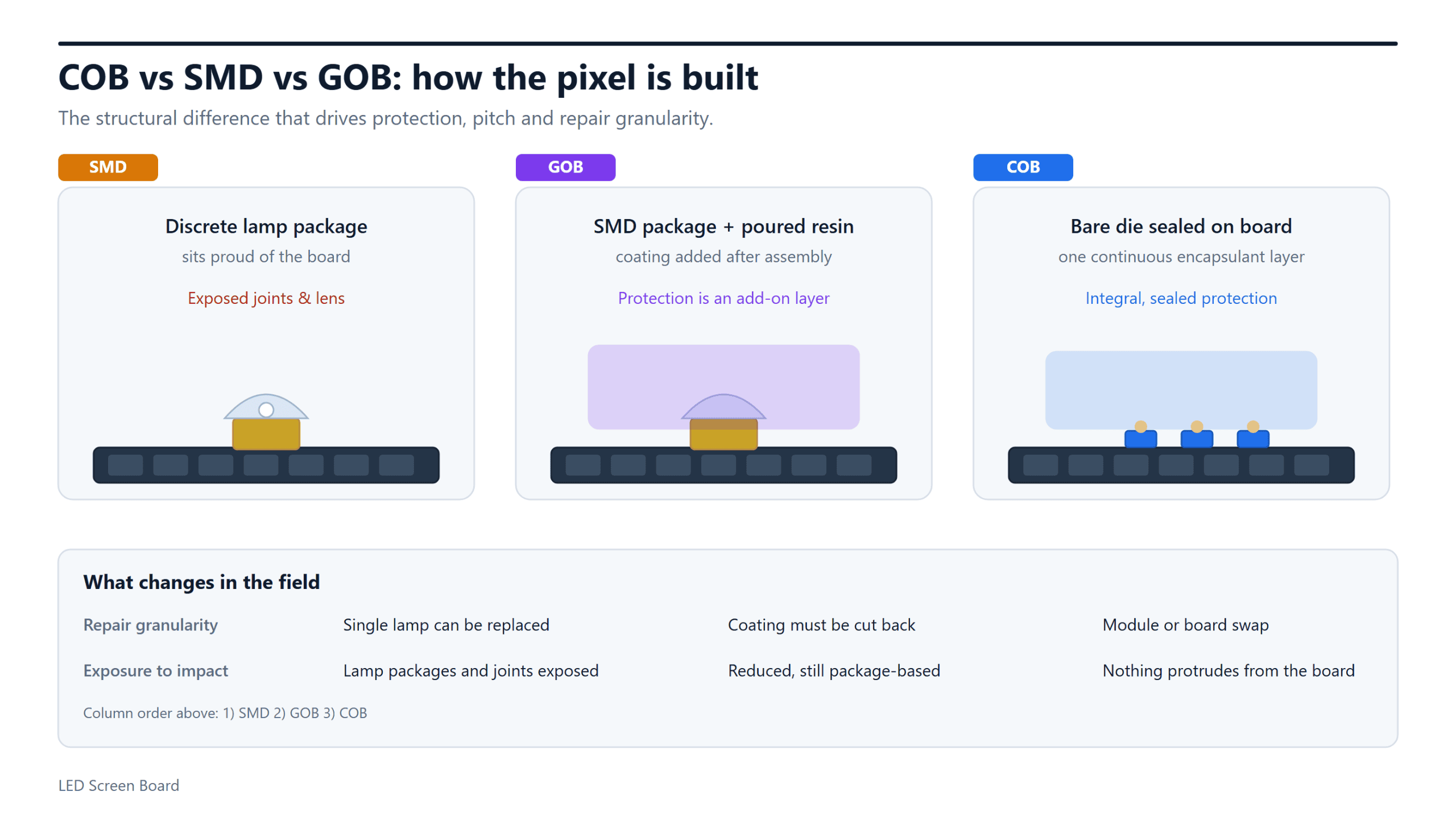
A GOB LED module typically starts with surface-mounted LED packages installed on a printed circuit board. A transparent encapsulant is applied across the display face and cured to form a protective layer around the LEDs.
The important distinction is that GOB describes an added protection process, while SMD describes how packaged components are mounted. A module can therefore be both SMD-based and GOB-protected. These terms are not mutually exclusive. Neoti’s LED technology comparison provides background on these construction differences.
01. What does the encapsulation protect?
Depending on the design, the encapsulant covers the LED packages and spaces between them. It creates a barrier between the covered components and the surrounding environment, while helping distribute some incidental contact across the surface.
Protection depends on material selection, adhesion, coverage, curing, and manufacturing consistency. The label “GOB” alone does not define these characteristics.
For procurement, ask the supplier to identify the coated areas in a module drawing or sample. Confirm whether edges, rear electronics, cable connections, and mounting penetrations receive separate protection.
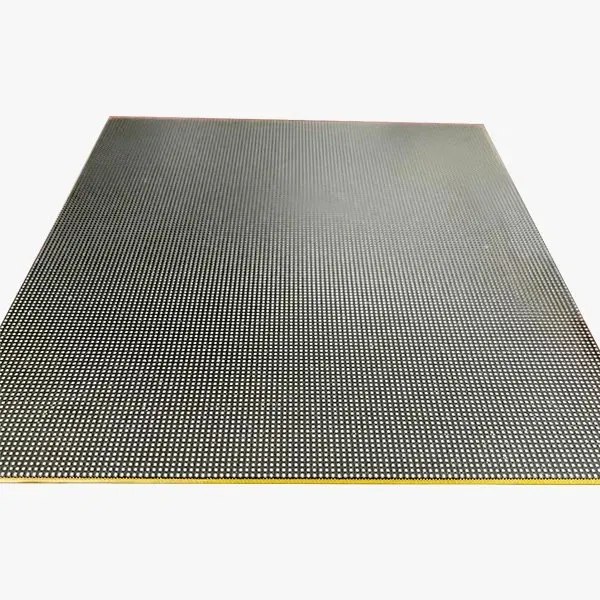
02. Why outdoor suitability needs separate confirmation
GOB LED modules are used in different product categories, including indoor displays. An indoor module does not become an outdoor module simply because its front surface is encapsulated.
For outdoor use, the complete assembly must provide the necessary brightness, operating-temperature capability, environmental protection, and service access. Treat GOB as one feature within that assembly.
2. Key Benefits of GOB Modules for Outdoor LED Displays
The strongest reason to consider GOB modules is to address a specific surface-related failure risk. That makes the buying decision more useful than comparing broad claims such as “more durable” or “maintenance-free.”
01. Protection during handling and servicing
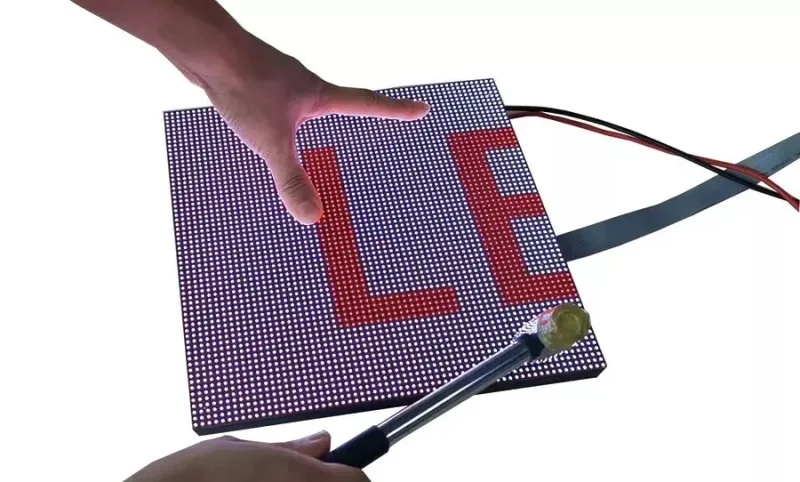
Display faces can be touched accidentally during unpacking, alignment, installation, and maintenance. Where LEDs are exposed, an impact may damage a package or its connection to the board.
A suitable encapsulation layer can reduce vulnerability to some of these contacts. For rental operators and contractors, this may be valuable because the same equipment passes through repeated installation cycles.
GOB protection does not justify rough handling. Cabinet corners, connectors, circuit boards, and other components remain vulnerable.
02. A barrier against surface contamination
Dust and moisture are recurring concerns around outdoor electronics. Encapsulation can limit direct exposure of the covered LED-side components, provided the protective layer remains intact.
However, exposure can also occur through module edges, rear connections, or cabinet openings. Front protection should complement the enclosure design.
03. Potentially fewer surface-related interventions
If a project’s maintenance records show repeated damage to exposed LEDs, GOB modules may address a meaningful cost driver. The benefit is less certain when most failures originate in power supplies, signal distribution, or water entering elsewhere.
| Project concern | Potential contribution of GOB | What still needs attention |
|---|---|---|
| Accidental contact during installation | Additional protection over LED packages | Handling methods and cabinet protection |
| Dust on the module face | A barrier over covered components | Cabinet openings and cleaning procedures |
| Moisture reaching the display surface | Reduced direct exposure of encapsulated areas | Seals, edges, rear electronics, and connectors |
| Frequent equipment deployment | Greater tolerance of some surface contact | Transport packaging and mechanical inspection |
| Repeated surface-related repairs | Possible reduction in relevant service events | Repair records and replacement costs |
The practical question is whether GOB protection addresses the failures your team actually expects.
3. Are GOB Modules Waterproof? Understanding Outdoor IP Ratings
GOB modules are not automatically waterproof, and a protected module face does not establish the ingress rating of the complete screen.
IP ratings classify protection provided by enclosures. The relevant framework is IEC 60529, Degrees of Protection Provided by Enclosures. Buyers should connect any declared rating to the tested product configuration rather than assume it applies to every component and installation arrangement.
01. Check the scope of the rating
An outdoor LED display may have different protection claims for its front and rear. A module-level result may also differ from a cabinet-level result.
Ask which assembly was tested, which surfaces were exposed, and whether the tested configuration includes the connectors, covers, and seals supplied with your order. Installation changes can affect protection.
For example, a protected module face cannot prevent water entering through an incorrectly assembled rear cable connection.
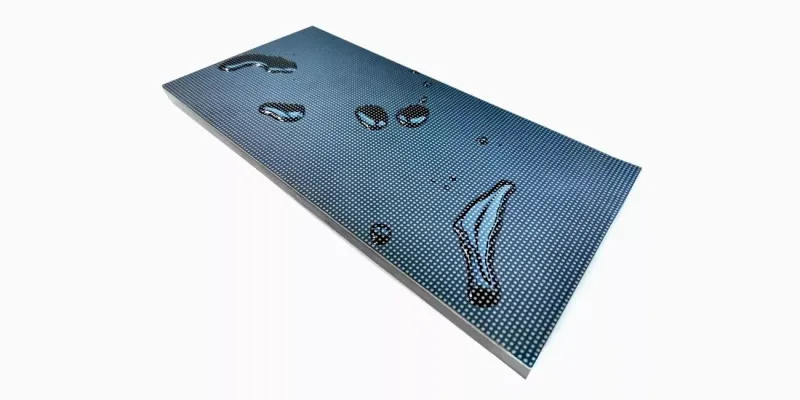
02. Separate water ingress from other environmental risks
Ingress protection does not, by itself, establish resistance to sunlight, salt exposure, chemical contamination, or long-term material aging. These are separate specification questions.
Condensation also deserves attention. Moisture can form within an enclosure under changing temperature and humidity conditions, even when direct rain entry is controlled.
| Supplier statement | Evidence to request | What the statement does not establish |
|---|---|---|
| “Outdoor GOB module” | Intended-use specification and environmental limits | Suitability for every outdoor location |
| “IP-rated cabinet” | Report identifying the tested assembly and rating | Protection after incorrect installation |
| “UV-resistant encapsulation” | Test method, exposure conditions, and acceptance criteria | An unlimited outdoor service life |
| “Suitable for coastal projects” | Relevant corrosion evidence and installation requirements | Protection from all salt-related deterioration |
| “Water-resistant front surface” | Defined test conditions and coverage | Equivalent protection at the rear |
For outdoor GOB LED displays, request evidence that matches the exposure at the actual site.
4. How GOB Coatings Affect Brightness and Image Quality
The encapsulation layer lies in the optical path between the LEDs and the viewer. Its properties therefore belong in the image-quality evaluation, alongside the LED packages, driver configuration, and calibration.
Do not assume every GOB coating improves contrast, preserves identical brightness, or produces the same surface appearance.
01. Evaluate the finished module
Compare completed GOB modules at the intended operating settings. Measurements taken before encapsulation do not fully describe the product being purchased.
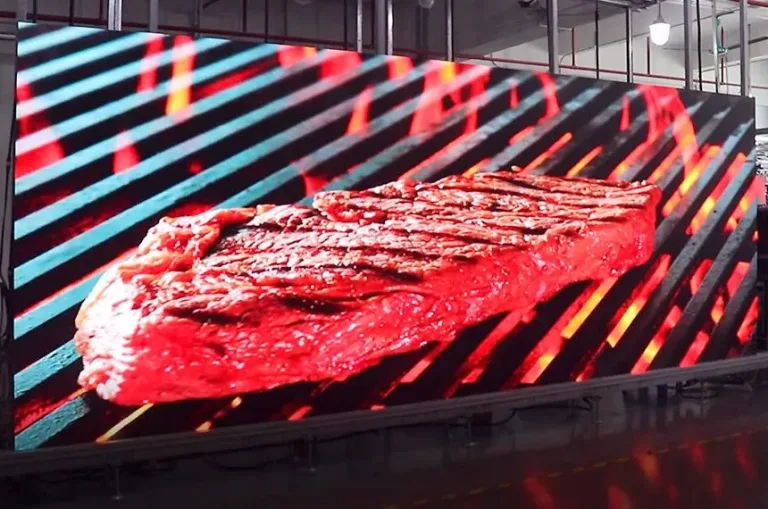
Request calibrated brightness data and inspect the screen under representative ambient light. A bright image in a dark showroom says little about readability under direct sunlight or strong reflections.
Surface texture and reflectance also matter. Examine dark content as well as bright advertising footage; reflected light can make differences between module surfaces easier to see.
02. Check consistency across several modules
One sample cannot show whether adjacent modules will form a visually consistent wall. Review a multi-module assembly for surface differences, visible boundaries, color variation, and off-axis appearance.
Useful test content includes:
- White and neutral gray fields.
- Solid red, green, and blue.
- Dark gradients and low-brightness content.
- Fine text and the customer’s actual advertising material.
For camera-facing applications, also test the complete screen with the intended camera settings. GOB encapsulation does not independently determine refresh behavior or eliminate filming artifacts.
03. Keep calibration in the acceptance process
Brightness and color calibration remain relevant after encapsulation. NovaStar’s documentation distinguishes brightness calibration from chroma calibration, reinforcing the need to assess both rather than rely on a single brightness figure. NovaStar’s calibration manual
For buyers, the acceptance target should describe the finished display at its agreed operating conditions.
5. GOB vs. Standard SMD and COB: Which Fits Outdoor Displays?
Comparing GOB, SMD, and COB requires care because the terms describe different construction choices.
Standard SMD modules use packaged LEDs mounted on a board. GOB commonly adds encapsulation to that construction. COB, or Chip on Board, uses LED chips mounted directly onto a substrate, with protection determined by the particular product design.
None of these labels alone proves outdoor suitability. Compare finished products that meet the same project requirements when reviewing LED module options.
| Decision factor | SMD without GOB face encapsulation | GOB-protected SMD | COB |
|---|---|---|---|
| Basic construction | Packaged LEDs mounted on a PCB | SMD construction with added face encapsulation | LED chips mounted directly on a substrate |
| Surface protection | Depends on package, mask, and other protection | Additional encapsulation over the LED face | Depends on encapsulation and product design |
| Repair approach | Component access may be more direct | Repair may require removing and restoring encapsulant | Often requires specialized processes |
| Outdoor qualification | Verify the complete product | Verify the complete product | Verify the complete product |
| Purchasing priority | Established performance and service capability | Value of extra protection versus repair complexity | Verified optical, environmental, and service performance |
01. When GOB deserves closer consideration
GOB modules are worth evaluating when surface contact, handling damage, or contamination creates a credible operational problem.
A rental contractor, for example, should compare repair histories and handling procedures before deciding whether additional encapsulation justifies its cost.
02. When standard outdoor SMD may be sufficient
For a fixed display installed beyond reach, the dominant concerns may be thermal behavior, cabinet sealing, service access, and long-term component availability. A suitable conventional outdoor SMD system may meet the brief without added face encapsulation.
The comparison should remain project-specific. Avoid selecting a construction method before confirming brightness, viewing distance, environmental conditions, and maintenance requirements.
6. What Are the Limitations of GOB LED Modules?
GOB modules introduce an additional material and production process. Both need to be controlled, and neither removes the need for sound display engineering.
01. Component repair can become more involved
Encapsulation may need to be removed before a failed LED can be replaced. The repaired area may then require restoration of its protective surface.
Ask whether local technicians are authorized and equipped to perform that work. If repairs must return to the factory, replacement modules and logistics become more important.
02. Outdoor aging requires evidence
The encapsulant must retain suitable optical and mechanical properties under the specified exposure conditions. Relevant concerns include discoloration, cracking, loss of adhesion, or changes in surface appearance.
These are evaluation topics, not inevitable failures. Request test conditions and acceptance criteria rather than accept an unsupported claim that the material will never change.
03. Thermal performance remains design-dependent
An added layer changes the module construction. Its effect depends on the material, thickness, interfaces, and the existing heat paths.
Do not accept a universal claim that GOB necessarily improves cooling or necessarily causes overheating. Ask for operating-temperature evidence from the finished assembly under defined conditions.
04. More protection may not improve the business case
If surface damage is unlikely and on-site component repair is important, encapsulation may create a tradeoff the buyer does not need.
For distributors, this is especially relevant: selling GOB modules without understanding the customer’s service capabilities can move costs from installation into after-sales support.
7. Best Applications for Outdoor GOB LED Displays
Application fit depends on exposure and operating practices. GOB modules should solve a defined problem within the proposed installation.
| Application | Why GOB may be useful | Main qualification question |
|---|---|---|
| Outdoor rental and event screens | Repeated handling creates opportunities for face damage | Can the product support the transport and repair workflow? |
| Pedestrian-level advertising displays | People or equipment may contact the screen | What contact protection has been demonstrated? |
| Close-view outdoor signage | A visible damaged pixel may be particularly distracting | Does the finished surface meet image-quality requirements? |
| Transport and public information displays | Availability and predictable servicing are important | Does protection address likely faults at this location? |
| Exposed retail installations | Surface contamination and public access may overlap | Is the complete assembly approved for the exposure? |
| Elevated fixed billboards | Additional face protection may have limited incremental value | What risk justifies the added process and cost? |
01. Public access requires more than encapsulation
For displays near people, review the surrounding structure, accessible edges, mounting arrangement, and maintenance procedures. A GOB surface is not evidence that a display is vandal-resistant or suitable for sustained pressure.
Likewise, stadium and floor applications need purpose-designed products. A standard GOB LED module should not be treated as a sports impact barrier or a load-bearing floor panel.
02. Match pixel pitch to the viewing task
Choose pixel pitch from viewing distance, content detail, and required resolution. Encapsulation does not increase the number of pixels.
For an outdoor information screen, small text may be decisive. For a distant advertising billboard, larger imagery may allow a different specification. Establish that requirement before comparing module protection options.
8. How to Choose GOB Modules for Outdoor Conditions
A useful request for quotation should allow suppliers to recommend and price the same scope. “Outdoor GOB display” is too broad to produce directly comparable proposals.
01. Start with a site brief
Record screen dimensions, installation height, viewing distances, orientation, surrounding light, operating hours, and access arrangements. Include local environmental exposure and whether the screen will be fixed or repeatedly deployed.
Photographs and drawings help identify constraints that a specification list can miss, such as a confined rear space or a difficult module-removal route.
02. Turn performance claims into deliverables
The purchasing specification should identify what the supplier must provide and how the buyer will assess it.
| Procurement item | Request from the supplier | Buyer’s acceptance focus |
|---|---|---|
| Outdoor suitability | Model-specific environmental specification | Compatibility with the site brief |
| GOB process | Coverage description and quality criteria | Consistent finished surfaces |
| Optical performance | Finished-product brightness and viewing data | Readability and uniformity |
| Ingress protection | Relevant report and assembly details | Correct tested configuration |
| Thermal behavior | Operating limits and test conditions | Suitability for installation conditions |
| Service design | Removal procedure, tools, and repair policy | Practical access and restoration |
| Control system | Hardware configuration and backup files | Compatibility with the intended workflow |
| Spare parts | Part numbers and replacement arrangements | Continued serviceability |
03. Inspect representative production
Approve samples that match the proposed order configuration. Check the encapsulated face for visible defects, edge condition, surface variation, and consistency between modules.
Then evaluate assembled cabinets. The interaction between modules, seals, wiring, mechanical alignment, and service access becomes clearer at cabinet level.
For a larger purchase, agree on the inspection method and rejection criteria before production. This reduces disputes over whether a visible difference is acceptable.
04. Ask EagerLED for a configuration-specific proposal
EagerLED lists outdoor fixed and rental display categories within its LED display portfolio. Buyers considering GOB modules should ask whether the proposed model and configuration are available with suitable encapsulation and supporting outdoor-performance documentation.
Include the site brief, required screen size, viewing distance, service direction, and intended market in the inquiry. Ask the quotation to identify the exact module, cabinet, control system, spare-parts scope, and warranty terms.
Do not assume every outdoor product is available with GOB protection or that changing the module leaves all other specifications unchanged.
9. Are GOB Modules Worth the Cost? Maintenance and Long-Term Value
GOB modules are worth the additional expenditure when their verified benefits reduce relevant operating costs or improve availability enough to justify the investment.
There is no reliable universal savings percentage. The result depends on failure causes, service access, repair methods, logistics, and downtime consequences.
01. Compare equal project scopes
Ask for comparable proposals using the same screen dimensions, pixel pitch, optical targets, cabinet design, controls, and support scope.
If several specifications change at once, the price difference cannot be attributed to GOB alone. Separate optional items so procurement teams can evaluate them clearly.
02. Include the cost of a service visit
The replacement component may be a small part of the repair bill. Access equipment, labor, travel, permits, transport, and interruption can dominate.
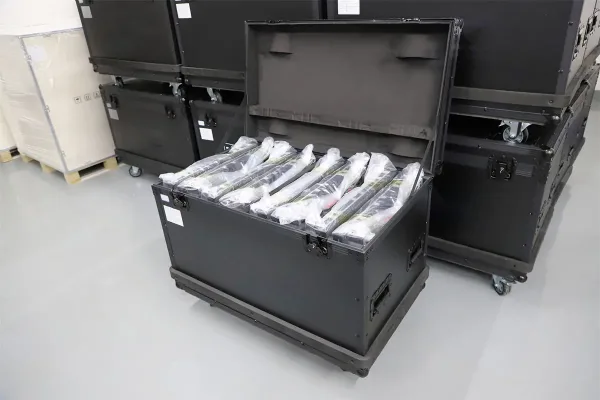
For a distributor, also consider diagnosis time, return shipping, repair turnaround, and the inventory required to keep customers operating.
| Cost category | What to include | How GOB may affect the calculation |
|---|---|---|
| Initial purchase | Modules, cabinets, controls, and agreed options | Additional encapsulation may change the quotation |
| Spares | Modules and other service components | Replacement strategy may require different stock |
| Field service | Labor, travel, and access equipment | Fewer relevant faults could reduce visits |
| Workshop repair | Diagnosis, component work, and surface restoration | Repair may require more specialized work |
| Downtime | Contractual or operational consequences | Faster module swaps may protect availability |
| Logistics | Packaging, freight, and return processing | Factory repair can extend the service cycle |
03. Use scenarios instead of unsupported promises
Compare a conservative scenario in which GOB produces no measurable reduction in failures with another based on a plausible reduction in documented surface-related faults.
Keep unrelated failures unchanged. Encapsulation should not receive financial credit for preventing controller faults or power-supply failures without evidence.
A useful decision rule is:
Additional investment is justified when expected avoided costs and operational benefits exceed the additional purchase, inventory, and repair costs.
Request warranty terms that address the encapsulated surface as well as the electronics. Clarify coverage, exclusions, freight responsibility, repair authorization, and how repaired or replacement modules will be accepted visually.
10. FAQ
01. Can GOB modules replace existing outdoor LED modules?
Sometimes, but matching pixel pitch and physical dimensions is insufficient. Check mounting points, electrical requirements, connectors, driver configuration, scan mode, control compatibility, and optical characteristics. Obtain written compatibility confirmation and test a small installation before purchasing replacements for an entire display.
02. Can GOB and non-GOB modules be mixed on one screen?
It is generally better to avoid mixing them within the same visible area unless the manufacturer validates the combination. Different surface reflectance or appearance may reveal module boundaries, even when electrical compatibility is correct. Inspect the proposed combination under both daylight and operating illumination.
03. How should an outdoor GOB LED display be cleaned?
Use the manufacturer’s approved procedure for the exact encapsulant and cabinet. Confirm permitted cleaning agents, tools, contact pressure, and power-isolation requirements. Do not infer pressure-washing or solvent compatibility from the GOB label. Trial any approved method on a suitable spare or designated test area first.
04. Can a conventional LED module be converted to GOB on site?
Treat this as a controlled manufacturing change, not a routine installation task. Material compatibility, surface preparation, application, curing, optical consistency, and subsequent verification all require attention. Unapproved field coating may create service and warranty problems. Ask the original manufacturer about a validated replacement option.
05. Do GOB modules need special controllers or video processors?
Encapsulation itself does not define the controller requirement. Compatibility depends on module electronics, receiving cards, scan configuration, pixel load, and system design. When substituting GOB modules, confirm the complete configuration with the supplier instead of assuming that the existing control settings will remain valid.
06. How many spare GOB modules should a project purchase?
There is no universal spare percentage. Base stock on display size, service response requirements, repair turnaround, shipping time, and replacement availability. Remote installations may need a different strategy from locally serviced screens. Obtain matching spares with the initial order and retain their identification and relevant configuration data.
07. Does GOB prevent camera flicker or moiré?
No. GOB is a surface-protection approach. Camera artifacts depend on factors including display driving behavior, refresh settings, camera shutter, pixel spacing, framing, and distance. If the screen will appear on camera, evaluate the proposed display with representative cameras and production settings before acceptance.
08. Can GOB modules be used in curved outdoor displays?
Only where the complete product is designed and qualified for the required geometry. A protective layer does not make a rigid module flexible. Confirm the permitted curve or bend arrangement, cabinet alignment, electrical connections, and environmental protection in the assembled configuration.
09. What documents should distributors keep for future servicing?
Retain the approved specification, module and cabinet identifiers, wiring drawings, receiving-card configuration, calibration data where applicable, inspection records, and warranty terms. Also keep the supplier’s cleaning and repair instructions. This documentation helps replacement decisions remain consistent after the original installation team has moved on.
11. Conclusion
GOB modules for outdoor LED displays can add useful protection where surface contamination, incidental contact, or repeated handling creates a real maintenance risk. Their value depends on the finished product and the installation, rather than the GOB label alone.
Professional buyers should verify environmental suitability, optical performance, repair procedures, spare-parts availability, and total ownership cost. Compare complete systems against the same project brief, and require evidence for performance claims.
For an EagerLED project inquiry, provide the site conditions, viewing requirements, screen dimensions, and service expectations. That gives the supplier a practical basis for evaluating whether GOB LED modules are an appropriate option and defining a configuration your team can purchase, install, and maintain confidently.
 LED Module Fault Guide: Dead Pixels, Lines and Color Shift