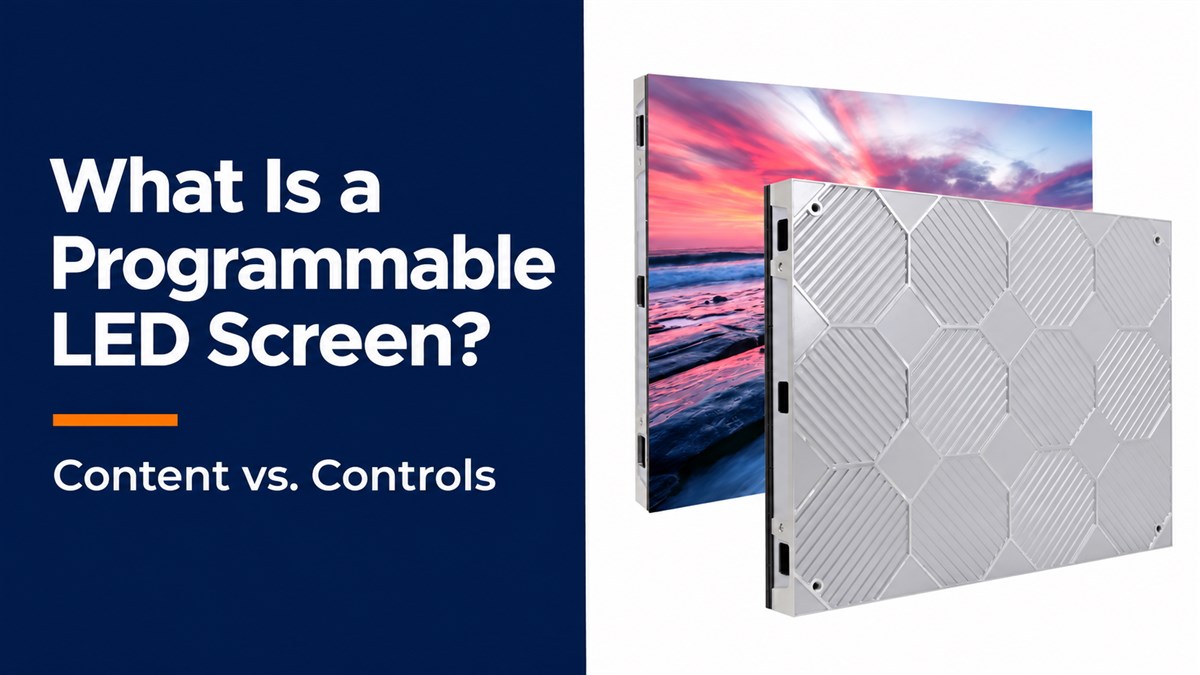

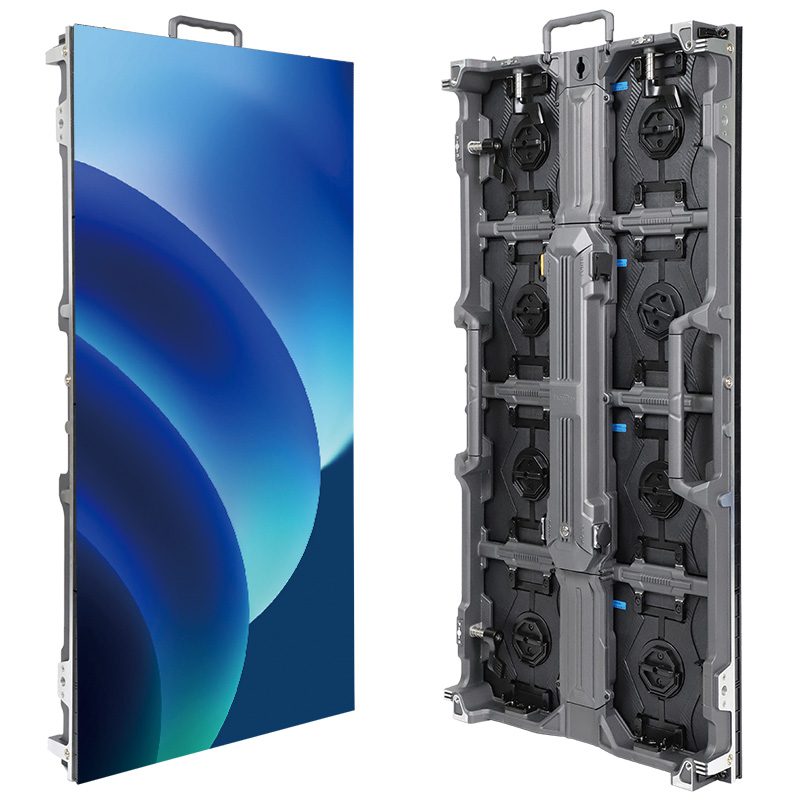
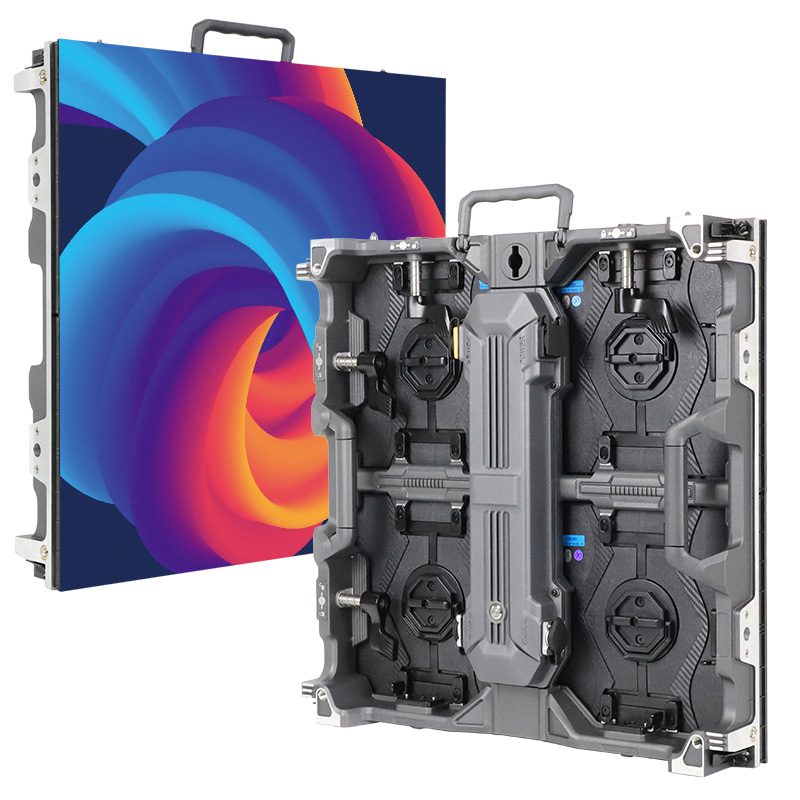
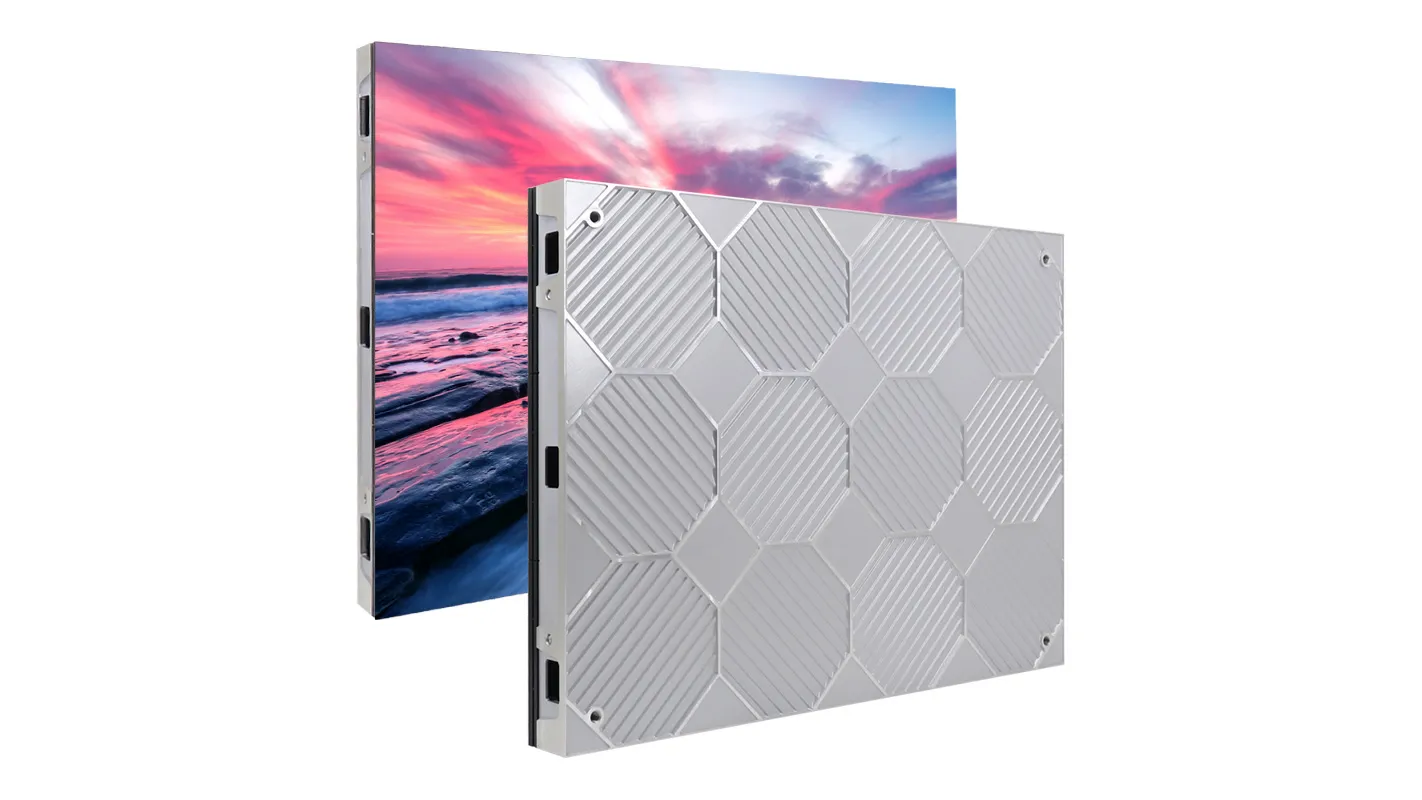
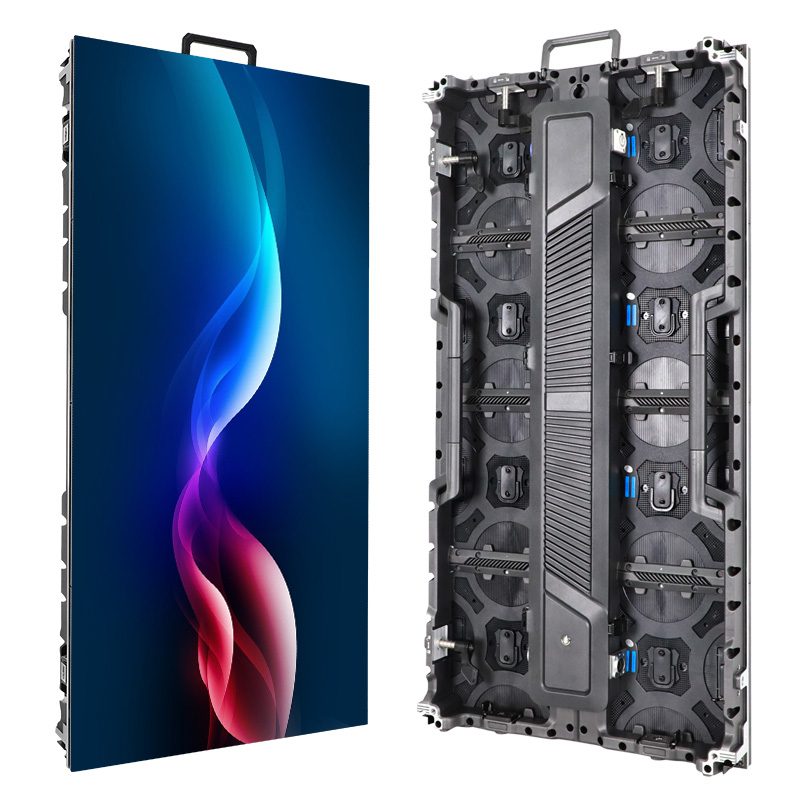
A small LED display screen is worth choosing when you need high brightness, a slim or unusual shape, or a format that LCD panels do not offer, such as a freestanding poster, a curved can or a reception desk front. At very small sizes, however, LED resolution is limited by pixel pitch, so the first check is whether the screen can show your content clearly at the distance people will stand.
This guide is for retail and hospitality teams choosing a compact display for an entrance, counter or lobby. It explains how size and pitch set resolution, which small formats exist, what they weigh and how they are controlled, and when an LCD is the better choice.
The examples use published data for EagerLED’s EA1920iP5, EA3DiP1, EA-FD and EA-DCan indoor products. Where a figure is not published, we say so.
1. How Small Can an LED Screen Be?
Physically, an LED screen can be as small as a single module. In practice, the useful minimum size of a small LED display screen depends on how many pixels the content needs. An LED screen’s resolution is its width and height divided by the pixel pitch, so a small screen has few pixels unless the pitch is very fine.
01. Work out the resolution from size and pitch
Take the EA1920iP5 poster, which has a 640 x 1920 mm (25.2 x 75.6 in) display area. At P2.5, that is 256 x 768 pixels. At P1.25, the finest SMD option listed, it is 512 x 1536 pixels. The same physical poster therefore holds four times as many pixels at the finer pitch, which is the difference between a short headline and a full menu or product photo with small text.
The calculation works for any size: divide each dimension in millimeters by the pitch. Use the manufacturer’s exact module matrix when you finalize the order, because real pitches are often rounded in model names.
02. Match the pitch to the viewing distance
A common rule of thumb is that the closest comfortable viewing distance in meters is roughly equal to the pixel pitch in millimeters. By that guide, a P2.5 screen looks smooth from about 2.5 m (8 ft), while a P1.25 screen holds up at about 1.25 m (4 ft). It is only an estimate; small text and fine graphics need more distance than video. If shoppers will stand right in front of a small LED display screen, plan for a fine pitch or keep the content large and simple.
| Pixel pitch | Resolution (W x H) | Rough closest viewing distance | Content that fits well |
|---|---|---|---|
| P2.5 | 256 x 768 | About 2.5 m (8 ft) | Bold headlines, video loops, large logos |
| P2 | 320 x 960 | About 2 m (6.6 ft) | Promotions with short text |
| P1.86 | 344 x 1032 | About 1.9 m (6.2 ft) | Product images with prices |
| P1.53 | 418 x 1254 | About 1.5 m (5 ft) | Menus and mixed text and images |
| P1.25 | 512 x 1536 | About 1.25 m (4 ft) | Detailed graphics viewed up close |
Resolutions are rounded down to whole pixels. Viewing distances use the rule of thumb above and are not manufacturer specifications.
2. Common Small LED Display Screen Formats
Most compact LED products are built as finished units rather than as loose cabinets, because the frame, controller and power supply have to fit inside a small body. These are the formats retail and hospitality buyers see most often.
01. Freestanding LED posters
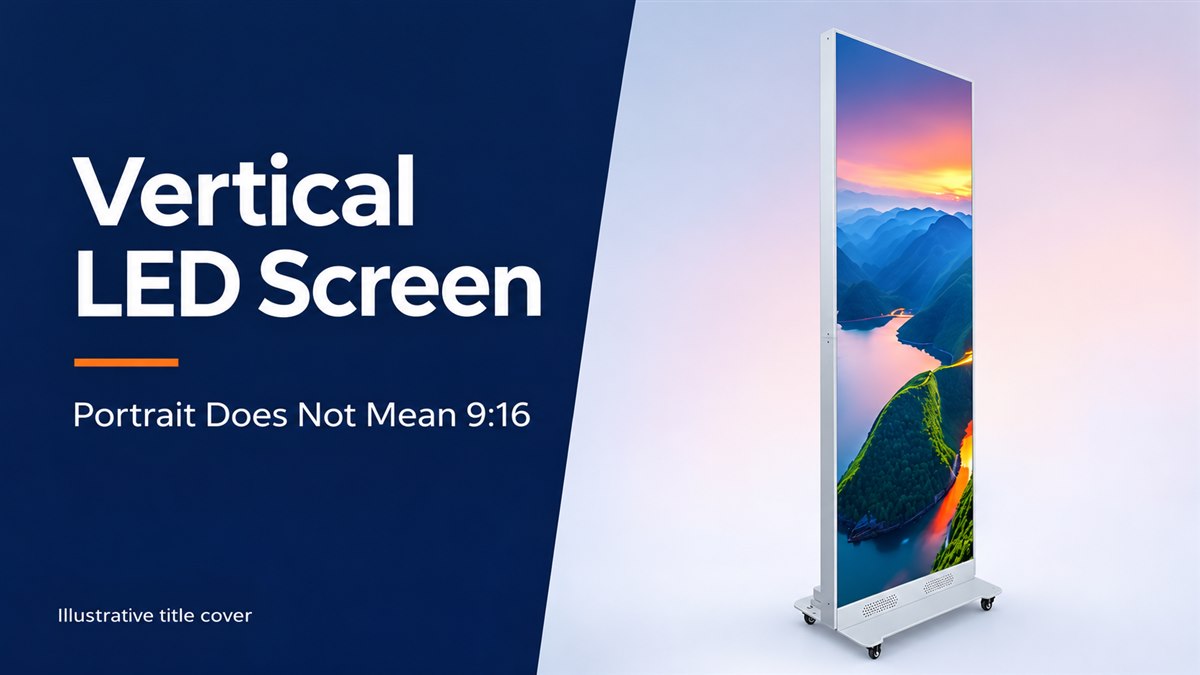
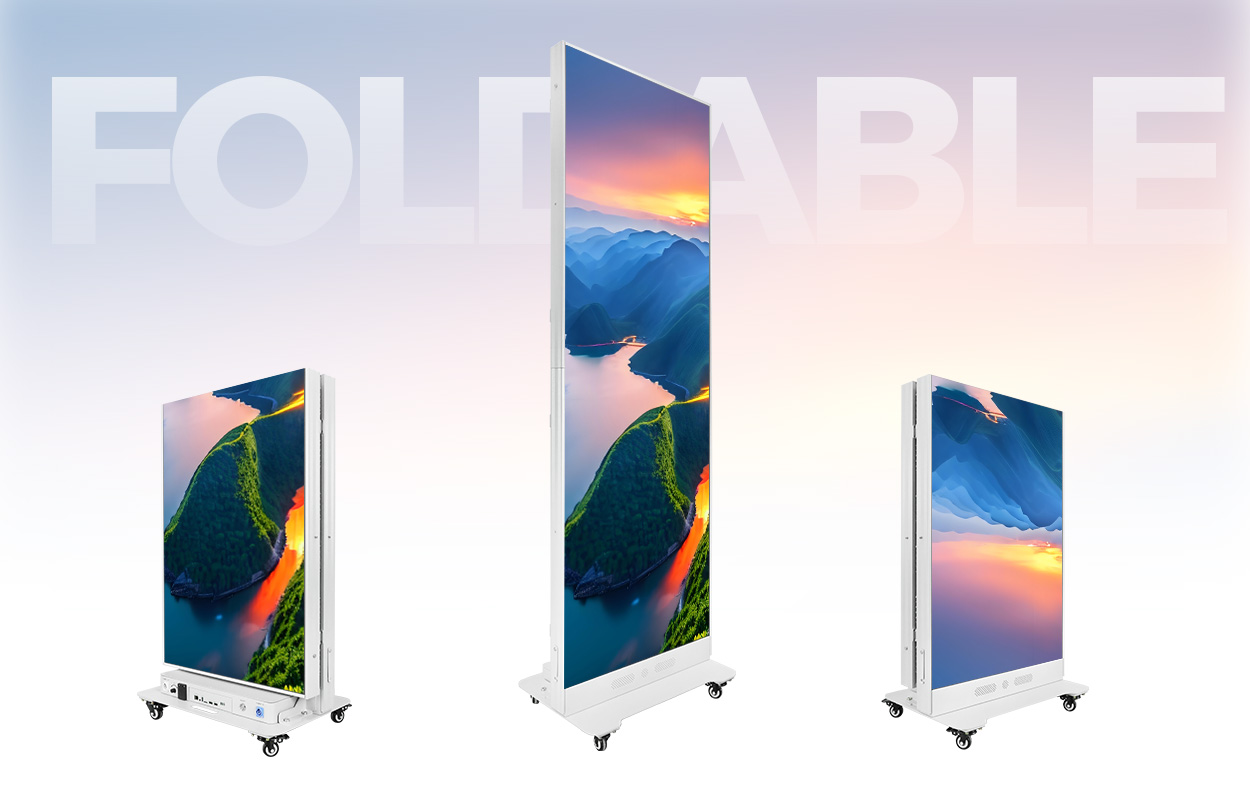
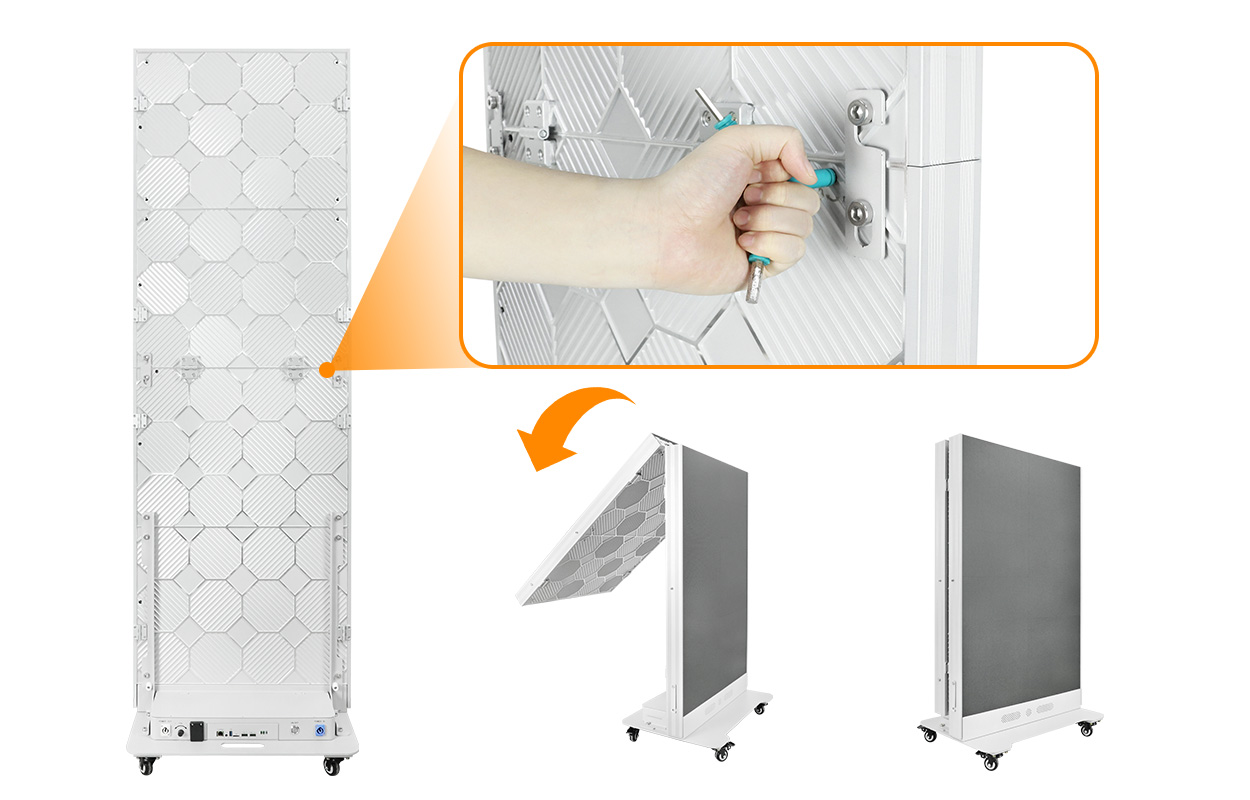
An LED poster is a portrait screen on a stand or wheeled base, used at shop entrances, in malls and in hotel lobbies. The EA1920iP5 foldable LED poster is 640 x 1920 mm, 65 mm (2.6 in) deep and folds for transport; it is listed in P1.25 to P2.5 SMD and P1.25 to P1.86 flip-chip COB versions, with brightness from 600 to 800 nits depending on pitch. Several units can be aligned side by side to make a larger wall. Our LED poster guide covers this format in more detail.
02. Multi-sided and 3D posters
For spaces where people approach from several directions, a multi-sided unit avoids having a blank back. The EA3DiP1 four-sided LED poster measures 680 x 1920 x 680 mm and is listed in P1.25, P1.56 and P1.86, with at least 600 nits and a 3,840 Hz refresh rate. Its four faces can show the same content or separate campaigns, and corner-wrapped content can create a glasses-free 3D effect.

03. Reception desks and counters
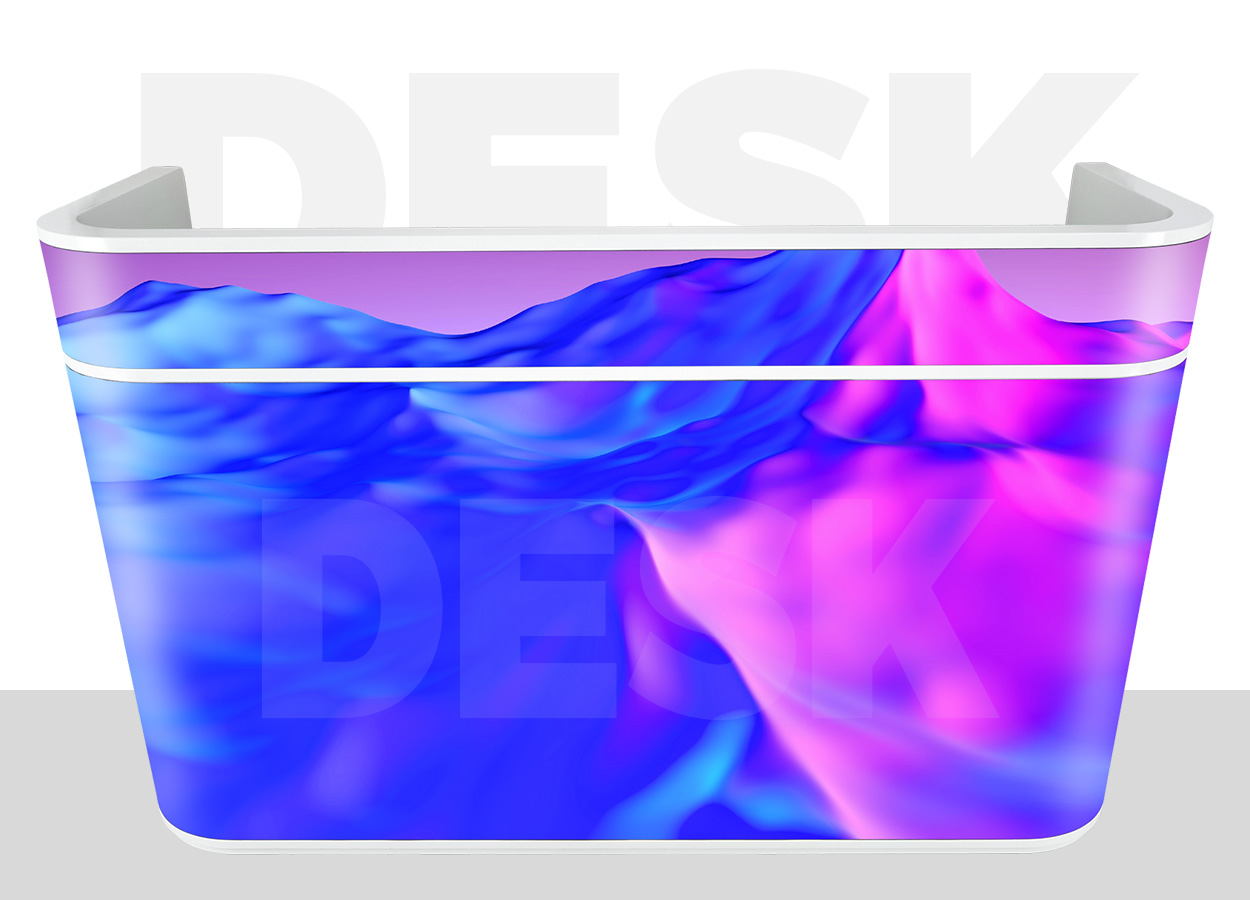
An LED front desk puts the screen on the front of a counter, where staff stand behind it and visitors see branding or event graphics. The EA-FD front desk LED screen is offered with display areas of 1920 x 960, 2240 x 960 and 2560 x 960 mm, in P1.53, P1.86 and P2.5 GOB, at 600 nits. The same pixel math applies: a 1920 x 960 mm front at P2.5 is 768 x 384 pixels, enough for a logo and a short message.

04. Shaped displays and counter screens
LED can also be formed into shapes that flat LCD panels cannot match. The EA-DCan can-shaped display uses flexible modules in P1.875 and P2, at 650 nits, with heights from about 1.3 to 1.9 m (4.2 to 6.3 ft). For food and drink counters, our article on the LED menu screen compares LED and LCD for that specific job.
3. Weight, Power, and Control
Small does not mean light. A small LED display screen still carries a frame, a controller and power supplies, so it is usually heavier than an LCD of similar size. Check the floor, the route into the building and who will move the unit before you order.
| Model | Format | Published weight | Protection | Check before ordering |
|---|---|---|---|---|
| EA1920iP5 | Foldable poster, 640 x 1920 mm | 55 kg (121 lb) | IP31 | Wheel locks, door widths, folding clearance |
| EA3DiP1 | Four-sided poster | 125 kg (276 lb) | IP31 | Floor load, moving equipment, caster brakes |
| EA-FD | Front desk, three sizes | 97 to 130 kg (214 to 287 lb) | IP43 | Socket standard, desk depth, storage space |
| EA-DCan | Can-shaped display | About 75 to 115 kg (165 to 254 lb) | IP31 | Height option, power entry at the base |
All four are sold as indoor products, and their ratings are not intended for outdoor weather. Outdoor sites need a model built for outdoor use.
01. Power and sockets
Ask for the maximum power of the exact size and pitch you order. EagerLED publishes 550 W, 650 W and 750 W maximum per set for the three EA-FD sizes, with integrated sockets in US, EU, UK or CN standards; the poster and can pages do not list power figures, so request them. Maximum power is for sizing the circuit, not an average running figure.
02. How content gets onto the screen
Many compact LED units can be updated without a dedicated PC. The EA1920iP5 lists Wi-Fi, SIM, Ethernet, HDMI and USB connections, and the EA3DiP1 lists remote control of content and brightness from a phone, tablet or computer. Scheduling, monitoring and multi-site management depend on the controller and software supplied, so confirm them in the quote if you manage several stores.
4. When an LCD Is the Better Choice
For a standard rectangle under about 1.5 m (5 ft) diagonal that people read from arm’s length, an LCD usually offers higher resolution at that size, weighs less and often costs less. A small LED display screen makes more sense when one of these applies:
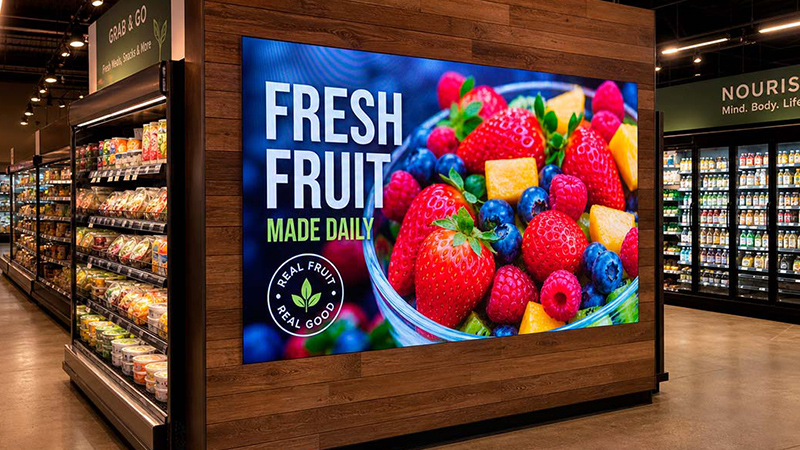
- The screen sits in a bright atrium or near windows and needs more brightness than a standard indoor LCD. For a shop window in direct sun, also compare high-brightness window LCDs.
- The shape is not a standard 16:9 rectangle, such as a tall poster, a desk front or a cylinder.
- You want several units joined into one larger image without LCD bezels.
- The display will be moved between events or stores and must fold or roll.
For meeting rooms that need a ready-made 16:9 LED screen, EagerLED’s sister site explains what an AIO LED display includes. If none of the points above apply, compare a commercial LCD before choosing LED. Our LED poster vs. LCD poster comparison lists the differences in more detail.
FAQ
01. What is the smallest practical size for an LED screen?
It depends on the content. Divide the screen size by the pitch to get the resolution, then check that your text and images fit. A 640 x 1920 mm poster at P2.5 is only 256 x 768 pixels, which suits headlines and video but not small print.
02. Can a small LED display screen be used outdoors?
Only if it is designed for outdoor use. The compact units in this guide are rated IP31 or IP43 for indoor spaces. Outdoor posters need higher brightness and weather protection, so ask for an outdoor model and its rating.
03. Can several small LED posters be joined into one screen?
Some can. The EA1920iP5 is listed for vertical or horizontal alignment into a larger wall, but the support structure, signal routing and pixel map must be planned for the final layout.
04. Do I need a computer to update the content?
Often not. Many compact units accept Wi-Fi, USB or mobile network updates through their own controller. Ask which software is supplied and whether it supports scheduling across several locations.
Getting a Quote for a Compact Display
To get an accurate recommendation, send the location and how close people will stand, the size or format you have in mind, the content you plan to show, whether the unit will stay in one place or move, the socket standard in your country, and how many locations need screens. With that, we can suggest a pitch and model and confirm the power and control details that are not published. Ask EagerLED about a small LED display screen for your space.
 LED Video Wall Packages: What a Complete Rental System Includes