
A flexible LED display screen price for a curved exhibition booth should separate the display modules, shaped support frame, control and power equipment, sample approval, assembly, on-site commissioning, spares and transport protection. Compare suppliers against the same approved surface drawing. A module-only rate cannot establish the cost of a working booth display.
This guide is for exhibition contractors preparing a budget before committing to fabrication. It focuses on an indoor, reusable curved feature, where the contractor must coordinate the display supplier, frame fabricator, content team and show-site installer. It does not present a current price list or promise a universal cost per square meter.
EagerLED’s EA-Flex product information provides the technical starting point: soft indoor modules, multiple footprints and model-specific pixel maps. The budgeting method below turns those choices into comparable work packages and approval steps.
1. Define What the Flexible LED Display Screen Price Covers
Start by describing the deliverable at the handover point. Is the supplier shipping loose modules, an assembled curved display, or a complete system that somebody will install and commission? Write that answer beside the total. Otherwise, a lower flexible LED display screen price may simply transfer fabrication and integration work to your own team.
Use three boundaries: equipment supply, preparation before shipment and work at the venue. Keep each visible even when one company quotes all three. This makes it possible to compare an overseas equipment purchase with a locally assembled system without treating two different scopes as identical products.
The screen area also needs a definition. Use the active curved surface for module quantities, while recording decorative borders and structural depth separately. A plan-view width across an arc is shorter than its developed surface length. A contractor who budgets from the visible chord alone can omit modules, frame material and content pixels.
| Package | Ask the supplier to identify | Contractor check |
|---|---|---|
| Display supply | Module model, pitch, quantity, receivers, power supplies and wiring | Active surface and approved module grid match |
| Shaped structure | Design responsibility, fabrication, finish, joints and fixing interfaces | Frame and display removal paths use the same revision |
| Factory preparation | Trial assembly, mapping, calibration and packed-condition checks | Evidence applies to the proposed deliverable |
| Venue work | Unloading boundary, assembly, power connection, commissioning and strike | Named parties accept the site work |
| Owner package | Labeled spares, tools, files, instructions and replenishment route | The system remains usable after the first show |

Use the same acceptance destination for every offer. For example, delivery to an overseas port leaves different tasks from delivery to a booth warehouse. Ask which party arranges unloading, temporary storage and the final move to the stand. An included freight line does not answer those questions. Keep the commercial delivery term beside the physical handover point so a project manager can identify the remaining work without interpreting a shipping abbreviation.
2. Freeze the Surface Before Requesting Final Rates
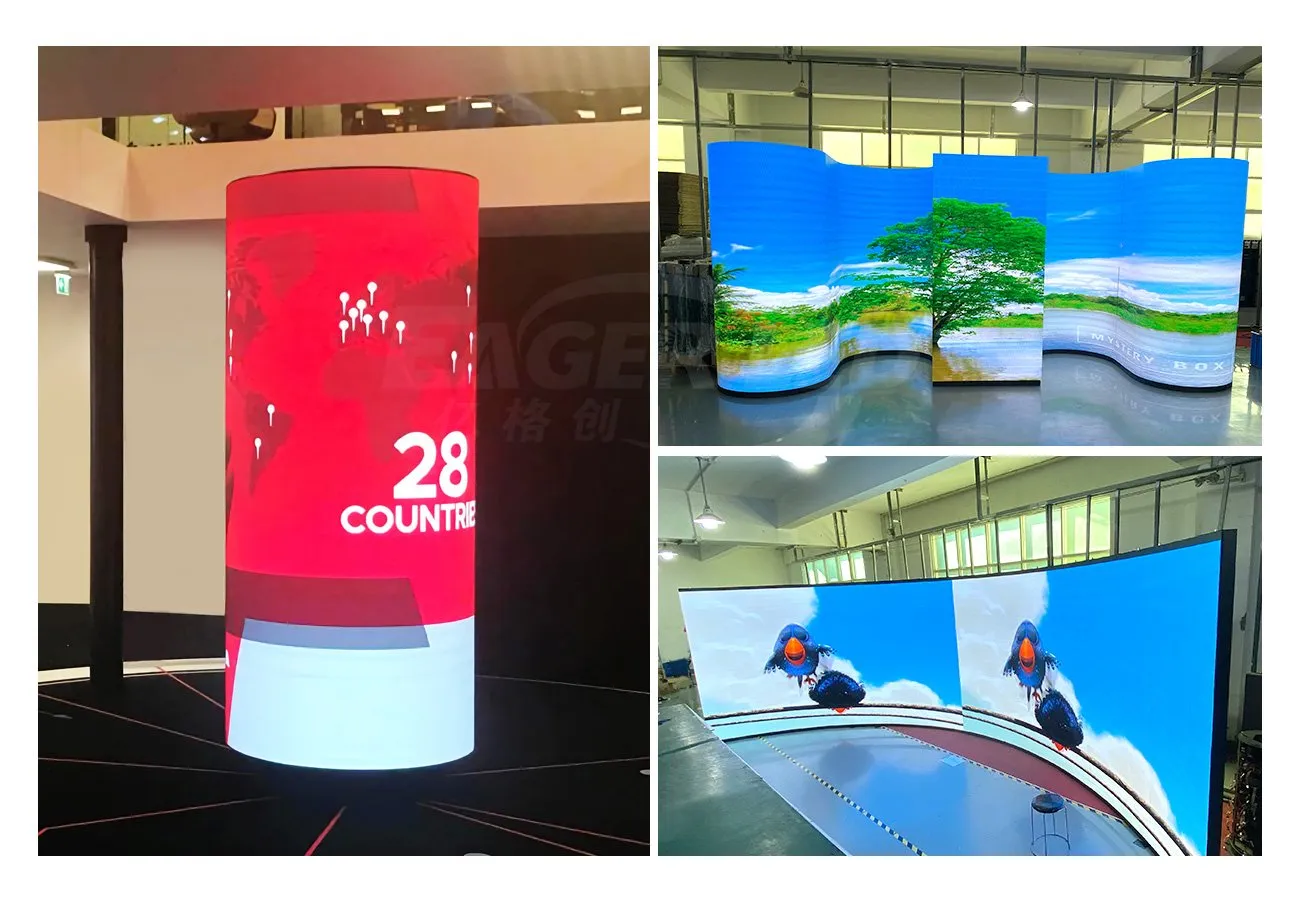
A reliable flexible LED display screen price begins with a dimensioned surface, not a rendering alone. Provide plan and elevation views, developed arc length, height, radius, concave or convex direction, seam positions and any changes in curvature. Identify the finished face that carries the modules so suppliers do not interpret the radius at different reference lines.
For an illustrative geometry check, a quarter-circle surface with a radius of 2 m (6.6 ft) has an arc length of approximately 3.14 m (10.3 ft). At 2 m (6.6 ft) high, its nominal surface area is approximately 6.28 m² (67.6 sq ft). These are mathematical planning values, not an approved module arrangement. The final outline must accommodate complete modules, edge treatment and the selected support method.
Ask each bidder to return the module grid overlaid on that surface. Identify where the proposed module count changes the finished size or moves a seam. When the concept cannot fit complete modules, request an explicit design revision. Do not let a contractor assume that modules can be cut, stretched or forced into an unapproved curve.
The EA-Flex page advises confirming the practical bend radius and mounting drawing for the selected format. Treat a published bend angle as incomplete information for fabrication: the useful radius depends on the module and orientation. Ask the supplier to identify the limiting direction, support spacing and handling restrictions in the submitted drawing.
Record nearby conditions too: front working space, access doors, platform edges, neighboring exhibits and the replacement route for a damaged module. A curved display can fit inside the visual envelope while leaving no practical service position. Resolve that interface before the flexible LED display screen price becomes a fixed order value.
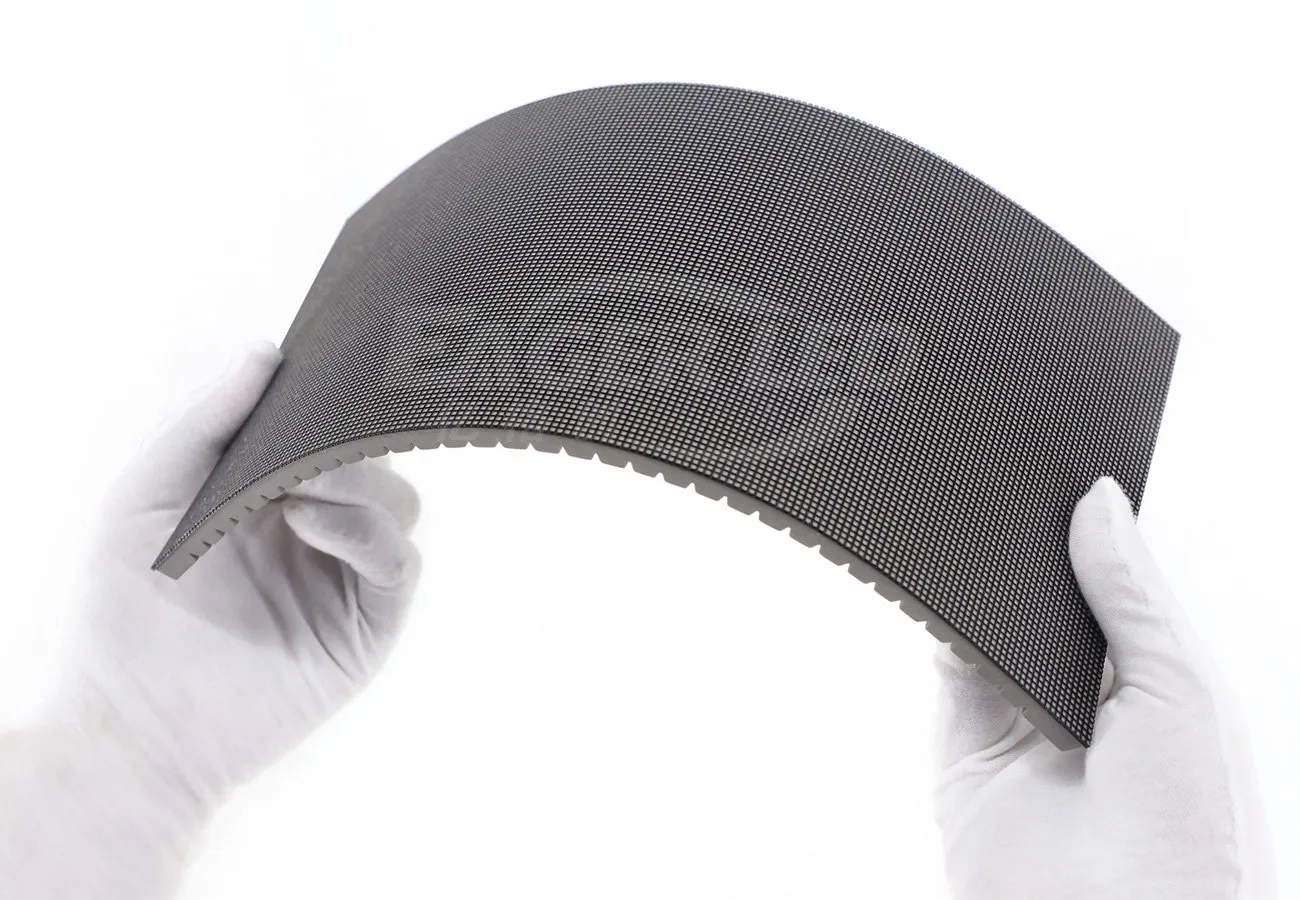
Distinguish a constant-radius curve from a changing-radius wave. A constant radius allows the same geometry to repeat along the surface; a wave can require several section profiles and more location-specific labels. Ask the fabricator how those sections will be identified during rebuilding. A drawing should also distinguish the active image height from the overall feature height, especially when a plinth, header or decorative cap occupies part of the booth envelope.
3. Separate Module Selection from Frame Fabrication
Compare module alternatives on the same viewing task. Send the nearest visitor position and representative content, including the smallest labels. Then request a named pitch and footprint rather than a generic flexible panel. A smaller pitch changes the pixel count and control requirements; it does not correct a frame that produces uneven seams.
Published EA-Flex P2 examples illustrate why the footprint matters. The 240 × 120 mm (9.4 × 4.7 in) format has a 120 × 60 pixel map; the 256 × 128 mm (10.1 × 5.0 in) format has 128 × 64 pixels; the 320 × 160 mm (12.6 × 6.3 in) format has 160 × 80 pixels. Those examples are separate configurations, not interchangeable spare parts.
Have the supplier state the ordered module model, receiving configuration, connector arrangement and mounting interface. Use the flexible soft LED module range for initial options, then confirm the actual assembly. Equal nominal pitch alone does not establish electrical, mechanical or calibration compatibility.
Put the frame on its own quotation line. Include design, fabrication, section joints, module supports, alignment provisions and the connection to the booth structure. Identify who checks loads and attachment details for the actual site. This is a coordination requirement for qualified project personnel, not a structural design based on an online guide.
A segmented transportable frame can have a different flexible LED display screen price from a single assembled frame even when both support the same area. Compare the packed volume, reassembly work, alignment process and number of shows expected. A cheaper fabrication line can become an expensive recurring installation task if every rebuild requires extensive adjustment.

Request the native pixel canvas after the grid is fixed. As an illustrative calculation, ten modules across and eight high, each with a 160 by 80 pixel map, produce a 1600 by 640 pixel canvas. That arithmetic does not approve a particular curve or processor. It gives the content and control teams a common starting point for checking capacity, file aspect ratio and the location of essential text.
4. Budget a Representative Sample and an Approval Gate
The sample allowance in a flexible LED display screen price should buy evidence for the difficult part of the design. A loose flat module may establish basic image behavior, but it does not prove the curved seam, frame junction or replacement path. Specify a representative joined section using the proposed module and support arrangement.
Agree what happens to the sample after approval. It may be retained as a reference, incorporated into the system if suitable, or excluded from production. State which treatment is quoted. Sample freight, fixture fabrication and repeat testing should be visible rather than hidden in a general engineering charge.
Use the intended content during the review. Check lettering across module boundaries, lines crossing the curve and artwork near the ends. View the assembly from the main approach and an oblique aisle position. Ask the content team to assess what must be remapped, repositioned or simplified before the production canvas is released.
Define approval as a documented decision with open items. Record the module identification, drawing revision, content file, operating settings and photographs of the joined surface. If the frame changes after approval, identify which observations need to be repeated. An attractive sample photograph is not approval for a different production radius.
Include a controlled module replacement demonstration by trained personnel following the manufacturer’s procedure. Confirm the tool, working area, handling route and final image check. Front removal should be demonstrated on the representative curve, because a method that works on a flat bench may be obstructed by the booth finish.
These steps make the flexible LED display screen price easier to defend internally: the sample cost closes defined design questions before a larger fabrication commitment. Ask for the approval milestone and the commercial treatment of revisions in writing. Do not assume unlimited redesign or repeat freight is included.
Ask the reviewer to record both accepted and rejected observations. A signed list such as readable labels, approved seam positions and accessible replacement opening is more useful than an unqualified approval email. Keep the evaluation conditions consistent when suppliers present samples: use the same artwork, comparable viewing positions and agreed operating settings. Otherwise, a difference in demonstration conditions can be mistaken for a difference in the supplied equipment.
5. Include Commissioning, Spares and Transport Protection
Commissioning should name the result to be delivered: the agreed physical layout, confirmed pixel map, stable playback, content alignment and a repeatable startup process. Separate that work from physical assembly. The person connecting cabinets may not be the person preparing the playback canvas or approving the final visual result.
Ask whether the flexible LED display screen price includes factory mapping only, remote assistance or an on-site technician. Define the access hours, language, travel responsibility and boundary between display troubleshooting and venue electrical work. No response time should be treated as a commitment until the responsible provider accepts it.
Build the spare package around the approved configuration. Identify spare modules, relevant power and receiving components, connecting cables and any dedicated extraction tool. Quantities should follow the service plan and replenishment route; a universal spare percentage cannot reflect every booth, handling pattern or event schedule.
Keep the module version and configuration files with the inventory. Ask how a replacement will be recognized, fitted and checked for acceptable image consistency. A nominally matching module that needs further configuration can leave the contractor with an unresolved field task. Request a demonstration using one of the proposed spare items.
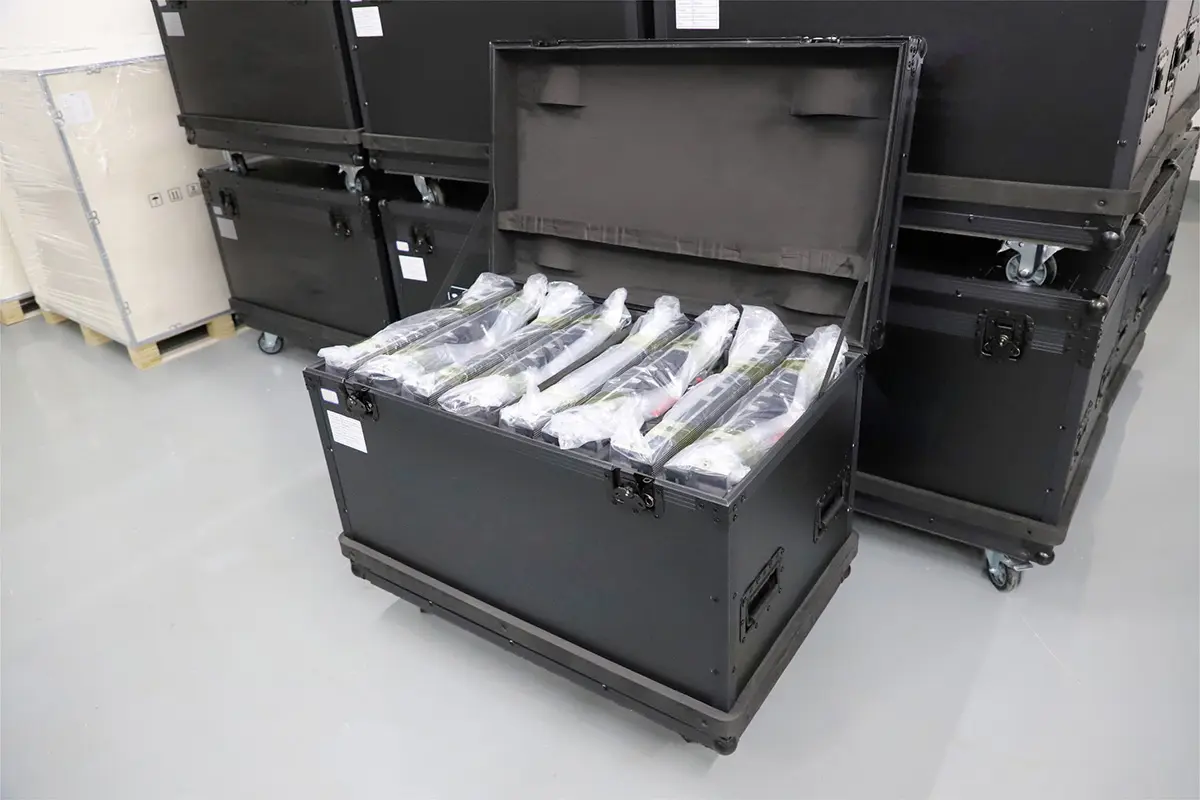
Transport protection belongs in the flexible LED display screen price comparison. Ask how curved sections, exposed module faces, frame joints and loose accessories will be protected. Record packed dimensions, gross weight, lifting or handling instructions and the delivery point. Confirm storage conditions with the manufacturer rather than leaving sensitive display faces loose in a general booth crate.
Plan the return journey as well. A custom frame may be reusable while its original packing is discarded during installation. Assign responsibility for retaining protection, identifying each section and recording condition after dismantling. That decision affects the second event even if the first shipment arrives without damage.

Separate routine startup training from advanced repair support. The booth operator may only need to select the correct content and recognize a fault, while an appointed technician handles replacement and configuration. Request instructions appropriate to each role. Include the current configuration backup, a location plan for labeled parts and a contact route that remains available after the shipment has been accepted.
6. Normalize Proposals and Control Changes
Normalize each flexible LED display screen price against a common scope sheet. Use one currency, a stated quotation date and a clear delivery basis. Mark items included, excluded or awaiting confirmation. Keep local taxes, venue services and contractor labor visible instead of treating an equipment subtotal as the installed total.
| Difference between bids | Evidence to request | Budget treatment |
|---|---|---|
| Different curved outlines | Dimensioned overlay and developed surface | Reprice on one accepted geometry |
| Different frame supply | Fabrication scope and fixing interfaces | Add missing work before comparison |
| Sample omitted | Representative assembly and approval plan | Carry a named provisional allowance |
| Content work unclear | Pixel map, file delivery and mapping responsibilities | Separate creative production from display setup |
| Remote support only | Available hours and site technician boundary | Price the required local capability |
| Spares or cases absent | Itemized inventory and packing schedule | Add the agreed service and transport package |
For an internal comparison, use a simple formula: comparable project total equals quoted supply plus excluded required work plus agreed provisional allowances. This is an accounting framework, not a market price estimate. Keep unconfirmed allowances labeled, and obtain project quotations before committing the budget.
Issue design changes through one person. A revised radius can affect the frame, module count, cable routing, packed sections and content map together. Ask for a written effect on scope, schedule and flexible LED display screen price before releasing the change. Updating only the attractive rendering leaves the manufacturing and content teams working from different assumptions.
Finally, attach the accepted scope sheet to the purchase documentation. Preserve the final drawing, approved sample record, component list, service boundary and exceptions. Those records allow the contractor to judge delivery against a defined system instead of reopening the original conversation when equipment reaches the venue.
Test the budget against one realistic change before approving it. Ask what happens if the booth moves to a hall with a different delivery window or if the client changes the curved outline. Identify which costs are fixed, which depend on quantities and which require a new quotation. This exercise exposes missing commercial boundaries without inventing a contingency percentage or assuming that every possible revision is covered.
Frequently Asked Questions
Should prototype charges be deducted from the production order?
Only when the quotation explicitly says so. Ask whether the sample becomes a retained reference or usable production stock, and whether any credit depends on order quantity or timing. Record that agreement before authorizing the prototype.
Can a future booth use the same screen with a different curve?
Request a fresh compatibility review. The original bend limit, frame sections, cable lengths and content map may constrain reuse. Keep the original configuration record so the supplier can identify what remains usable and what needs a new design.
Should creative animation be included with the hardware?
Treat creative production as a separate deliverable unless expressly included. Identify who creates the files, who owns the source assets and which revisions are covered. Hardware commissioning should still prove that the accepted content plays correctly.
What if the booth design changes after sample approval?
Ask for a change assessment against the approved drawing. Repeat only the checks affected by the change, such as curvature, seams, access or mapping. Require the revised cost and delivery effect before continuing fabrication.
Can indoor flexible modules be used near an exposed entrance?
Do not infer weather suitability from flexibility. EA-Flex is published as an indoor product with IP31 protection. Have the supplier review actual moisture, sunlight and temperature conditions and confirm a suitable configuration before ordering.
Prepare a Comparable Booth Quotation
Send EagerLED the dimensioned curve, module-grid expectations, visitor positions, representative artwork, booth construction method, destination and event dates. Include the sample task, packing plan and named commissioning boundary. Request an itemized flexible LED display screen price with exclusions and approval milestones, then discuss the curved exhibition display requirements before releasing fabrication.
 LED Screen for PowerPoint: Test Small Text Before Buying
 LED Screen Rental Las Vegas: Booth Setup and Rehearsal