
A stadium LED display is far more than an oversized scoreboard. In a modern venue it is a connected system of screens – the main video board, perimeter ribbons, courtside units, hospitality panels and concourse information displays – that together decide how a match feels, how sponsors are seen and how quickly staff can react on a busy matchday.
For clubs, venue operators, AV integrators and sponsorship teams, choosing a stadium LED display is a commercial decision as much as an engineering one. A well-specified system earns its keep through sponsorship inventory, hospitality packages and matchday revenue. A poorly specified one produces washed-out images at three in the afternoon, dark panels after two winters outdoors, and a maintenance bill nobody budgeted for.
This guide explains how stadium LED display technology evolved, where it creates commercial and operational value, how LED compares with LCD inside a sports venue, which specifications genuinely matter, and what a realistic installation, maintenance and cost plan looks like. It is written for the people who sign the purchase order.
Everything below comes back to four variables that explain most of the price difference between supplier quotes: pixel pitch matched to viewing distance, brightness matched to ambient light, refresh rate matched to broadcast cameras, and service access matched to the mounting structure. Get those four right and the rest of the specification falls into place.
catalogue
Quick answer: a stadium LED display is a high-brightness, high-refresh direct-view LED screen system used to show live video, replays, statistics, sponsorship content and safety messaging inside a sports venue. For an outdoor bowl, specify 6,000–8,000 nits brightness, a refresh rate of 3,840 Hz or higher, IP65 front and IP54 rear protection, and a pixel pitch matched to the furthest seat – typically P6–P10 for a main video board and P4–P6 for perimeter ribbons.
- Main video board: P6–P10, 6,000–8,000 nits, 3,840 Hz+
- Perimeter ribbon: P4–P6, 5,000–6,000 nits, 3,840 Hz+
- Broadcast safety: no visible flicker or scan lines on TV cameras
- Resilience: redundant signal path, redundant power feed, front or rear service access
1. What Is a Stadium LED Display and How Has It Evolved?
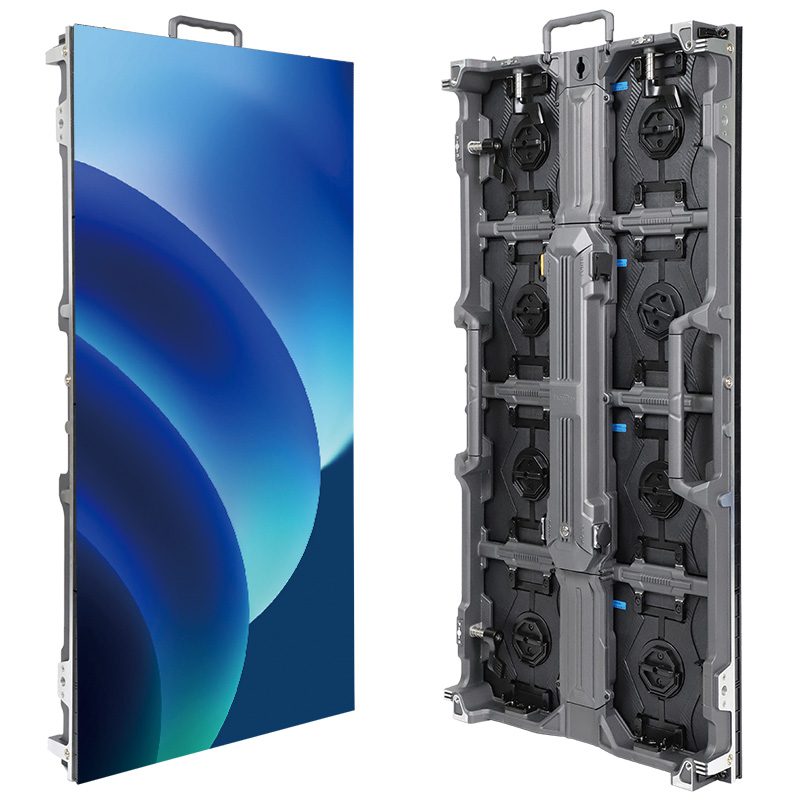
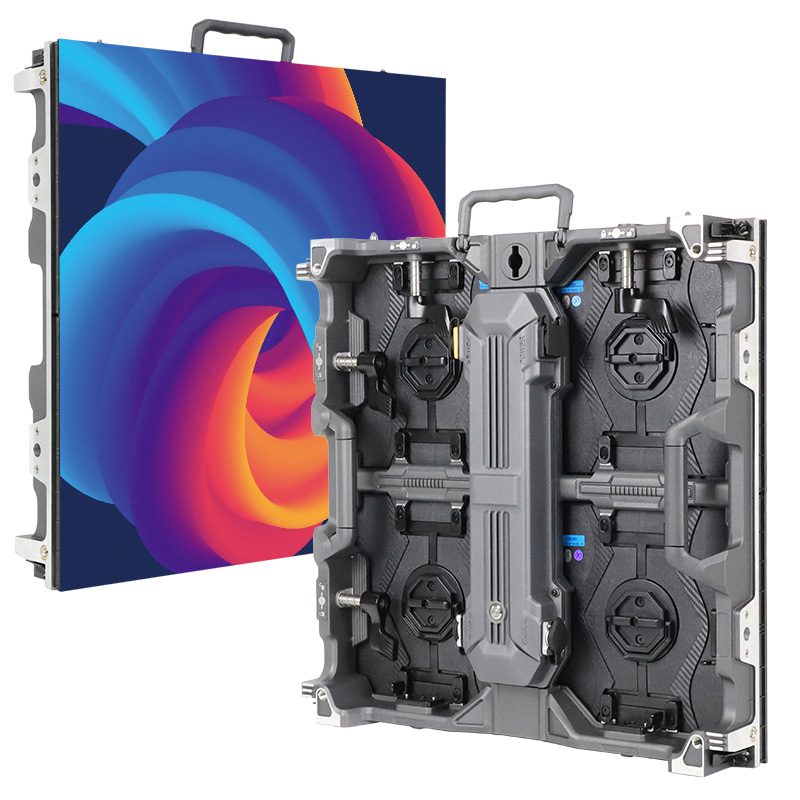
A stadium LED display is a direct-view LED screen system engineered for large-scale live viewing. That means high brightness, a high refresh rate, wide viewing angles and weather-sealed cabinets that survive years outdoors. Unlike a television, the screen is assembled from modular cabinets, so it can be built to almost any size or shape and repaired panel by panel instead of being replaced as a whole.
The technology has changed beyond recognition. Early electronic scoreboards used incandescent lamps and could only show digits and simple text. Dot-matrix boards arrived in the 1980s, the first true LED video boards followed in the 1990s, and the move from through-hole DIP lamps to surface-mounted SMD packages made finer pixel pitches and smoother video possible. More recently, chip-on-board and MIP packaging have pushed outdoor pixel pitches below P4 while improving contrast and durability.
What changed commercially is that the stadium LED display stopped being a scoreboard and became a media platform. Once a screen can show video, it can carry sponsorship, hospitality messaging, community campaigns and live statistics on the same surface, and each of those has a value that can be sold. That single shift is why a stadium LED display is now usually assessed as a revenue asset rather than a facilities cost.
Modern venues rarely install one screen. A typical project combines a hero video board, a pitch-facing ribbon, courtside or floor units, and concourse displays, all driven from one control system so that a single operator can schedule content for the whole stadium from a laptop. Halo and corner displays extend the same idea to bowl stadiums where a single end-stand screen would leave a large part of the crowd looking at the back of the structure.
2. How a Stadium LED Display Improves Advertising and Matchday Revenue
01 Perimeter and Ribbon Advertising Inventory
The perimeter ribbon is the workhorse of matchday revenue. Because a stadium LED display can rotate content automatically, a single ten-metre section of perimeter board can carry twelve or more sponsor messages during a match, split by minute, by half or by region. Static vinyl boards carry one advertiser for the whole season; a digital ribbon sells the same physical space many times over.
Ribbon inventory also sells at a premium because it sits in every wide broadcast shot. Sponsors buy perimeter positions for the exposure on television and streaming highlights as much as for the people in the ground, which is why refresh rate and brightness on a perimeter stadium LED display matter commercially: a flickering or washed-out board is a board the sponsor will not renew.
02 Sponsor Proof, Dynamic Content and Measurable ROI
Because a stadium LED display is software-driven, exposure becomes measurable. The control system logs what ran, when it ran and for how long, so a club can hand a sponsor a proof-of-performance report rather than an estimate. That record supports renewals, justifies premium pricing for high-traffic slots and makes it possible to sell last-minute inventory at short notice.
It also opens up dynamic content. The same stadium LED display can show a live scoreline to the north stand, a hospitality promotion during the interval, and a sponsor sting triggered by a goal, all without an operator touching the desk. Clubs that treat the screen as a scheduling platform, rather than a slideshow of fixed images, typically generate the strongest return on that investment.
| Display position | Typical pixel pitch | Primary commercial role | Where it works best |
|---|---|---|---|
| Main video board (end stand) | P6–P10 | Hero replays, sponsor stings, scoreline, VAR explanations | Single-tier and two-tier end stands |
| Perimeter ribbon | P4–P6 | Rotating sponsor inventory and in-play messaging | Pitch-facing walls and barriers |
| Courtside and floor LED | P2.6–P4 | Close-range branding and replays for courtside seats | Basketball, volleyball, arena sports |
| Hospitality and concourse | P2.5–P4 | Upsell offers, wayfinding and partner content | Concourses, boxes, club levels |
| Corner and halo display | P6–P8 | 360-degree viewing and TV-visible branding | Bowl stadiums with roof structures |

3. What Other Roles Can a Stadium LED Display Play on Matchday?
01 Accessibility, Safety and Multilingual Communication
A stadium LED display is one of the few communication channels that reaches every person in the ground at once. That makes it the natural home for subtitles and captions for deaf and hard-of-hearing supporters, for multilingual safety messaging in venues that draw international crowds, and for clear explanations of referee decisions, VAR reviews and stoppage time.
In an emergency the same display becomes part of the safety system. Stewards can push pre-agreed messages to the stadium LED display within seconds, directing spectators away from a closed exit or holding a stand in place while an incident is resolved. Venues that have tested this route before an event find the process far smoother than venues improvising on the day.
02 Atmosphere, Fan Engagement and Memorable Moments
Atmosphere is the hardest thing to buy and the easiest thing to lose. A stadium LED display carries the moments that turn a fixture into a memory: the replay from three angles, the crowd close-up that fills the screen, the birthday message, the half-time competition, the community club being celebrated in front of forty thousand people.
These segments cost almost nothing to schedule, yet they lift the experience for the whole stadium and generate the social clips that promote the next match. When a stadium LED display is used only for advertising and the score, the venue is leaving its most valuable engagement tool half idle.
| Matchday stage | Typical stadium LED display content | Business outcome |
|---|---|---|
| Arrival and pre-match (T−120 to T−30) | Sponsor loops, wayfinding, transport updates, hospitality offers | Higher hospitality take-up, smoother ingress |
| Warm-up (T−30 to T−0) | Line-ups, player statistics, partner activations | Sponsor value, crowd anticipation |
| Live play | Replays, live statistics, VAR explanations, safety messaging | Clarity in the ground, fewer public-address queries |
| Half-time | Competitions, community messages, hospitality advertising | Additional revenue, sustained engagement |
| Full-time and egress | Results, travel updates, next-fixture promotion | Safer egress, repeat attendance |
4. Comparing LED and LCD Displays for Sports Venues
01 Brightness and Visibility
Brightness is the first filter. An outdoor stadium LED display has to compete with direct sunlight on a late kick-off, so 6,000–8,000 nits is normal for a hero screen and perimeter boards rarely go below 5,000 nits. LED maintains contrast because each pixel emits its own light; an LCD panel rated at 700 nits looks grey and washed out the moment sunlight reaches it, and no amount of gain setting recovers the picture.
02 Viewing Angles and Image Quality
A stadium LED display is watched from behind the goal, from the upper tier and from the corner flag at the same time. LED pixels hold their colour and brightness past 160 degrees, while LCD panels begin to fade and shift well before that. Seamless cabinets also matter: a video wall built from LCD tiles always shows bezels, which is unacceptable on a hero screen showing replays and close-ups.

03 Durability and Lifespan
Outdoor cabinets are rated IP65 at the front and IP54 or better at the rear, with anti-corrosion treatment on frames and fixings. A quality stadium LED display is specified to 100,000 hours to 70 per cent brightness, which is more than a decade of matchdays even at heavy use, and individual cabinets can be swapped without dismantling the screen.
04 Energy Efficiency and Operating Costs
Power draw scales with screen area and average content brightness, so a large stadium LED display with automatic brightness control will consume far less than its peak rating suggests. Modern driver ICs and common-cathode designs cut consumption further, and the saving shows up across a ten-year ownership period in a way that the purchase price alone never does.
05 Design Flexibility and Installation
LED is not limited to rectangles. Cabinets can be curved to follow a roof line, shaped into a corner or halo, built as a slim ribbon along a pitch wall, or hung as a centre-hung cluster in an arena. That flexibility lets a stadium LED display fit the structure that already exists instead of forcing steelwork to be redesigned around a flat panel.
| Factor | LED display | LCD video wall | Why it matters in a stadium |
|---|---|---|---|
| Brightness | 5,000–10,000 nits | 500–800 nits typical | LCD washes out as soon as daylight reaches it |
| Viewing angle | No colour shift past 160° | Noticeable fade past 40–60° | End-stand and corner seats still see the picture |
| Seams | Seamless modular cabinets | Visible bezels between tiles | A hero screen cannot show split replays |
| Working life | About 100,000 hours to 70% brightness | Around 50,000 hours | More than a decade of matchdays |
| Weather resistance | IP65 front, IP54 rear as standard | Needs a separate weatherproof housing | Outdoor use without an added enclosure |
| Shape options | Curved, corner, halo and ribbon formats | Rectangles only | Screen follows the venue geometry |
5. How to Choose the Right Stadium LED Display Specifications
01 Pixel Pitch and Viewing Distance
Pixel pitch is the distance between the centres of two pixels, and it decides how close a viewer can stand before the image breaks into dots. As a working rule, the nearest comfortable viewing distance in metres is roughly the pixel pitch in millimetres. A P10 stadium LED display therefore holds together from about ten metres, which suits a main video board at the far end of a large bowl; a P4 ribbon needs viewers at four metres or more.
02 Brightness, Refresh Rate and Colour Depth
Brightness should be matched to the venue, not maximised. Outdoor bowls need 6,000–8,000 nits, indoor arenas 1,500–6,000 nits, and concourse screens far less. Refresh rate is the broadcast number: at 3,840 Hz or higher a stadium LED display stays clean on slow-motion replays, while a 1,920 Hz screen can band and flicker on camera even though it looks fine to the crowd.
03 IP Rating, Wind Load and Structural Safety
Every outdoor stadium LED display carries a wind load, and in exposed stands the structure rather than the screen usually drives the cost. Cabinets should be IP65 front and IP54 rear as a minimum, with drainage paths that do not rely on seals alone. The mounting design, bolt specification and inspection regime should be signed off by a structural engineer before installation begins.
04 Control System, Redundancy and Power
The control system decides how usable the screen is on matchday. Look for scheduled playlists, live input switching, per-cabinet monitoring and a backup signal path so a failed source does not take the whole stadium LED display offline. Dual power feeds with automatic changeover, plus a reasonable stock of spare cabinets and receiving cards, keep a screen running when a single module fails.
| Application | Pixel pitch | Brightness | Refresh rate | IP rating |
|---|---|---|---|---|
| Main video board, outdoor bowl | P6–P10 | 6,000–8,000 nits | 3,840 Hz or higher | IP65 front / IP54 rear |
| Perimeter ribbon, outdoor | P4–P6 | 5,000–6,000 nits | 3,840 Hz or higher | IP65 |
| Courtside or floor LED, indoor | P2.6–P4 | 1,500–3,000 nits | 3,840 Hz or higher | IP40 or better |
| Indoor arena centre-hung | P3–P6 | 4,000–6,000 nits | 3,840 Hz or higher | IP40 or better |
| Concourse and hospitality | P2.5–P4 | 800–1,500 nits | 1,920 Hz or higher | IP40 or better |
6. The Future of Stadium LED Display Technology
The next few seasons will push three trends at once. Finer pixel pitches are moving outdoors as chip-on-board and MIP packaging improve, which means a stadium LED display can now deliver near-indoor image quality on an exposed stand. Transparent and semi-transparent panels are opening up positions that were previously blocked by the screen itself, such as railings and glass frontages. And energy use has become a procurement criterion in its own right, with common-cathode drivers and smarter brightness control cutting consumption on the largest screens.

Content is changing just as fast. Once a stadium LED display is on the venue network, it can be fed by the same data that drives the club app: live statistics, player tracking, betting-safe odds-free updates and personalised hospitality offers. Trials of augmented reality overlays and second-screen synchronisation point to a future where the screen, the phone and the broadcast feed show three different views of the same passage of play.
The practical consequence for buyers is that the control system and the network design now matter as much as the panels. A stadium LED display specified with open inputs, adequate processing and spare capacity will absorb these changes; one bought as a closed, single-purpose sign will not.
7. Installation, Maintenance and Cost Planning for a Stadium LED Display
Cost is driven by screen area, pixel pitch, cabinet specification, structure, control hardware and the access arrangements for installation. A finer pitch over the same area means more cabinets, more drivers and more receiving cards, so two quotes for a similarly sized stadium LED display can differ by a factor of two without either supplier being dishonest. Structural work, cranes and out-of-hours installation frequently account for a larger share of the project than the panels themselves, and are the line items most often underestimated.
Plan for the ten-year cost, not the purchase price. Power consumption, spare parts, calibration, access equipment and the labour to swap failed cabinets all continue after commissioning. A maintenance contract with a defined response time is usually cheaper than reactive call-outs, particularly for a stadium LED display mounted high on a roof structure where access alone is a scheduled event.
| Interval | Task | Carried out by |
|---|---|---|
| Every matchday | Brightness and content check, quick dead-pixel and colour sweep | Venue AV team |
| Monthly | Cabinet, connector and seal inspection; cooling fan and filter clean | Venue AV team with integrator support |
| Quarterly | Colour calibration and module matching; redundancy and power-changeover test | LED display supplier or integrator |
| Annually | Structural and torque check, gasket replacement, spare-parts audit | Installer and structural engineer |
8. Frequently Asked Questions About Stadium LED Displays
9. Conclusion
A stadium LED display has become the single most visible piece of technology in a modern sports venue. It sells sponsorship, explains decisions, welcomes supporters, carries safety messaging and turns ordinary passages of play into moments worth filming. Specified well – the right pixel pitch for the viewing distance, enough brightness for the light, a refresh rate that satisfies broadcasters and a service plan that keeps it running – it earns its cost back over a decade of matchdays.
EagerLED designs and manufactures LED display systems for outdoor stadiums, indoor arenas, perimeter ribbons and concourse installations, and supports venue teams from specification through installation and spares. If you are planning a stadium LED display project, send us the seating plan and viewing distances and we will recommend a pixel pitch, brightness and cabinet configuration to match.
 2026 Best 15 LED Display Suppliers In The World
 Best LED Display Controllers 2026: 7 Tested & Price Compared