
Sourcing an LED screen is a capital purchase, and the manufacturer you choose decides what that screen costs to buy, to power, to service and eventually to replace. This guide compares LED display screen manufacturers on the criteria that actually change lifetime cost: LED binning discipline, cabinet build quality, calibration on every panel, certification, spare-parts policy and local service support.
Whether you are a systems integrator, an AV reseller, an advertising operator or a brand buying a first video wall, one rule holds: the lowest quote is rarely the cheapest screen. Below you will find comparison tables, a total-cost-of-ownership model, a certification checklist and a seven-step RFQ process you can copy straight into your next tender.
catalogue
1.LED Display Screen Manufacturers in 2026: Key Findings
Quick answer: the strongest LED display screen manufacturers in 2026 are the ones that can prove three things before you pay a deposit – consistent LED binning across the production batch, calibrated brightness and colour on every cabinet, and a documented service path in your region. Price per square metre only becomes meaningful once those three are equal.
Four findings shape this guide:
- Calibration is the cheapest quality upgrade you can buy. Factory calibration and a per-cabinet data file cost little at order time and prevent visible seams that are expensive to fix on site.
- Spares decide year three. A manufacturer that holds receiving cards, power supplies and LED modules for 5-7 years turns a two-week outage into a two-hour repair.
- Freight and duty can exceed the hardware saving. A 20% cheaper screen from a distant supplier can cost more landed than a serviced local supply.
01 What LED Display Screen Manufacturers Actually Deliver
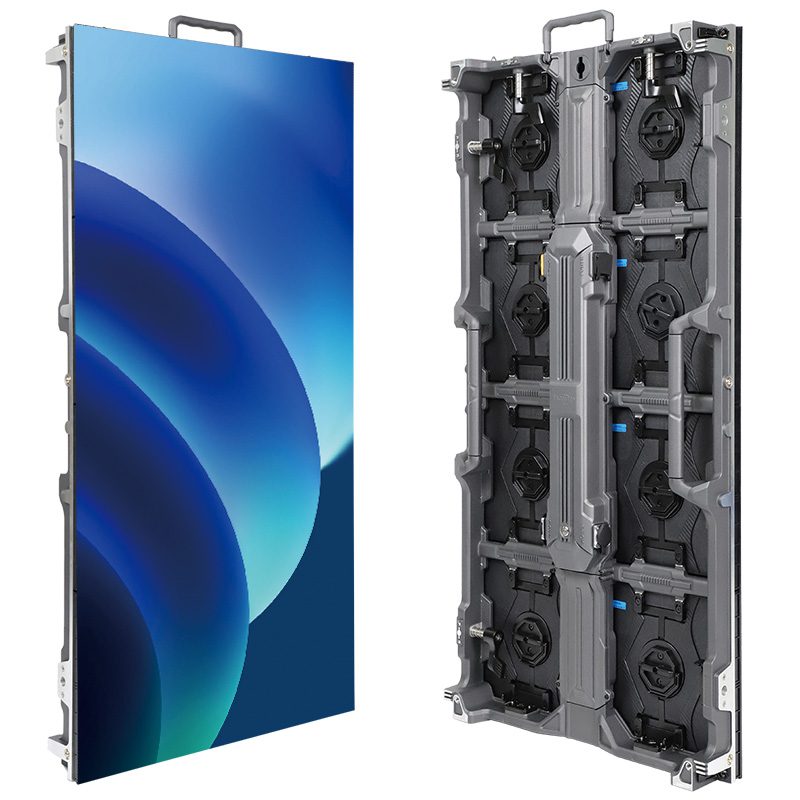
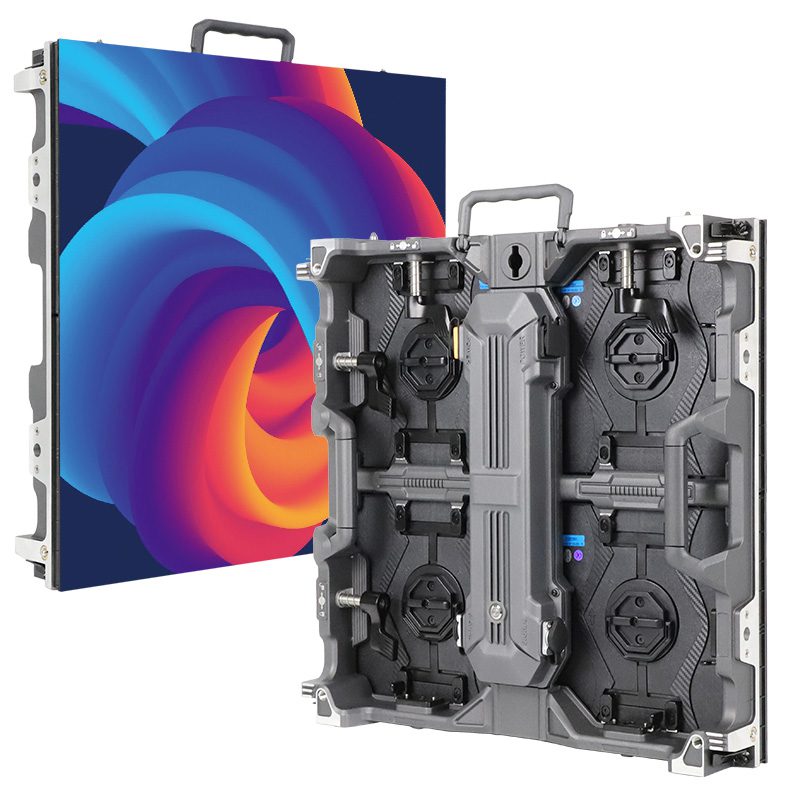
An LED display screen manufacturer is not only a cabinet supplier. A complete delivery also includes SMD or COB LED modules, driver ICs, receiving cards, power supplies, interface boards, frames, a sending card or video processor, and the calibration data that makes the wall read as one screen.
Ask which of those items are made in-house and which are bought in. Manufacturers that control module assembly, driver placement and ageing tests usually deliver more consistent colour than assemblers that buy finished modules and build cabinets around them.
02 What Cost-Effective Means After Year One
Cost-effective does not mean cheap. It means the lowest total spend across the screen’s service life. Three cost lines dominate after the installation invoice is paid: electricity, maintenance and replacement parts. A screen that draws 15% less power per square metre and holds brightness for longer will usually beat a cheaper screen over a five-year horizon, even before downtime is counted.
That is why this guide evaluates LED display screen manufacturers on verifiable data – datasheets, test reports, spare-parts commitments – rather than on marketing claims about high quality or premium components.
2.How to Compare LED Display Screen Manufacturers: 8 Criteria
Most buyers compare LED display screen manufacturers on pixel pitch and price per square metre. Neither explains why two screens with identical specifications look different after twelve months. The eight criteria below separate a genuine factory from an assembly shop, and each can be verified from documents rather than promises.
| # | Criterion | What a serious LED display screen manufacturer provides | Warning sign |
|---|---|---|---|
| 1 | LED binning and wavelength control | Binning report per batch, single-bin supply across the whole order, wavelength and luminance ranges stated in nm and mcd | “Same model” quotes with no binning detail, or mixed bins used to hit a price |
| 2 | Driver IC and refresh rate | Named driver IC, refresh rate at or above 1,920 Hz for indoor work and 3,840 Hz for camera or broadcast use | Refresh rate listed as “high” with no figure, or measured at 480-960 Hz |
| 3 | Power supply and power factor | Branded PSU with power factor above 0.95, stated max and average power per square metre | Unbranded PSU, no consumption figures, no derating guidance for hot climates |
| 4 | Cabinet and module build | Die-cast aluminium or reinforced steel, flatness tolerance in mm, IP rating with the test standard named | IP65 claimed without a test report, or flatness tolerance left undefined |
| 5 | Factory calibration | Brightness and chroma calibration per cabinet, calibration file supplied for field re-calibration | “Calibration done on site” as an extra-cost line item |
| 6 | Certification package | CE, RoHS, FCC and UL/ETL where required, plus IEC 62471 photobiological safety | Certificates in a different company name, or expired test dates |
| 7 | Spare parts and warranty | Written spares commitment for 5-7 years, 2-5 year warranty with response times | Warranty described only as “free repair” with no logistics or timeline |
| 8 | Engineering support | Structural drawings, power and data schematics, processor configuration files, training | Documentation produced only after the balance payment |
Use it as a scoring sheet: weight criteria 1, 5 and 7 for permanent installations, and 2 and 4 for screens that will be filmed, rented out or mounted in windy locations.
01 Technical Criteria You Can Verify From a Datasheet
Pixel pitch is the distance between LED centres and it sets both resolution and price; our LED display size guide covers the sizing maths for wall dimensions. Indoor fixed installations typically run P1.25 to P4, outdoor advertising P4 to P10, and rental cabinets P2.6 to P3.9. Brightness should be matched to ambient light rather than maximised: 800-1,500 nits indoors, 5,000-8,000 nits for outdoor daylight, with automatic brightness control to avoid glare complaints at night.
Confirm grey scale of 14-16 bit, a contrast ratio with its measurement method, a horizontal viewing angle of at least 140 degrees, and a refresh rate high enough to avoid camera scan lines. For screens that will be filmed or used in virtual production, treat refresh rate as a primary specification.
02 Commercial Criteria That Decide Lifetime Cost
On the commercial side, ask for a written spares commitment, the nearest technical partner and the response time for a dead module. A three-year warranty that means shipping a cabinet back to Asia is not the same product as one with regional stock.
Finally, check the production schedule: 20-35 days for standard cabinets and 45-60 days for custom shapes are normal, so a four-week promise in peak season needs explaining. Comparing LED display screen manufacturers on documents rather than impressions is the most reliable way to avoid both traps.
3.Top 10 LED Display Screen Manufacturers Compared
No single manufacturer wins every project. The table summarises where each company is strongest and the notes explain the trade-offs; use both to build a shortlist, then apply the eight criteria from section 2 to the two or three LED display screen manufacturers that survive.
| # | LED display screen manufacturer | HQ | Founded | Strongest at | Typical best fit |
|---|---|---|---|---|---|
| 1 | Samsung Electronics | South Korea | 1969 | MicroLED and premium direct-view LED, integrated signage ecosystems | Flagship retail, lobbies, corporate experience centres |
| 2 | Leyard | China | 1995 | Small-pitch LED and large video walls, control-room grade | Control rooms, command centres, corporate video walls |
| 3 | LG Electronics | South Korea | 1958 | LED signage and fine-pitch displays with strong CMS integration | Retail chains, transport hubs, brand showrooms |
| 4 | Daktronics | USA | 1968 | Outdoor and sports displays engineered for weather extremes | Stadiums, arenas, roadside billboards, US public projects |
| 5 | Unilumin | China | 2004 | High-volume fine-pitch and rental production at competitive cost | Large indoor walls, rental fleets, hybrid fixed-rental |
| 6 | EagerLED | China | 2009 | Direct-from-factory indoor, outdoor and rental screens with custom sizing | Dealers, integrators and end users buying value-first |
| 7 | Absen | China | 2001 | Rental, creative and curved cabinets, fast on-site build | Events, touring, broadcast studios, creative shapes |
| 8 | Liantronics | China | 2003 | Fine-pitch video walls with modular upgrade paths | Meeting rooms, retail, mid-size control rooms |
| 9 | ROE Visual | China | 2006 | Rental and XR stage LED with high frame-rate handling | Virtual production, concerts, film and TV stages |
| 10 | AOTO Electronics | China | 1993 | Fine-pitch LED, digital billboards and advanced packaging research | Outdoor digital out-of-home, premium indoor walls |
Pricing must still be confirmed project by project: cabinet size, pixel pitch, brightness and certification move a quote far more than brand does.
01 Samsung Electronics (South Korea)
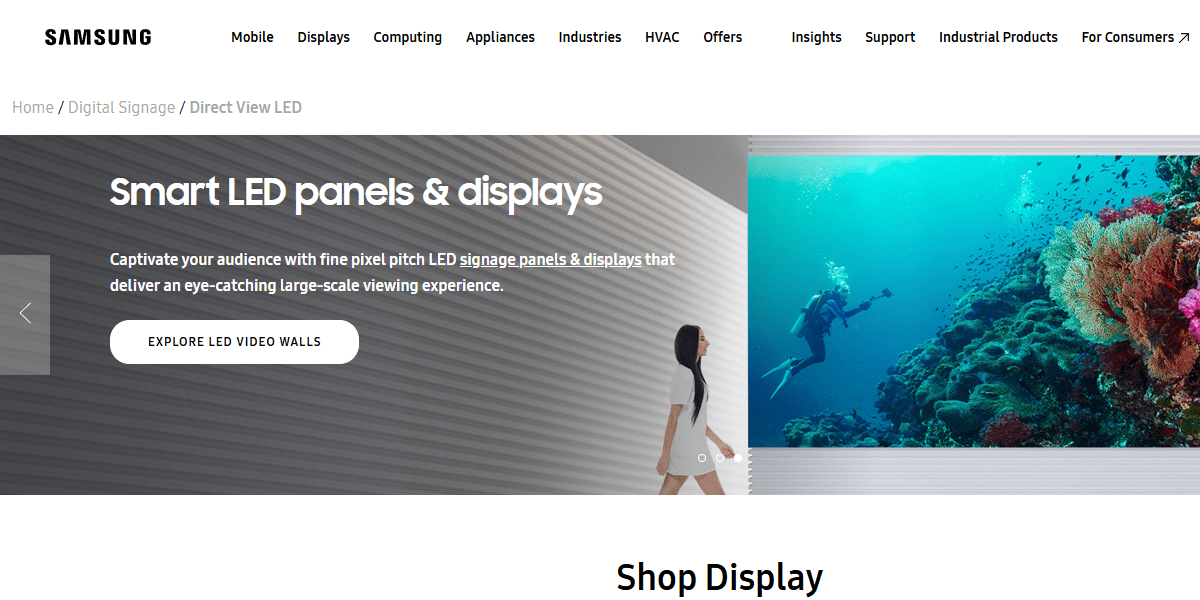
Samsung sells direct-view LED as a managed ecosystem – panels, processors and content management under one support contract. It suits brand-standard, high-visibility installations where premium uniformity matters more than price per square metre.
02 Leyard (China)
Leyard is known for small-pitch LED and very large video walls, including control rooms running 24/7. Buyers shortlist Leyard when uniformity across a very wide wall outweighs a lower imported price.
03 LG Electronics (South Korea)
LG pairs fine-pitch LED signage with the same CMS used across its commercial display range, which suits chains that configure and monitor hundreds of screens centrally.
04 Daktronics (USA)
Daktronics engineers outdoor and sports displays for wind load, weather and sunlight, with US-based service. For stadiums and roadway billboards, local support often beats a lower imported price.
05 Unilumin (China)
Unilumin combines very large production volume with fine-pitch and rental ranges, giving consistent module supply and short lead times for tenders and touring fleets.
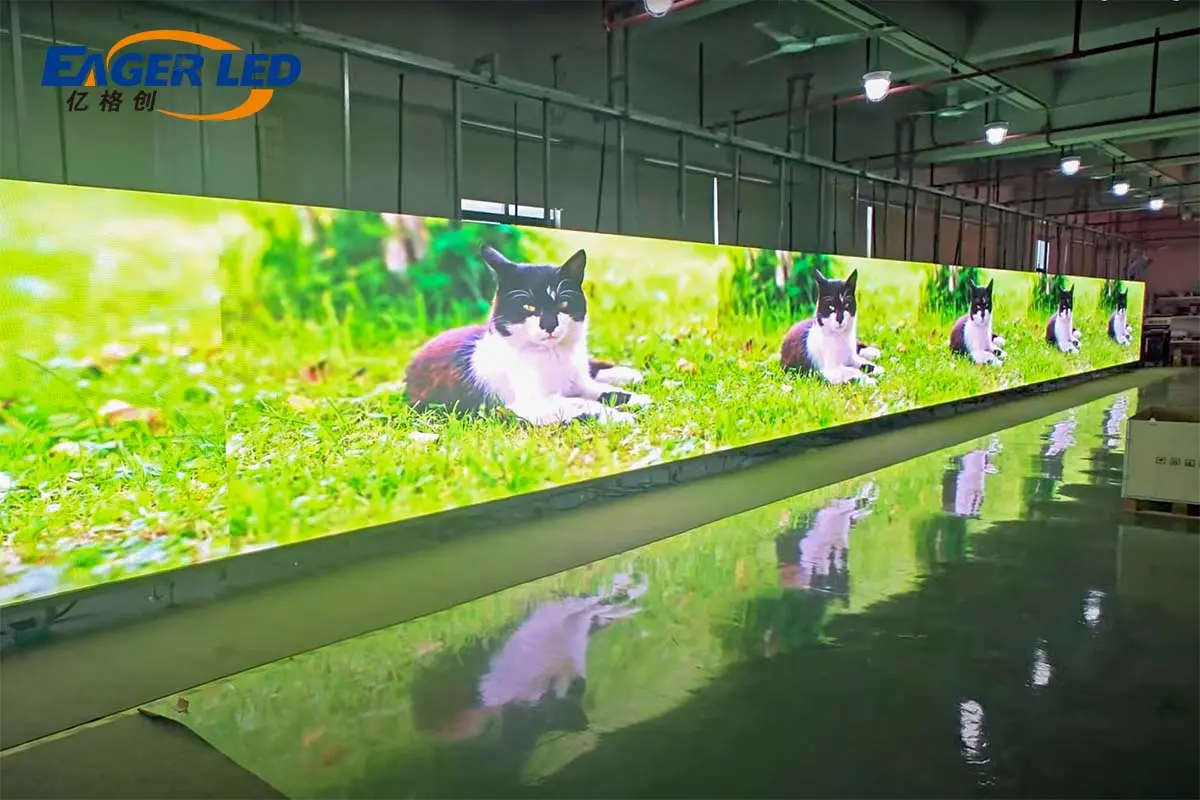
06 EagerLED (China)
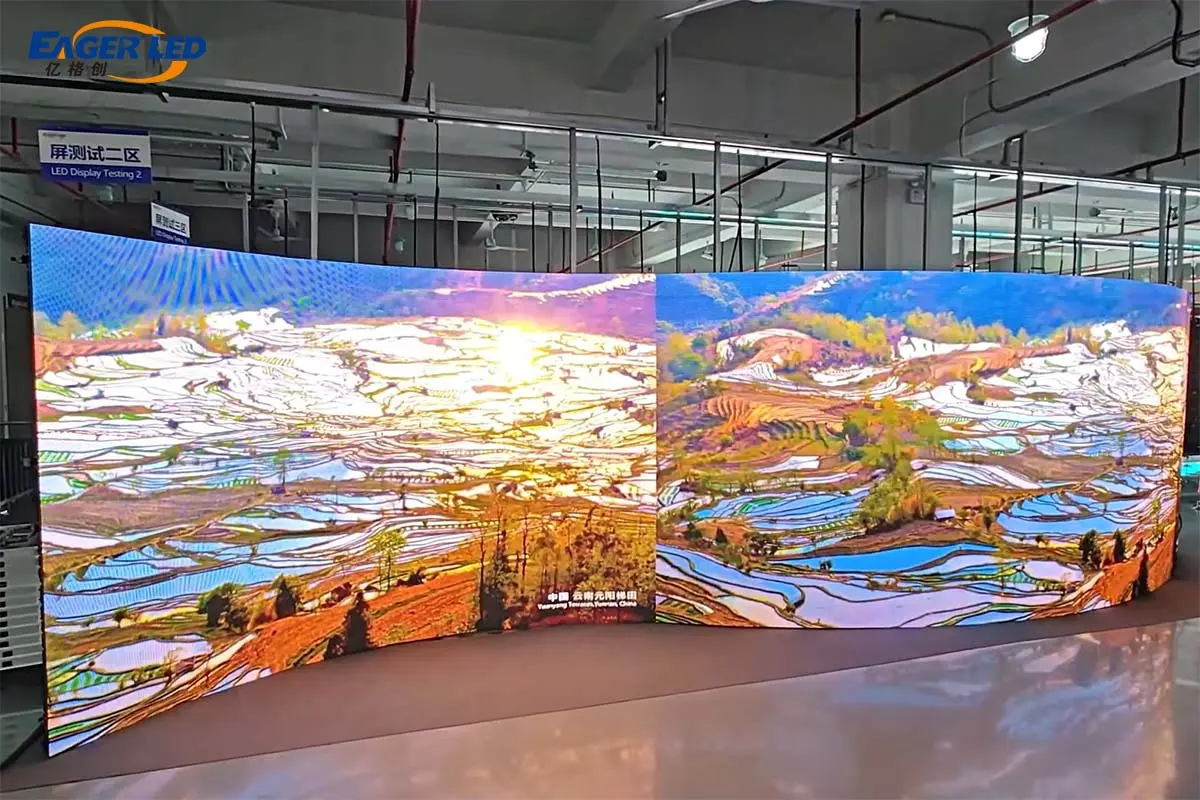
EagerLED builds indoor, outdoor, rental and custom-shaped displays in its own Shenzhen factory and sells direct, removing distributor margin. Dealers and integrators get factory pricing, engineering input at quotation stage and cabinets sized to the real installation.
07 Absen (China)
Absen’s rental and creative cabinets are engineered for fast builds, curved configurations and repeated transport – the setup time that dominates event economics.
08 Liantronics (China)
Liantronics focuses on fine-pitch video walls with modular architecture, so a wall can start small and grow later without replacing the original cabinets.
09 ROE Visual (China)
ROE Visual supplies rental and XR stage LED where refresh rate and colour consistency under camera matter more than fixed-signage economics.
10 AOTO Electronics (China)
AOTO works across fine-pitch indoor displays, outdoor digital billboards and advanced packaging research, with a long record in digital out-of-home.
4.LED Display Screen Manufacturers by Application
The same pixel pitch can be right for one project and wrong for the next. Matching the application first stops you over-specifying an indoor wall or under-specifying an outdoor one, and makes quotes from different LED display screen manufacturers comparable.
| Application | Typical pixel pitch | Brightness | Cabinet type | Specification to verify first |
|---|---|---|---|---|
| Retail, reception and showroom | P1.5 – P2.5 | 800 – 1,200 nits | Fixed indoor, die-cast or steel | Uniformity and colour calibration across every cabinet |
| Boardroom and control room | P0.9 – P1.8 | 600 – 1,000 nits | Fine-pitch fixed, front service | Refresh rate for cameras and 24/7 duty rating |
| Outdoor advertising billboard | P6 – P10 | 5,000 – 8,000 nits | Outdoor sealed cabinet | IP rating with test standard, wind-load drawings |
| Rental, stage and touring | P2.6 – P3.9 | 3,500 – 5,500 nits | Lightweight die-cast rental | Cabinets per hour build time and flight-case packing density |
| Stadium and perimeter | P6 – P10 | 5,500 – 8,000 nits | High-bright outdoor, angled modules | Power factor, heat management and glare control |
| Transparent and creative shapes | P3.9 – P10 | 2,000 – 5,000 nits | Transparent or custom frame | Transparency percentage and structural fixing design |
Two rules of thumb are worth remembering. First, choose the largest pixel pitch that satisfies your closest realistic viewing distance – every step down in pitch raises cost per square metre sharply. Second, never accept an outdoor brightness figure without the associated power consumption, because a screen that wins the specification on nits can lose the budget on running costs.
01 Matching Pixel Pitch to Viewing Distance
As a starting point, divide the closest expected viewing distance in metres by 1,000 to estimate a comfortable pixel pitch in millimetres for detailed content, then relax it one step if viewers will mostly see video. A screen viewed from six metres is well served by P6 for video, but P2.5 or finer for small text.
02 When Rental Cabinets Are the Cheaper Choice
Rental cabinets cost more per square metre than fixed cabinets, yet often win on total cost where spaces are reconfigured, hired out or moved between venues. Fast build times, flight-case logistics and lightweight aluminium cut labour at every deployment.
5.Total Cost of Ownership With LED Display Screen Manufacturers
Purchase price is the easiest number to compare and the least useful on its own. The model below shows how a five-year budget typically distributes across an LED installation; treat the percentages as planning ranges, since freight, structure and duty vary by region.
| Cost line | Planning share of 5-year spend | What to verify with the manufacturer |
|---|---|---|
| Cabinets, modules and LED components | 35 – 45% | Binning, cabinet flatness, spare module price |
| Control system and video processing | 5 – 8% | Processor headroom, redundant sending path, licence terms |
| Steelwork, installation and rigging | 10 – 20% | Structural drawings, service access, engineer certifications |
| Freight, duty and insurance | 5 – 12% | Incoterm, crate dimensions, landed-cost calculation |
| Commissioning, spares kit and training | 3 – 6% | Spare module count, calibration file, remote support hours |
| Electricity over five years | 8 – 15% | Average power per square metre, annual duty-cycle assumption |
| Maintenance and part replacement | 5 – 10% | Failure rate history, regional parts stock, response time |
Run the model with your own tariff and duty cycle: a screen running 18 hours a day at 5,000 nits separates competing LED display screen manufacturers far more than one running six hours at 1,000 nits, because energy and brightness decay compound.
01 Cost Lines That Disappear From a Quotation
Watch for spares kits, calibration files, processor licences, structural drawings, commissioning days and warranty freight. Each is small in isolation; together they can add 8-15% to real project cost, so ask every LED display screen manufacturer on your shortlist to itemise them.
02 How to Normalise Quotes From Different LED Display Screen Manufacturers
Rebuild each quotation into one spreadsheet with identical line items: cabinets, control system, structure, install, freight, duty, commissioning, spares, warranty and energy estimate. Convert power to average watts per square metre and brightness to nits with the calibration condition stated.
6.Certifications, Testing and Warranty to Request
Compliance paperwork is where inexpensive quotations quietly diverge from professional ones. For most commercial installations you should expect CE marking with an EU declaration of conformity, RoHS material compliance, and FCC or equivalent EMC evidence for markets that require it. In North America, UL or ETL listing is frequently demanded by inspectors and insurers, and IEC 62471 photobiological safety matters wherever people stand close to a very bright screen.
Beyond certificates, ask how the manufacturer tests what it ships. Serious factories age or burn in assembled modules, measure brightness and chromaticity per cabinet, and supply the calibration data. Reputable LED display screen manufacturers state a field failure rate rather than claiming failures never happen.
01 Warranty Terms Worth Negotiating
Two to five years is the normal band, with outdoor and rental products often at the lower end. Negotiate three things: who pays freight on warranty parts, how quickly replacements ship, and whether on-site labour is covered. A warranty that covers parts but leaves you paying for a lift and an engineer is only half a warranty.
02 Documentation That Reduces Installation Risk
Before cabinets ship, request dimension and weight drawings, load calculations for the mounting structure, power and data schematics, processor configuration files, and a spare-parts list with part numbers. These let local contractors work in parallel with production instead of waiting for delivery, which saves more time than a discounted lead time.
7.How to Vet LED Display Screen Manufacturers: A 7-Step RFQ Process
The process below is the shortest reliable route from an idea to a purchase order. It is designed to be run in parallel with several suppliers so that you are comparing documents rather than impressions.
| Step | Action | Document or answer to request |
|---|---|---|
| 1 | Define the project before contacting factories | Viewing distance, screen size, indoor or outdoor, mounting type, content type, daily duty cycle |
| 2 | Request a budget quotation from 3-5 manufacturers | Price per square metre with pixel pitch, brightness and cabinet type stated |
| 3 | Ask for the technical package | Datasheet, binning report, power consumption, refresh rate, IP test reference |
| 4 | Verify the compliance file | CE, RoHS, FCC, UL or ETL and IEC 62471 reports in the manufacturer’s own legal name |
| 5 | Confirm production and service commitments | Lead time, spares holding period, regional service partner, warranty freight responsibility |
| 6 | Test before full shipment | Ageing test report, photos of the assembled wall, optional third-party inspection |
| 7 | Lock the contract details | Incoterm, payment milestones, calibration files, spare parts list, training scope |
One caution at step three: request documents from the legal entity that will issue the invoice. Buyers are regularly shown certificates belonging to a trading company or a partner factory, which leaves the warranty unenforceable later.
8.Where LED Display Screen Manufacturers Are Located
LED production is concentrated in a handful of regions, and each brings a different balance of price, lead time, engineering depth and service reach.
01 China: The Volume and Component Hub
Shenzhen and the surrounding Pearl River Delta host the deepest concentration of LED display screen manufacturers in the world, together with most module, driver and packaging suppliers. Buyers gain component choice, custom cabinet sizes, competitive tooling costs and short prototyping cycles. The main risks are supplier variance and the effort required to verify quality, which is exactly what the RFQ process above addresses.
02 South Korea, the United States and Europe
See also our round-up of LED display manufacturers in China and LED screen suppliers in the USA. Korean manufacturers compete on premium display technologies and integrated signage platforms. US manufacturers dominate sports and outdoor infrastructure where local engineering, service trucks and procurement rules favour domestic supply. European producers concentrate on project engineering, certifications and short delivery within the region. For many projects the optimum structure combines engineering and service locally with volume manufacturing in Asia – which is why integrators often specify cabinets from one manufacturer and control systems from another.
9.Why EagerLED Is a Cost-Effective LED Display Screen Manufacturer
EagerLED manufactures indoor, outdoor, rental and custom-shaped LED displays in Shenzhen and sells directly from the factory, which removes distributor margin from the price you pay. For dealers, integrators and end users who have already shortlisted two or three LED display screen manufacturers on specification, that direct model changes the commercial picture: custom cabinet sizes, factory-level engineering support at quotation stage and spare parts supplied from the same production line that built the screen.
The practical advantages buyers mention most often are straightforward. Cabinets are built to the project rather than chosen from a fixed catalogue, so odd wall dimensions do not force a compromise layout. Technical questions reach the engineers who configure the production run. And because the screen is not passing through two layers of resellers, the budget stretches further across modules, power supplies and control hardware – the components that determine how the display performs in year three rather than on installation day.
For buyers who want to compare configuration options against real project requirements, the fastest route is to send a screen size, viewing distance and installation type and ask for a specification proposal with pixel pitch options and a landed-cost breakdown. That single document makes EagerLED directly comparable with the other LED display screen manufacturers on your shortlist.
Installation and configuration support continues after delivery. EagerLED provides wiring documentation, processor settings and remote guidance while the wall is commissioned, which matters most to buyers installing their first large-format display or switching from a different control system.
If your priority is the lowest total cost across five years rather than the lowest invoice today, treat the direct-factory model as a specification advantage: it lets you spend the same budget on better LED bins, a stronger power supply or a larger spare-parts kit instead of on distribution margin.
10.FAQs About LED Display Screen Manufacturers
These are the questions buyers ask most when comparing LED display screen manufacturers, written so you can reuse the answers in internal approvals or tender documents.
01 What does an LED display screen manufacturer actually supply?
A complete delivery covers LED modules, driver ICs, receiving cards, power supplies, cabinets or frames, a sending card or video processor, cabling, calibration files and installation documentation. Ask which items are made in-house: factories that assemble their own modules and control binning deliver more consistent colour than those buying finished modules.
02 How do I compare LED display screen manufacturers fairly?
Rebuild every quotation into the same line items: cabinets, control system, structure, installation, freight, duty, commissioning, spares, warranty freight and energy estimate. Then compare components rather than the headline price – LED bin, driver IC, power supply brand, cabinet material and calibration method. Two screens at the same pixel pitch can differ by 30-40% because of these choices.
03 Are Chinese LED display screen manufacturers reliable?
Established Chinese factories supply a large share of the world market and are routinely specified for control rooms, stadiums and touring fleets. Reliability depends far less on the country than on the supplier’s binning discipline, ageing tests and spare-parts policy. Verify documents, request a pre-shipment test report, and confirm the invoice comes from the same legal entity that holds the certificates.
04 Which pixel pitch should I specify for my project?
Start from the closest realistic viewing distance. Indoor retail and reception areas usually need P1.5 to P2.5, boardrooms and control rooms P0.9 to P1.8, outdoor advertising P6 to P10, and rental stages P2.6 to P3.9. Most LED display screen manufacturers publish a viewing-distance table you can check against your own.
05 Which certifications matter most when choosing LED display screen manufacturers?
CE with a declaration of conformity, RoHS and FCC or equivalent EMC evidence cover most commercial requirements. Add UL or ETL listing for North America and IEC 62471 photobiological safety where the public can stand close to the screen. Request reports in the manufacturer’s own legal name and check the test dates.
06 How long does an LED display last?
Well-built LED modules are typically rated for around 100,000 hours to roughly half of original brightness. In practice, lifetime is governed by driver quality, thermal management and power supply stability, so a screen run at reduced brightness in a ventilated cabinet holds its appearance far longer.
07 What warranty should I expect from LED display screen manufacturers?
Two to five years is the market norm, with outdoor and rental products often at the shorter end. Negotiate the details that cost money: who pays freight on warranty parts, how fast replacements ship, how long spare modules stay available, and whether on-site labour is included.
08 How long does production and delivery take?
Standard cabinets usually ship in 20-35 days; custom shapes, unusual pixel pitches or large stadium projects can take 45-60 days. Add transit, customs clearance and a commissioning allowance, and ask for the production slot in writing rather than a verbal estimate.
11.Conclusion: Choosing Between LED Display Screen Manufacturers
Choosing between LED display screen manufacturers is a documentation exercise before it is a price negotiation. The manufacturers that protect your budget are the ones that can show binning control, per-cabinet calibration, current certification, a written spares commitment and a service route in your region. Once those five are satisfied, price differences finally mean something.
Start with the application table to fix pixel pitch and brightness, screen your shortlist against the eight criteria, rebuild every quotation into the same total-cost structure, and run the RFQ process before paying a deposit. That prevents the two expensive procurement mistakes: buying more resolution than the viewing distance needs, and buying a screen nobody can service in year two. LED display screen manufacturers that document their process are the ones worth a long-term partnership.
If you would like a like-for-like proposal from a manufacturer that builds to your wall dimensions rather than a catalogue page, send your screen size, viewing distance and installation type for a specification and landed-cost comparison.
 Giant Screen vs IMAX: Which Is Right for Your Theater?
 The Biggest LED Screen in the World: 12 Landmark LED Displays by Country