

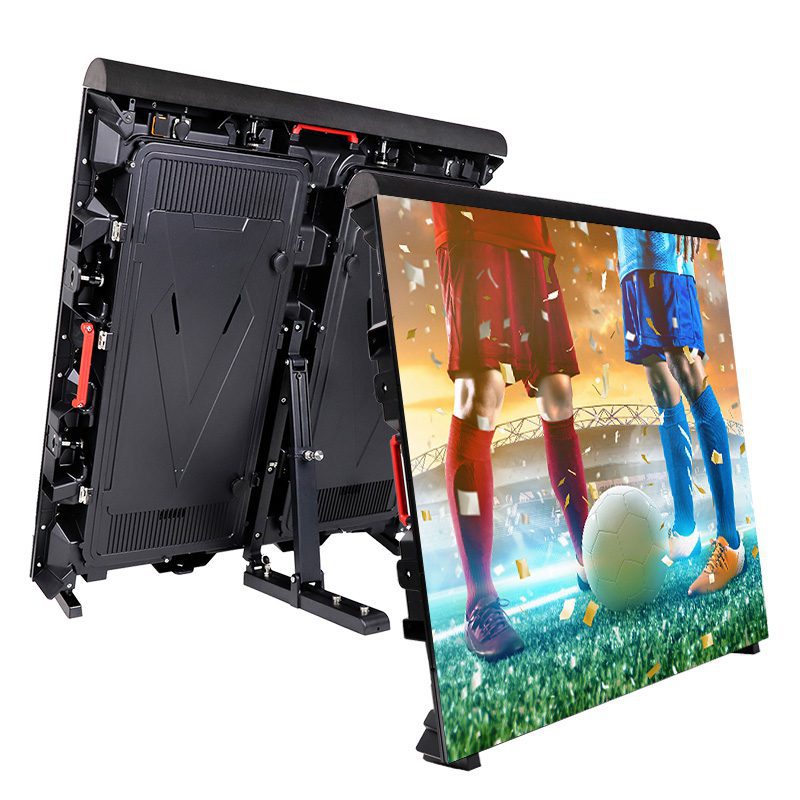
Stadium LED screens include cabinet-based displays for sports advertising and venue content. Use this page to compare the listed stadium and perimeter products, including cabinet format, service access and field-facing protection. The EA960SP4 description identifies a soft mask, rubber edge protection and an adjustable support; confirm the exact configuration for your order.
- Choose perimeter products by cabinet layout and field-facing protection.
- Send the perimeter length, display height, camera positions and service route.
- Agree control equipment, supports, spares and local installation scope before comparing quotes.
On this page
Stadium Perimeter LED Screen Product Checks
Define the perimeter run before selecting the cabinet. Provide its length, display height, straight or angled sections, the closest viewer and the camera positions. Cabinet count, pitch, support hardware and the final pixel map must match that layout.
- Field-facing construction: compare the specified soft mask, top-edge protection and support arrangement for the selected model.
- Maintenance: confirm front or rear access, the route for technicians and how a failed module can be replaced during the operating schedule.
- Environment: check the stated front and rear protection separately, together with cable routing and the venue installation conditions.
- Order scope: identify cabinets, control equipment, supports, cables, packing and spare parts; confirm local structural review and installation responsibilities.
When should I use the sports-system planning page?
Use the sports LED display system guide when the project also includes main video screens, score-data interfaces or several coordinated display positions. For product selection, send the perimeter drawing, viewing distance, camera requirements, destination and date through our stadium screen quotation enquiry.
Categories
2026 New LED Screen Price for You
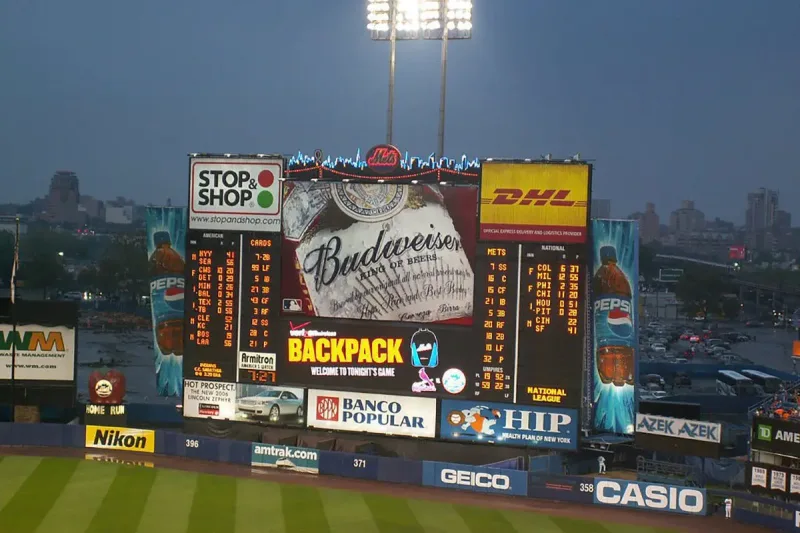
A stadium LED screen is a modular, high-brightness display system built for live sport, scoring, replay, sponsor content and venue messaging. The right system is selected from the viewing distance, camera workflow, ambient light, weather exposure, impact risk, structure and service access. Perimeter boards need player-facing protection and stable supports; scoreboards and large video walls need engineered mounting, redundant signal paths and a control plan that keeps essential information visible during an event.
Table of Contents
1. What Is a Stadium LED Screen?
A stadium LED screen combines LED modules, cabinets, power supplies, receiving cards, video processing and venue control into one scalable display. It can show live video, timing, scores, player data, sponsor rotations, wayfinding and safety messages. Unlike a television, the cabinet system can be configured as a long pitch-side ribbon, a suspended center display, a large end-zone video wall or a fixed scoreboard.
01 A Complete Venue System
The screen is only one part of the project. A usable specification also defines finished dimensions, native pixel resolution, content sources, brightness control, mounting, power distribution, signal redundancy, service access, spare parts and operator training. Integration requirements should be agreed with the scoring, timing and broadcast teams before cabinet quantities are finalized.
02 Perimeter Screens Need Additional Protection
Pitch-side cabinets sit close to players, balls and maintenance traffic. They therefore need a stable rear support, a soft front mask, protected top edges and a viewing angle that keeps content readable from the stands. EagerLED’s EA960SP4 sports LED display uses a 960 x 960 mm cabinet, an adjustable support, a soft mask and rubber edge protection for this role.
2. Stadium LED Screen Types and Use Cases
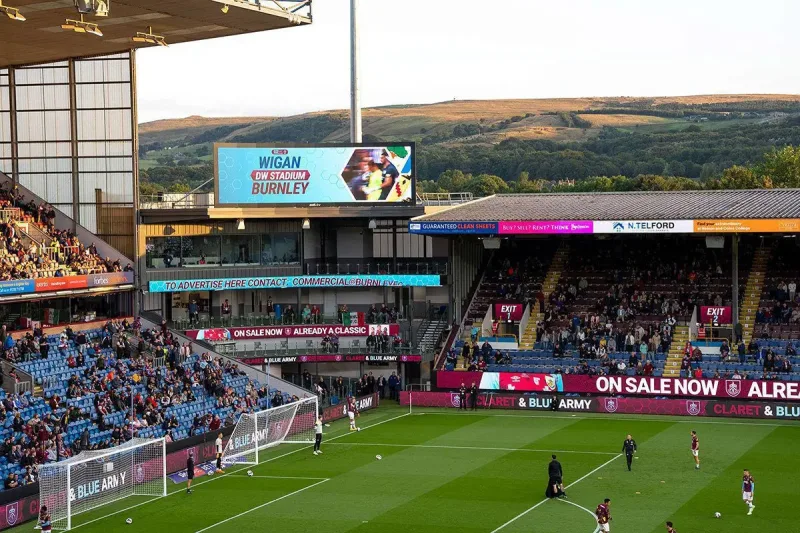
Choose the display format from its operational job. A perimeter board optimized for sponsor rotation is not a direct substitute for a replay screen, and a fixed scoreboard has different control, structure and redundancy requirements from a temporary event display.
| Display type | Typical position | Primary content | Key design priorities |
|---|---|---|---|
| Perimeter LED display | Pitch or court boundary | Sponsor campaigns, event identity, short alerts | Impact protection, stable support, wide viewing angle, quick cabinet replacement |
| Large video wall | End stand, facade or bowl | Live feed, replay, athlete introductions | Long-distance readability, structural engineering, camera-friendly refresh, redundancy |
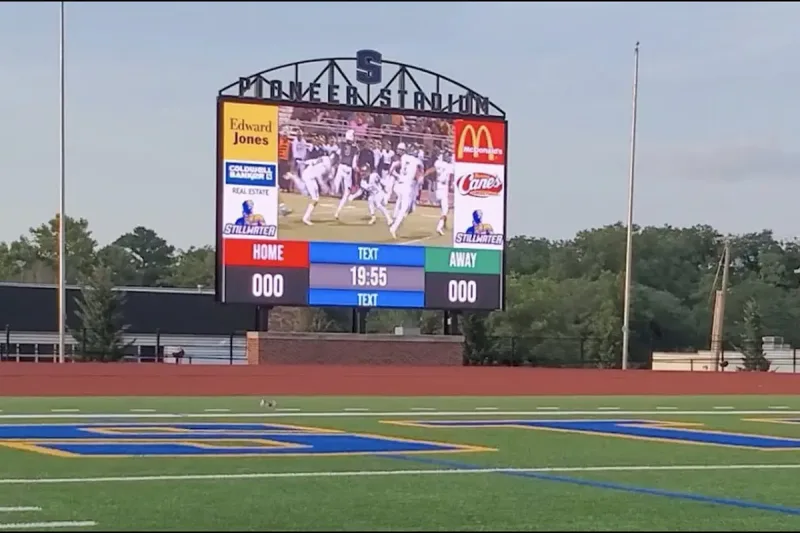
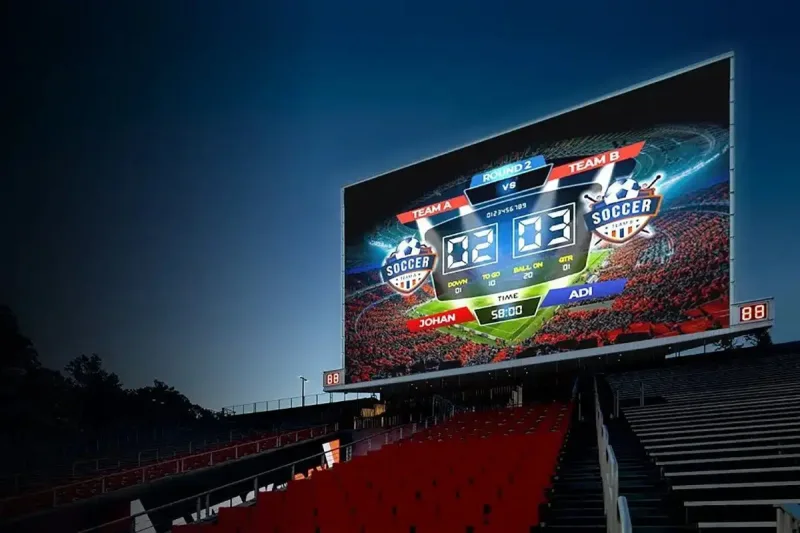
| LED scoreboard | End zone, stand or dedicated tower | Score, clock, statistics, team information | Reliable data integration, legible layout, failover and continuous operation |
| Ribbon display | Balcony or fascia | Sponsor content, prompts, venue branding | Unusual aspect ratio, content templates, sightline coordination and access |
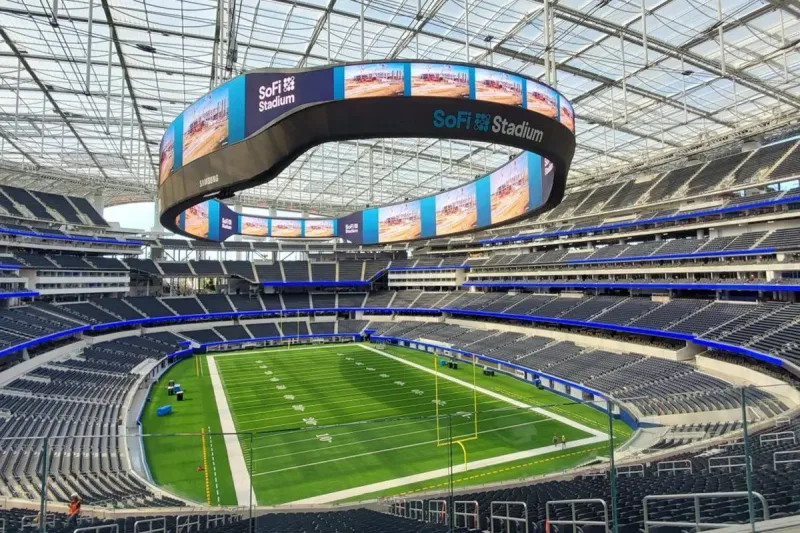
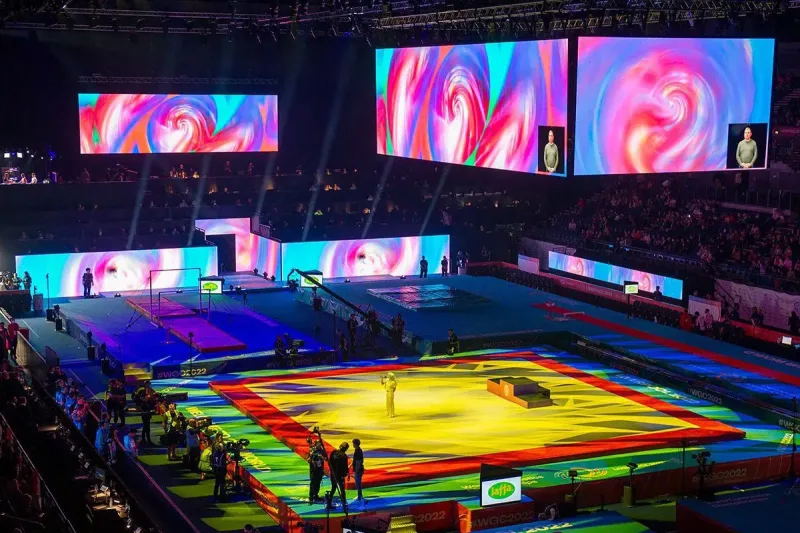
| Center-hung display | Indoor arena roof structure | Live video, replay, scoring and entertainment | Weight, rigging, multi-face alignment, heat management and safe service access |
01 Perimeter Advertising
A long, low display gives sponsors continuous visibility around the field and can switch campaigns by match segment. Content should use large type, strong contrast and a safe motion pace because spectators view it from multiple distances. For broader commercial applications, compare the advertising LED board range.
02 Replay, Score and Fan Engagement
Large-format screens can combine the program feed with score overlays, athlete profiles, social prompts and emergency messaging. A dedicated jumbotron screen guide explains the planning differences for large central or end-zone displays.
3. Core Specifications to Compare
Compare specifications as a connected system. The smallest pixel pitch is not automatically the best choice, and maximum brightness is not a complete daylight-readability plan. Finished size, viewing distance, native resolution, content, camera positions, night operation and maintenance access must be evaluated together.
01 Pixel Pitch and Viewing Distance
Pixel pitch is the center-to-center distance between adjacent pixels. A smaller pitch increases pixel density and near-view detail, but also raises LED count, processing load and cost. Calculate the native width and height for at least two pitches, then preview the actual score layout and sponsor creative from the nearest and farthest seats. Use the pixel pitch selection guide as a starting framework.
02 Brightness, Refresh Rate and Camera Capture
Brightness should be specified as an operating range, not a single maximum. Outdoor displays need daylight output and controlled night dimming. Broadcast and in-venue cameras also need a suitable refresh rate, scan configuration and shutter test. The EA960SP4 product specification lists model-dependent brightness of 5,500-6,000 cd/m2 and a refresh rate of at least 3,840 Hz; those values apply to that series and should not be generalized to every stadium display.
03 Protection, Cabinet and Service Direction
IP ratings describe enclosure protection against solids and water under defined test conditions. The IEC ingress protection guide explains the IP code framework. Confirm front and rear ratings separately, then review cable entries, ventilation, drainage, orientation and local exposure. A cabinet marked IP65 on the front may have a different rear rating.
| EA960SP4 item | Published value | Project implication |
|---|---|---|
| Pixel pitch options | P5, P6.67, P8, P10 | Compare native resolution and content legibility at the planned dimensions. |
| Cabinet size | 960 x 960 mm | Use the cabinet grid to confirm exact finished dimensions and structure. |
| Cabinet weight | 26 kg | Include cabinet quantity, support and access loads in engineering review. |
| Brightness | Up to 6,000 cd/m2 | Commission day and night brightness presets for the venue. |
| Refresh rate | At least 3,840 Hz | Test with the actual broadcast and in-house camera workflow. |
| Ingress protection | Front IP65; rear IP54 | Design rear exposure, cable entries and drainage around the stated ratings. |
| Viewing angle | 140 degrees | Coordinate cabinet angle with the seating bowl and camera sightlines. |
Specification note: values above are taken from the EA960SP4 product page and are model-specific. Confirm the current data sheet, test configuration and ordered variant before procurement.
4. How to Choose a Stadium LED Screen
Start with the venue and the content, then select hardware. This order prevents a catalog specification from driving the project before sightlines, cameras, weather, structure and operation are understood.
01 Document the Site
- Measure the available width, height, curve and structural attachment area.
- Map the nearest, median and farthest viewing positions.
- Record sunlight direction, night conditions, rain, dust, salt, heat and wind exposure.
- Identify player contact zones, public access and restricted service areas.
- Confirm front, rear or dual-side maintenance access.
02 Define Content and Control
List the score-data source, program feed, replay workflow, sponsor schedule, emergency-message process, source resolution, frame rate and daily operating hours. Review the proposed LED control system with the scoreboard, broadcast and IT teams so interfaces and responsibilities are clear.
03 Request an Itemized Quotation
Ask each supplier to quote the same finished size and scope: cabinets, modules, controller, processors, receiving cards, power distribution, signal cabling, mounting structure, spare modules, spare power supplies, packing, freight, commissioning and training. This makes price comparisons meaningful and exposes missing items before installation.
5. Installation, Integration and Safety
Installation is a coordinated engineering task. The screen supplier can provide cabinet drawings and system loads, while qualified local professionals must verify structure, rigging, electrical work, permits, egress and venue safety requirements.
01 Position and Sightlines
FIFA’s Football Stadiums Guidelines on pitch dimensions and surrounding areas specifically note that LED-board height should be considered when selecting the distance from the field of play. Use the applicable sport, league and venue rules for the final position; the guidance does not replace local approval.
02 Structure, Power and Signal
Provide cabinet weight, wind area, support reactions and service loads to the structural engineer. The electrical design should cover site voltage, maximum and typical power, protection, grounding, surge protection, isolation, heat dissipation and safe cable routes. Plan primary and backup signal paths where loss of score or safety messaging would disrupt the event.
03 Broadcast and Venue Coordination
Test display refresh, scan behavior, brightness, color temperature and content frame rate with the cameras that will be used. FIFA’s media and broadcasting guidance also highlights pitch-side power and data needs around perimeter boards. Coordinate these routes so photographers, broadcast crews and technicians can work without obstructing egress or maintenance access.
6. Operation and Preventive Maintenance
A stadium display needs a documented operating baseline and a repeatable inspection routine. Maintenance frequency should follow the manufacturer, local conditions and event schedule rather than a universal calendar.
01 Commission and Record the Baseline
- Save approved controller files, calibration data, brightness presets and content templates.
- Record module batches, cabinet positions, receiving-card maps and network settings.
- Photograph cable routes, distribution panels and service clearances.
- Train operators on normal startup, shutdown, failover and emergency messaging.
02 Inspect the Physical System
Check supports, locks, fasteners, masks, edge protection, seals, cable entries and drainage. Clean only with the model-approved method. Monitor fans, filters, temperatures, power supplies, receiving cards and communication alarms, then replace a failed component with the mapped spare.
03 Prepare for Event-Day Recovery
Keep labeled spare modules, power supplies, receiving cards, data cables and approved tools accessible to trained technicians. Define who can change content, who can isolate power and who decides whether a fault requires shutdown. A short, rehearsed recovery plan is more useful than an untested promise of redundancy.
7. Why Choose EagerLED?
EagerLED supplies perimeter and large-format LED display configurations for stadium projects. The useful decision is not whether one series is universally best, but whether the proposed cabinet, pitch, protection, control and service plan match the venue.
01 Project-Specific Configuration
Share venue drawings, finished dimensions, seating distances, installation photos, camera requirements, local voltage, service access, delivery country and schedule. EagerLED can then prepare a cabinet layout, native resolution, control proposal and bill of materials for review.
02 Product Evidence and Pre-Shipment Review
Ask for the current model data sheet, cabinet drawing, wiring diagram, test information, aging records, packing list, spare-parts plan and warranty scope. Review the Bahrain racecourse perimeter LED display case study as one application example, then compare it with your own environment and scope.
03 Clear Scope and Limitations
Performance values are model-dependent, and final compliance depends on the complete installed system. Structural engineering, electrical design, permits, rigging and venue safety remain subject to qualified local review. Product selection does not replace those approvals.
8. Stadium LED Screen FAQs
01 What pixel pitch is best for a stadium LED screen?
The best pitch depends on finished screen size, nearest viewing distance, content and budget. Perimeter displays commonly use a coarser pitch than close-view indoor boards. Calculate the native resolution at two or more pitches and preview the actual score and sponsor layouts before selecting.
02 How bright should an outdoor stadium LED screen be?
Brightness should match measured daylight and night conditions. The EA960SP4 is specified at up to 6,000 cd/m2, but the correct project setting is an operating range with scheduled or sensor-based dimming. Local rules, audience comfort and camera exposure must also be considered.
03 What protection does a perimeter LED display need?
Review impact protection, cabinet stability and front and rear ingress ratings separately. A soft mask and protected cabinet edge help in player-facing locations. IP ratings apply to tested enclosure conditions, so cable entries, drainage, orientation and maintenance practice still matter.
04 Can a stadium screen connect to scoring and broadcast systems?
Yes, when the interfaces are defined during design. Document the scoring-data format, timing source, program feed, replay workflow, processor inputs, output resolution, frame rate and redundancy. Test the complete chain before the first live event.
05 How is a stadium LED screen maintained?
Use a documented schedule based on the model and site. Inspect supports, protection, seals, cabling, ventilation, temperatures, power supplies and communication status. Keep mapped spare modules and control backups so technicians can restore the approved configuration.
06 What information is needed for an accurate quotation?
Provide finished width and height, seating distances, screen position, site photos, ambient light, weather exposure, camera use, content sources, local voltage, service access, delivery location and schedule. Ask for an itemized quotation with structure, control, spares, freight and commissioning clearly identified.
9. Conclusion
A stadium LED screen should be selected as a complete venue system. Match pixel pitch to viewing distance and native resolution, brightness to measured operating conditions, refresh and scan behavior to the camera workflow, protection to the real exposure, and cabinet access to the maintenance plan. Then compare itemized quotations using the same dimensions and scope. For a project-specific layout and bill of materials, contact EagerLED with your venue drawings, site photos, viewing distances, voltage and delivery schedule.
