
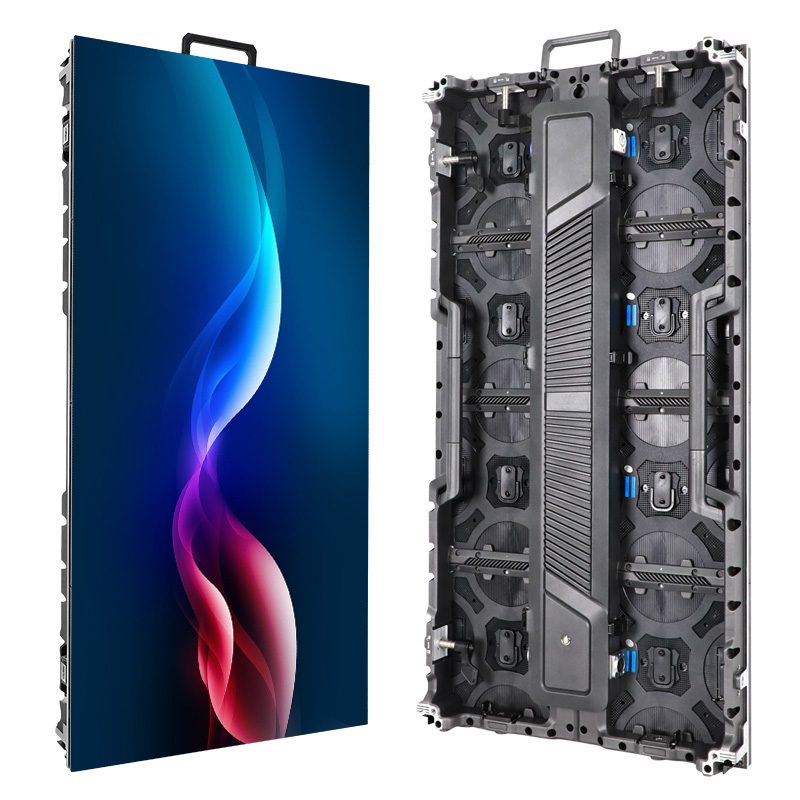
MIP technology — Micro LED in Package — is a chip packaging method that groups Micro LED and Mini LED dies into standardised, surface-mountable devices before they are built into an LED display. Instead of transferring millions of microscopic dies directly onto a board, an MIP LED display is assembled on a conventional SMT line. That one change removes the biggest bottleneck in Micro LED manufacturing: speed.
The result is a fine-pitch LED display with the visual quality buyers expect from Micro LED — deep black, wide colour gamut, high brightness — at a pitch and price that ordinary surface-mount production can actually reach. This guide covers how MIP technology works, how it compares with COB, SMD and GOB, what a MIP LED display costs per square meter in 2026, and how to specify one.
- MIP means Micro LED in Package. Micro or Mini LED dies are packaged into discrete devices and then mounted with standard SMT equipment.
- The core benefit is manufacturability. Placement tolerance relaxes from microns to tens of microns, and throughput rises by orders of magnitude.
- MIP sits between COB and true Micro LED. It is more capable than COB at sub-1 mm pitch, and far cheaper than direct Micro LED assembly.
- Realistic pricing in 2026: roughly USD 2,000 to 5,000 per m² for P0.9 to P1.25, and USD 6,000 to 12,000 per m² for a calibrated 8K cinema-grade wall.
- Specify by viewing distance, not by pitch. The pitch table below maps density, PPI and comfortable viewing distance.
1. What Is MIP Technology (Micro LED in Package)?
01. MIP Technology Defined
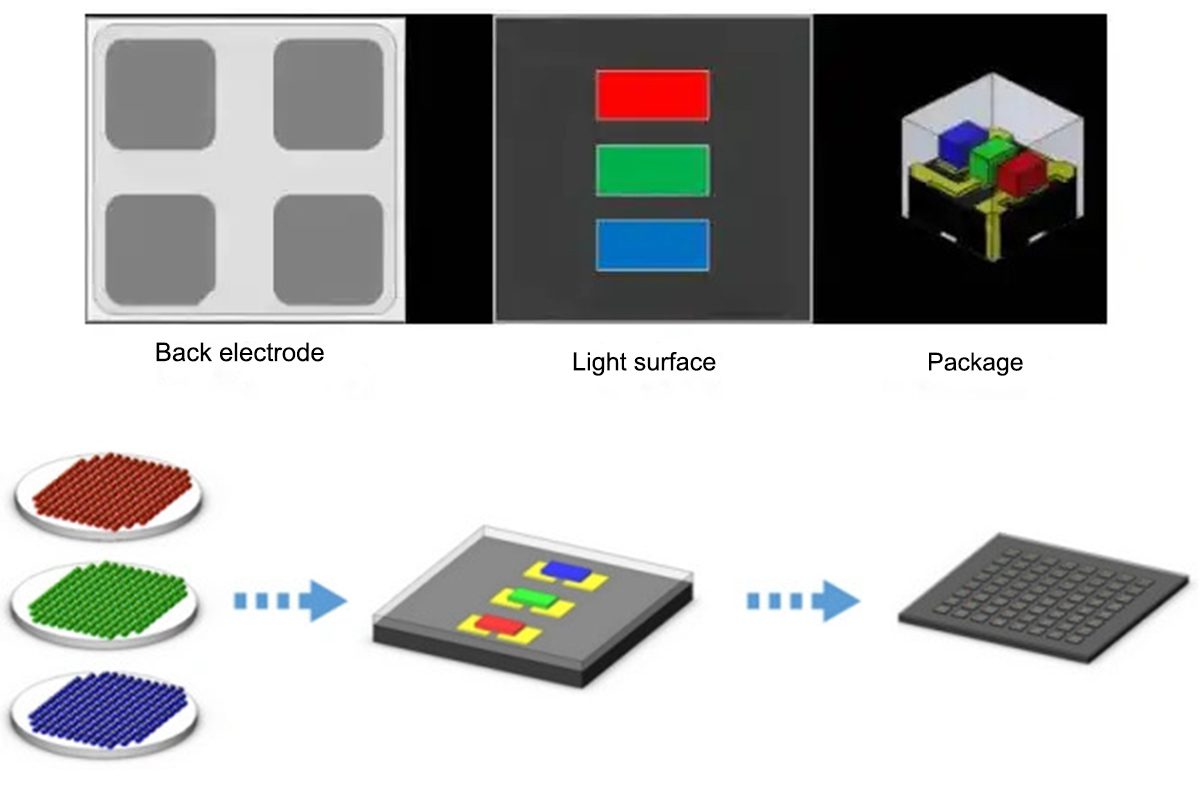
MIP technology is a packaging stage, not a display design. A supplier takes Micro LED or Mini LED dies — the raw light-emitting chips, typically tens of microns across — and packages several into one sealed, surface-mountable device that behaves like a conventional SMD component, picked and placed by equipment that has been standard for decades.
A MIP LED display is therefore an indoor LED screen built from these packaged devices rather than from raw dies. The distinction is commercial: it decides who can build the panel, how fast, and how the panel behaves when something fails.
One clarification: many products marketed as MIP use Mini LED rather than true Micro LED dies, and some suppliers describe this as “Mini and Micro LED in Package”. When comparing quotations, ask for the die size in microns rather than the label — 100 micron Mini LED dies and 30 micron Micro LED dies are different products.
02. How MIP Technology Works: The Manufacturing Route
The process separates the difficult, high-precision step from the routine, high-volume step:
- Dies are grown on a wafer and probed for wavelength and brightness.
- They are transferred onto a carrier substrate to form a dense array, which is then divided and sorted — this is where binning happens and where defective dies are removed before they can reach a finished screen.
- Dies are packaged into discrete devices, typically 2-in-1, 4-in-1 or larger multi-chip packages, then cut and individually tested.
- The devices are surface-mounted onto a PCB or glass substrate with standard SMT equipment.
- The assembled module is tested, calibrated and colour-corrected, then built into cabinets and complete MIP LED displays.
The sorting step is the commercially important one. In direct Micro LED assembly a defective die is usually found only after the display is assembled, when repair is expensive; under MIP technology the same die is screened and discarded while it is still a cheap package.
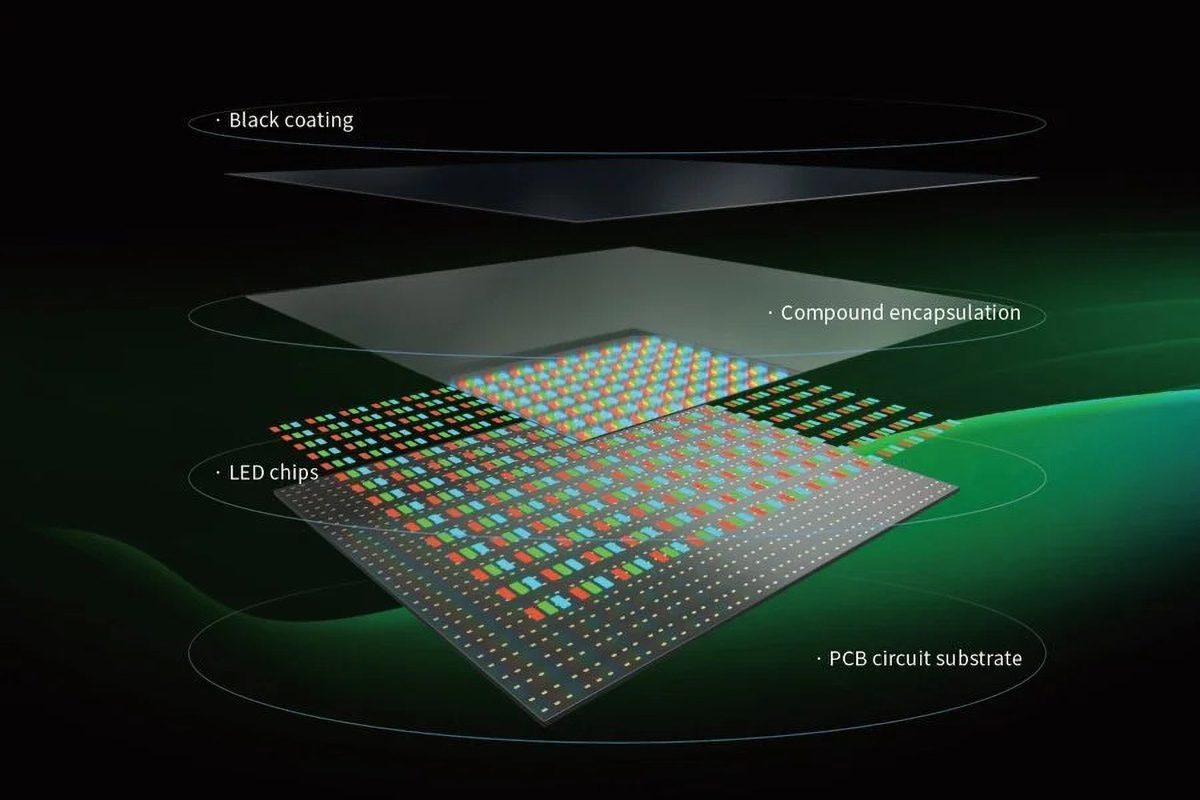
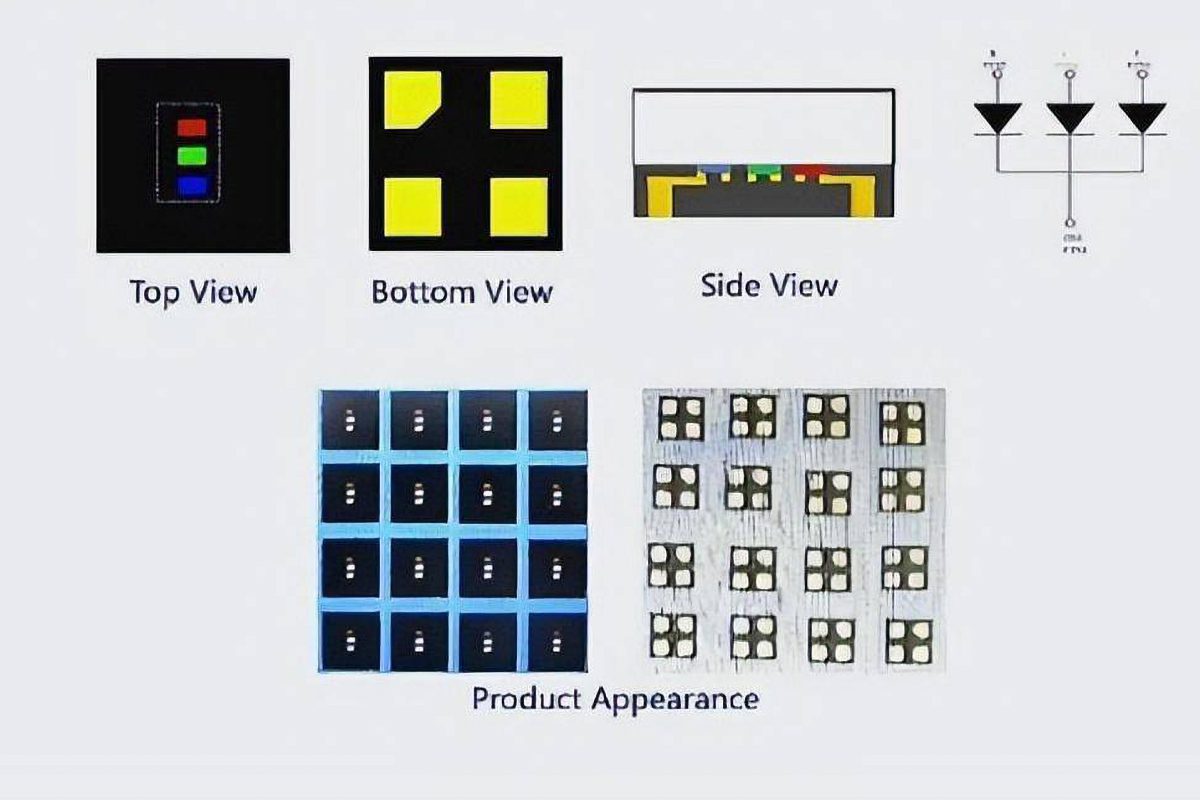
The image above shows a packaged MIP device in cross-section: LED chips, compound encapsulation, the black contrast coating and the PCB substrate.
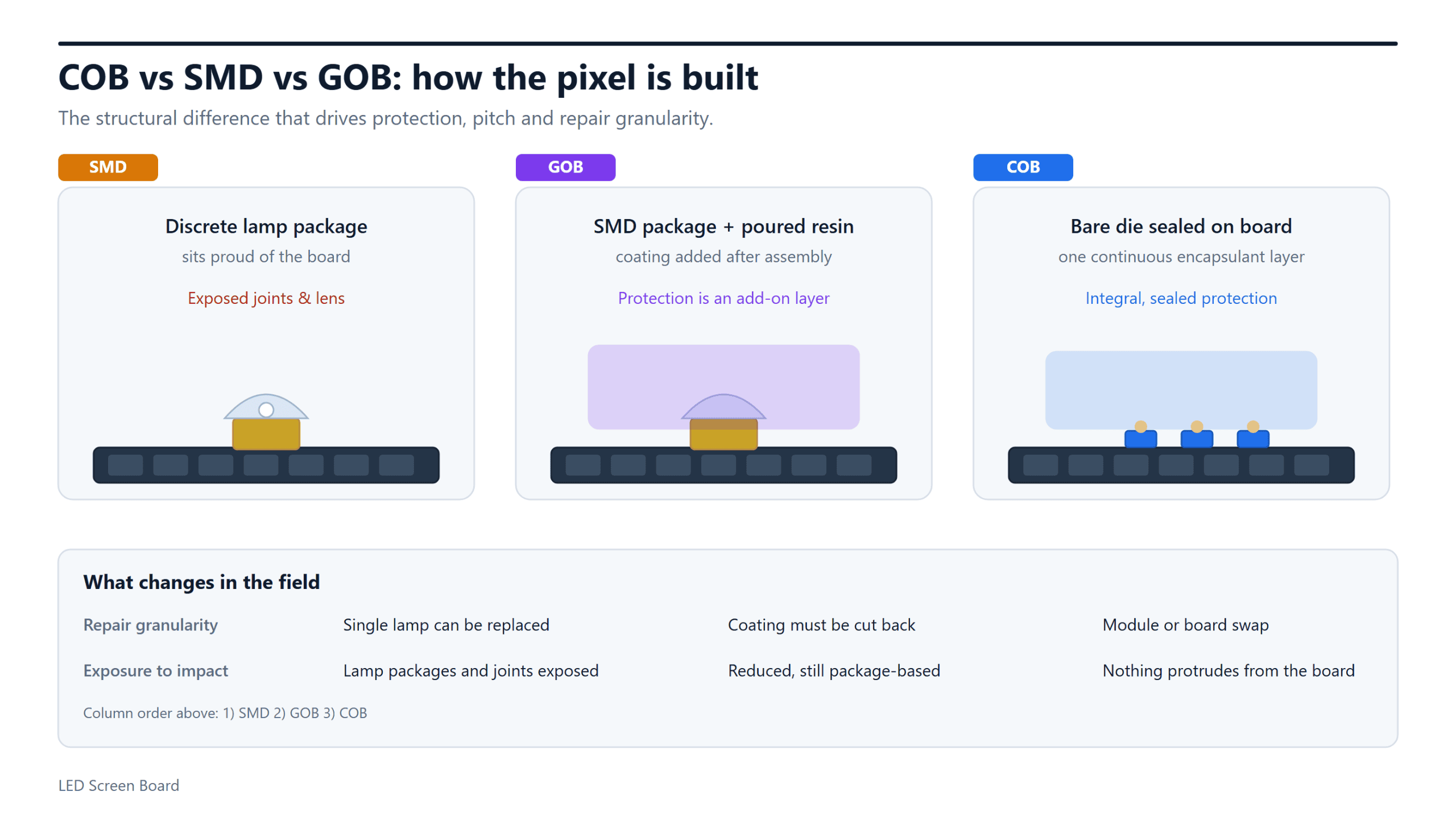
Below, the same dies sit directly on the board with no protective device.
03. MIP vs COB vs SMD vs GOB Compared
Four packaging families dominate fine-pitch LED displays today. GOB LED module and COB are mature; MIP is the newest. The table below sets out how they differ in the areas that affect a purchase decision.
| Feature | MIP (Micro LED in Package) | COB (Chip on Board) | SMD (Surface Mount Device) | GOB (Glue on Board) |
|---|---|---|---|---|
| How the LED is packaged | Dies are pre-packaged into a discrete, surface-mountable device, then mounted like a standard SMD component | Bare dies are bonded directly to the PCB and sealed with resin, with no discrete package | Each LED lamp is packaged individually, then reflow-soldered onto the PCB | SMD lamps, with the module surface filled with a layer of optical glue |
| Practical pixel pitch range | P0.4 to P1.5 | P0.6 to P1.8 | P1.2 and above (fine pitch becomes costly) | P1.2 and above |
| Production route | Standard SMT line, no mass-transfer capex required | Requires dedicated chip-on-board bonding and encapsulation equipment | Standard SMT line, mature and widely available | Standard SMT line plus a glue-filling process |
| Repairability | Package or module level; failed devices can be reworked | Module level; damage usually means replacing the whole module | Single lamp level; cheapest repair route | Single lamp level, but glue must be removed first |
| Heat dissipation | Good, though the package adds one thermal interface versus COB | Best in class, because the die sits directly on the board | Weakest of the four; heat passes through the lamp body | Similar to SMD, improved slightly by the glue layer |
| Best suited to | Fine-pitch indoor, virtual production, cinema, boardrooms | Rugged indoor, high-usage environments | Rental, outdoor and mainstream indoor screens | Indoor screens needing extra moisture and impact protection |
The practical reading: SMD is cheapest at P1.2 and above, GOB is an SMD module with extra protection, COB is the most thermally efficient, and only MIP technology reaches sub-millimetre pitch on an ordinary SMT line.
2. Why MIP Technology Changes LED Display Economics
01. Transfer Efficiency
Direct Micro LED assembly is limited by throughput. Each die is a fraction of a millimetre wide and must be placed with sub-micron accuracy, which restricts a transfer head to a handful of chips per second — impractical machine time for a 10 m² LED wall.
MIP technology sidesteps this by changing the unit of work. A package containing four or nine dies carries four or nine pixels per placement instead of one, and because the package is rigid and standardised, placement tolerance widens dramatically. The precision requirement has not disappeared; it has moved upstream into packaging, where it is handled at wafer scale.
02. Yield and Dead Pixels
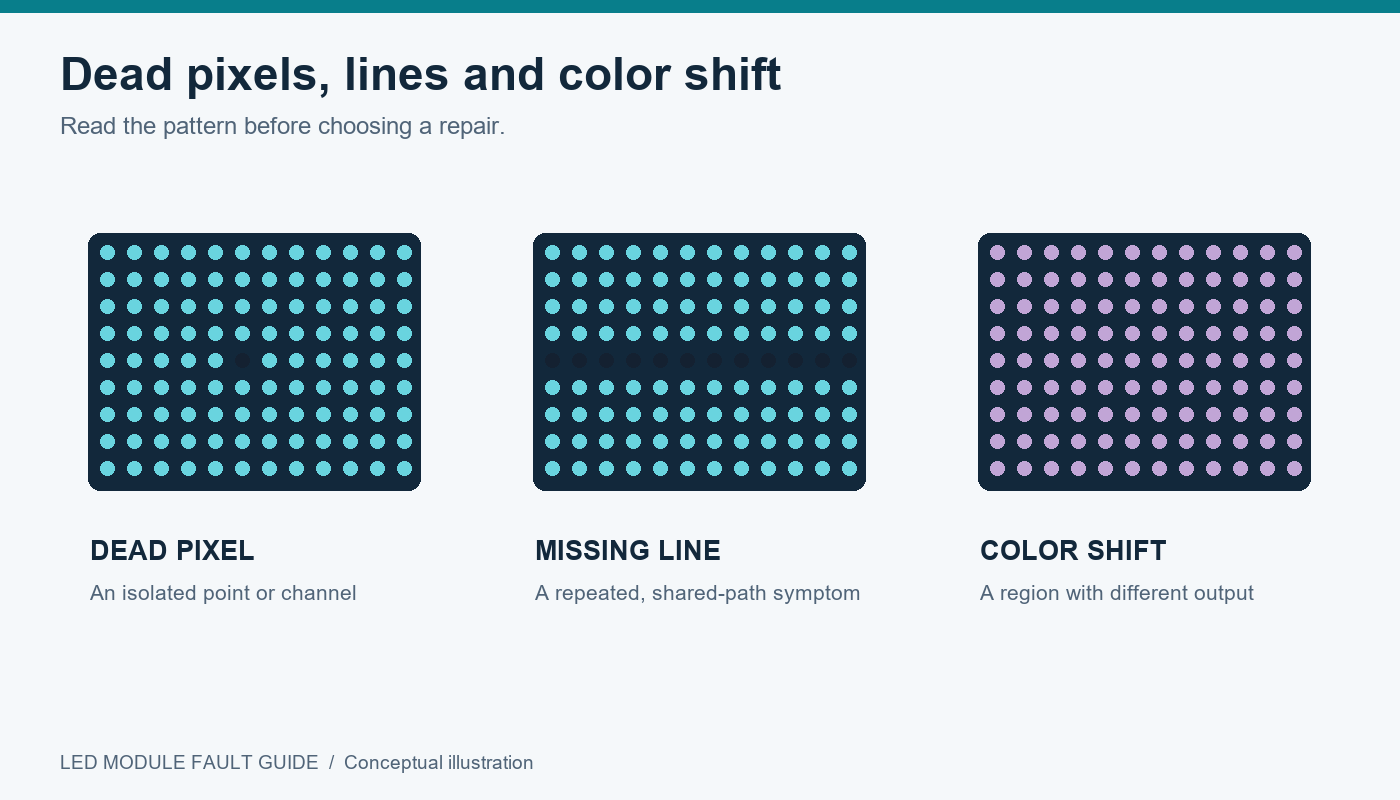
Dead pixels are the most visible failure mode in fine-pitch LED displays. MIP technology changes the arithmetic three ways:
- Wavelength and brightness binning happens at package level, so colour uniformity is established before the panel is built.
- Defective dies are screened out during packaging instead of being discovered after assembly.
- A failure in the field affects a package, not the whole module — the LED display module can be reworked, which is a genuine advantage over COB.
The trade-off is that one failure can affect a small cluster rather than a single pixel. Because dies are screened first, field failure rates on MIP LED displays rarely dominate the maintenance budget.
03. Cost Structure: Where the Savings Come From
A MIP LED display still costs more than an equivalent COB product; what MIP technology changes is the shape of the fine-pitch cost curve.
| Cost or yield factor | Conventional direct Micro LED assembly | MIP packaging route |
|---|---|---|
| Chip placement | Millions of dies placed one at a time, with tolerance measured in single microns | Dies are grouped into standardised packages first, so tolerance relaxes to tens of microns |
| Placement throughput | A few chips per second, limited by precision | Hundreds of pixels per second, because each package carries multiple chips |
| Defect screening | Defects surface only after the panel is assembled, which is expensive | Dies are tested and binned during packaging, so most defects never reach the screen |
| Equipment investment | Dedicated mass-transfer tools costing millions | Existing SMT lines, so more factories can build fine pitch |
| Field repair | Panel-level repair in most cases | Package or module replacement, so repairs are faster and less disruptive |
Two consequences follow. Because MIP uses existing SMT capacity, more factories can build credible fine-pitch panels, which is why sub-1 mm prices have fallen faster than forecasts assumed. And because the entry price for a given resolution keeps dropping, specifications that were unrealistic on a boardroom budget three years ago are now quotable.
3. MIP LED Display Specifications and Performance
01. Pixel Pitch, Resolution and Viewing Distance
Pixel pitch is the single most consequential specification, because it simultaneously sets resolution, cost and minimum viewing distance. MIP LED displays available in 2026 run from about P0.4 to P1.9, with P0.6 to P1.25 covering most premium indoor projects. Standard cabinets are usually 600 x 337.5 mm in a 16:9 screen aspect ratio, which makes 4K and 8K walls straightforward to stack.
| Pixel pitch | Pixels per m² | Pixel density (PPI) | Comfortable viewing distance | Typical MIP LED display use |
|---|---|---|---|---|
| P0.4 | 6,250,000 | 63.5 | From 1.2 m | Micro LED home cinema, premium consumer walls |
| P0.6 | 2,777,778 | 42.3 | From 1.8 m | Executive briefing centres, home theatre |
| P0.78 | 1,643,655 | 32.6 | From 2.3 m | Broadcast studios, control rooms |
| P0.9 | 1,234,568 | 28.2 | From 2.7 m | Virtual production volumes, design review suites |
| P1.25 | 640,000 | 20.3 | From 3.8 m | Boardrooms, flagship retail, museums |
| P1.5 | 444,444 | 16.9 | From 4.5 m | Lobbies, auditoriums, premium signage |
| P1.9 | 277,008 | 13.4 | From 5.7 m | Large meeting rooms, conference halls |
Use the table as a filter, not a rule. The right pitch makes individual pixels invisible from the closest seat a viewer will actually occupy. If that seat is 3 m away, P1.25 is comfortable, and P0.9 buys resolution nobody will resolve. The companion question — how many pixels a given pitch produces across a given width — is covered in our LED screen resolution guide.
02. Brightness, Contrast and Colour Gamut
MIP LED displays typically deliver 600 to 1,200 nits indoors, with contrast improved by the black coating visible in the schematic above. Because wavelength binning happens at package level, colour uniformity across a large wall is one of the strongest arguments for MIP technology over SMD at the same pitch.
Well-specified MIP panels cover 95 percent or more of DCI-P3, which is why they are now credible for colour-critical grading and review environments. For a desktop-sized product rather than a wall, the considerations differ and are set out in our guide to whether a microLED monitor is worth buying.
03. Heat Dissipation, Power and Lifespan
This is the most honest criticism of MIP technology. A package adds one thermal interface between die and board, so heat travels a longer path than in COB, where the die is bonded directly to the substrate. Well-designed MIP modules manage this with metal-core PCBs and cabinet ventilation, but in a 24/7 control room the difference is measurable.
Ask suppliers for two numbers: power consumption in watts per m² at the brightness you will actually run, and junction temperature under sustained load. A quoted 100,000-hour lifespan is only meaningful if the panel is not running hot, because LED degradation is strongly temperature-dependent.
04. Repairability and Serviceability
For anything other than a permanent installation, repairability should carry real weight. SMD is easiest to repair, COB hardest, and MIP technology sits closer to SMD than most buyers expect: the packaged device can be replaced with hot-air or infrared rework instead of an entire module.
Ask how spares are supplied and how long packages will remain available. Because there is still no industry standard for MIP package footprints, a display from one supplier may not be serviceable with another’s devices — a lock-in risk worth writing into the contract.
4. MIP LED Display vs COB: Which Should You Choose?
01. Where MIP Technology Wins
Choose MIP technology when you need sub-millimetre pitch and cannot accept the service model COB imposes:
- Pitch below P1.0. This is MIP’s home ground, and the gap widens as pitch shrinks.
- Repairability matters. If the screen runs in a live environment where module-level replacement is disruptive, MIP is the better service model.
- You want colour consistency without paying for full calibration. Package-level binning does part of that work at the factory.
- You need to scale quickly. Because MIP uses SMT capacity, lead times are generally shorter than for direct Micro LED or specialised COB lines.
02. Where COB Still Wins
COB remains the stronger choice when the environment is rough, the duty cycle is punishing, or the budget is tight at pitches around P1.0 and above.
- Heat and moisture. The die-on-board bond gives COB the best thermal path in the industry, which matters for 24/7 operation and for humid or dusty locations.
- Pitch above P1.2. At P1.5 and P1.9 the visual difference narrows while the price difference does not.
- Established supply chains. COB is mature, widely second-sourced and well documented — an EA600COB3 COB LED display is a lower-risk procurement than a first-generation MIP product.
If your project sits on the boundary, either technology will work; the deciding factors are service access and total cost of ownership, not image quality. A COB LED display module comparison and a MIP quotation, priced over five years rather than at purchase, usually make the answer obvious.
5. Where MIP LED Displays Are Used Today
01. Virtual Production and Film Studios
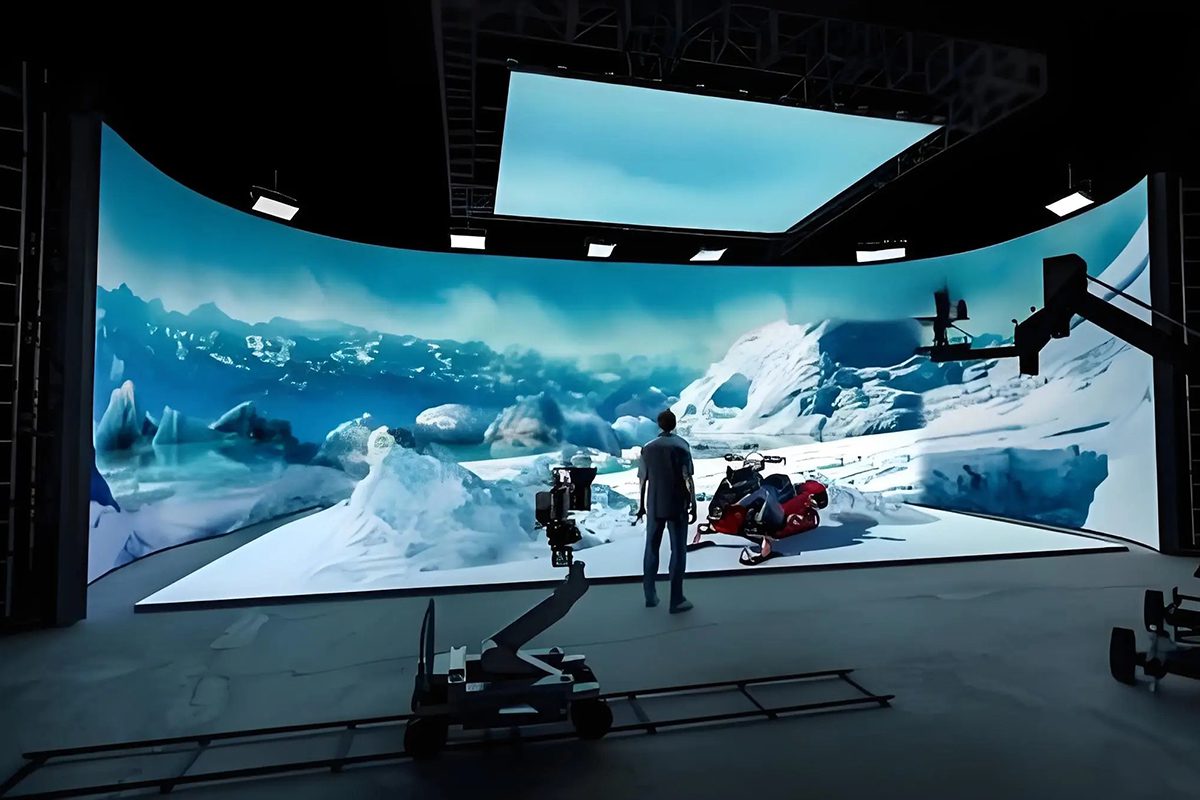
Virtual production is the application that pushed MIP into the mainstream. A virtual production LED wall must be camera-friendly above all: high refresh rate and grayscale depth to eliminate rolling-shutter banding, accurate colour to avoid fighting the grade in post, and enough resolution for the focal lengths actually used.
MIP LED displays do well on all three counts and add a practical benefit on set: a damaged panel can be repaired without shipping an entire module back to the factory. Studios typically specify P0.9 to P1.5 at 3,840 Hz or higher.
02. Micro LED Cinema Screens
Cinema is the highest-value application and the one where MIP technology genuinely displaces tradition. An LED cinema screen replaces projection entirely: no lamps, no projector booth, and no screen-gain falloff at the edges.
The specification logic differs from a boardroom. A cinema screen is sized by the auditorium, so pitch is derived from the resolution you intend to deliver across that width — which is why cinema projects are usually quoted per square meter rather than per cabinet.
| Cinema screen width | Native resolution | Pixel pitch needed | Indicative 2026 cost per m² |
|---|---|---|---|
| 5 m | 2K DCI (2048 x 1080) | Approximately P2.4 | USD 2,500 to 5,000 |
| 10 m | 4K DCI (4096 x 2160) | Approximately P2.4 | USD 3,000 to 6,500 |
| 10 m | 8K (7680 x 4320) | Approximately P1.25 | USD 6,000 to 12,000 |
| 15 m | 8K (7680 x 4320) | Approximately P1.9 | USD 4,500 to 9,000 |
| 20 m | 16K (15360 x 8640) | Approximately P1.3 | USD 8,000 to 15,000+ |
| Any width | Any | Any | Add 15 to 30 percent for DCI-P3 calibration, redundancy and cinema processing |
Treat these as indicative market bands, not quotations. Cinema-grade work adds certification, DCI-P3 calibration, redundant processing and a service contract, so a certified installation costs materially more per square meter than the raw panel. Panel-level costs for the widest formats still vary by a factor of two or more between suppliers.
03. Boardrooms, Control Rooms and Retail
Outside film and cinema, the strongest adopters are environments where text sharpness or unattended duty cycles matter. Executive boardrooms and conference room display installations at P0.9 to P1.25 produce text that reads like print. Control rooms value the repairability, because an operator cannot wait for a module to return to the factory.
In premium retail and exhibition work, MIP LED displays are chosen for colour accuracy: reproducing artwork or product colour faithfully is often the whole point. For chains specifying many identical sites, package-level binning consistency is worth more than the last increment of pitch.
6. How Much Does a MIP LED Display Cost?
01. Indicative Price per Square Meter in 2026
Anyone searching for the cost per square meter of a MIP LED display is usually trying to sanity-check a quotation. Honest framing: below P1.0, MIP sits at a modest premium over COB and a large premium over SMD at the same pitch. Above P1.5 the three technologies converge and packaging stops driving price.
As reference points for 2026, fine-pitch indoor LED walls generally fall into these bands, per square meter of finished screen:
- P0.9 to P1.25, indoor: roughly USD 2,000 to 5,000.
- P1.5 to P2.5, indoor: roughly USD 1,200 to 2,500.
- P2.6 to P3.9, rental: roughly USD 800 to 1,800.
- True chip-level Micro LED, cinema and consumer: commonly above USD 12,000, and higher again once certified.
A useful rule of thumb: halving the pitch roughly doubles to triples the price per square meter. That is what makes specification discipline valuable — moving from P0.9 to P1.25 can cut the panel budget by a third without changing what the audience perceives, provided the viewing distance supports it.
02. Hidden Costs That Change the Total
Purchase price is rarely the whole number. In real projects these items typically add 20 to 40 percent to the total investment:
- Structure, mounting and rigging, including any steelwork the wall requires.
- Video processing and the control system, which for fine pitch is not a trivial line item.
- Spare modules and packages — a working stock of spares is the difference between a five-day outage and a two-hour repair.
- Installation labour, commissioning and calibration.
- Power and cooling, which scale with the brightness you actually run.
- A service contract, if unattended operation is required.
03. What Will Bring MIP Prices Down
Three forces are pushing MIP LED display pricing down. Packaging capacity is expanding as more suppliers enter, which attacks the fixed cost per package. Standardisation of package footprints is reducing the tooling burden. And die costs keep falling as wafer yields improve.
The countervailing force is demand. Cinema, virtual production and premium retail are all growing at once, and a technology that is simultaneously the best answer to several markets tends to hold its price. If your project is not time-critical, the historical trend favours waiting; if it is, the current generation is already specified well enough to be a sound investment.
7. How to Specify and Buy a MIP LED Display
01. A Procurement Checklist
Before requesting quotations, fix the five variables that determine price and performance:
- Closest and furthest viewing distance. This sets the maximum useful pitch.
- Native resolution required. Work backwards from resolution and width to get the pitch.
- Duty cycle. Continuous 24/7 operation changes the thermal requirement.
- Ambient light. A bright atrium needs more nits than a darkened grading suite.
- Service model. Front-service, rear-service or both, and who performs the repairs.
Once those are fixed, ask for die size in microns, package configuration, refresh rate, greyscale depth and colour uniformity specification — not just pitch and price.
02. Questions to Ask a Supplier
The questions below separate a genuine MIP LED display supplier from a reseller repackaging a specification sheet:
- What is the die size, and are the dies Micro LED or Mini LED?
- How many chips are in each package, and what is the package footprint?
- How are packages binned for wavelength and brightness, and what is the maximum colour deviation across the wall?
- What is the measured junction temperature at rated brightness?
- How is a failed package replaced, and what does that cost in labour and downtime?
- How long will this exact package remain in production?
A supplier who can answer all six without qualification is worth shortlisting. Our quality control process documents how those numbers are verified before shipment, and answers for any specific product are available from contact our engineers.
8. MIP Technology Trends to Watch
Three developments are worth tracking. First, share: MIP packaging is gaining ground fastest in the fine-pitch segment, and forecasters expect it to take a substantial share of sub-P1.0 production as capacity comes online. Second, pitch: commercial MIP products are moving below P0.5, where the format begins to compete directly with true chip-level Micro LED for consumer and cinema products.
Third, standardisation. A shared package footprint would reduce lock-in, shorten lead times and make multi-vendor servicing possible. Until then, the practical defence is to specify durability and serviceability explicitly in the contract rather than assuming a future supplier can service today’s panel.
9. FAQs About MIP Technology
10. Conclusion
MIP technology is best understood as a manufacturing answer to a manufacturing problem. Micro LED has always promised the best picture in the industry; what held it back was that nobody could build it fast enough, cheaply enough, to be reliable. By packaging the dies first and mounting them with ordinary SMT equipment, MIP LED displays convert an exotic process into a standard one.
The practical consequence for a buyer in 2026 is that fine pitch is now a specification decision rather than a budget impossibility. Match the pitch to the real viewing distance, confirm whether the chips are Micro LED or Mini LED, ask how a failed package is replaced, and price the whole system rather than the panel. Do that, and a MIP LED display is usually the right answer for premium indoor work.
If you are specifying a project and want the numbers applied to your room — pitch, resolution, brightness and a realistic budget — contact our engineers with your viewing distances.
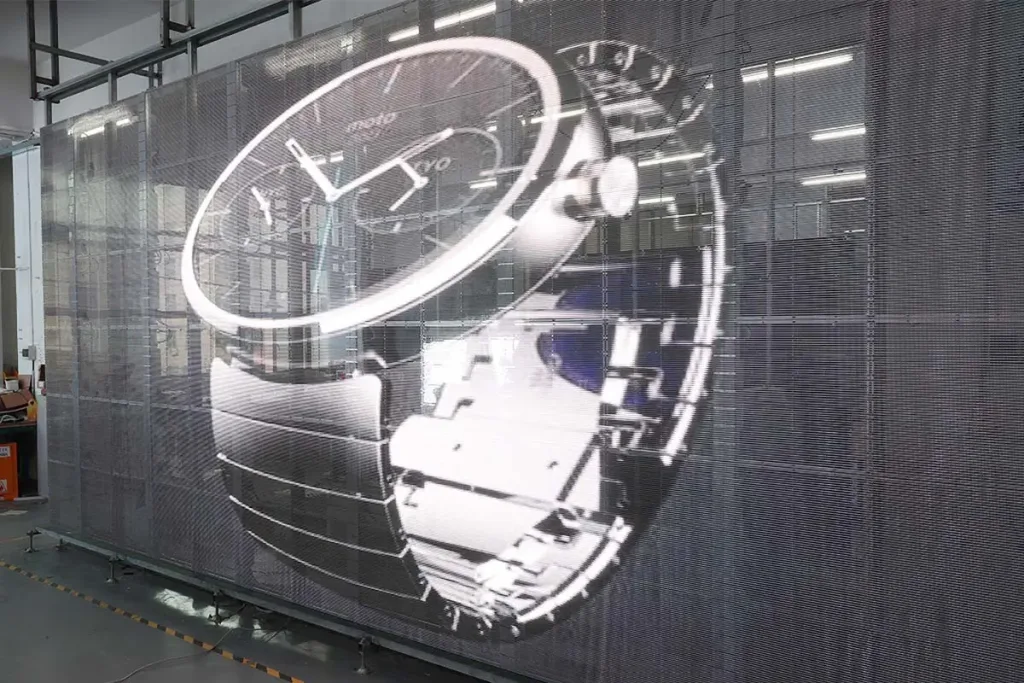 How LED Transparent Screen Transforms Retail Window Displays
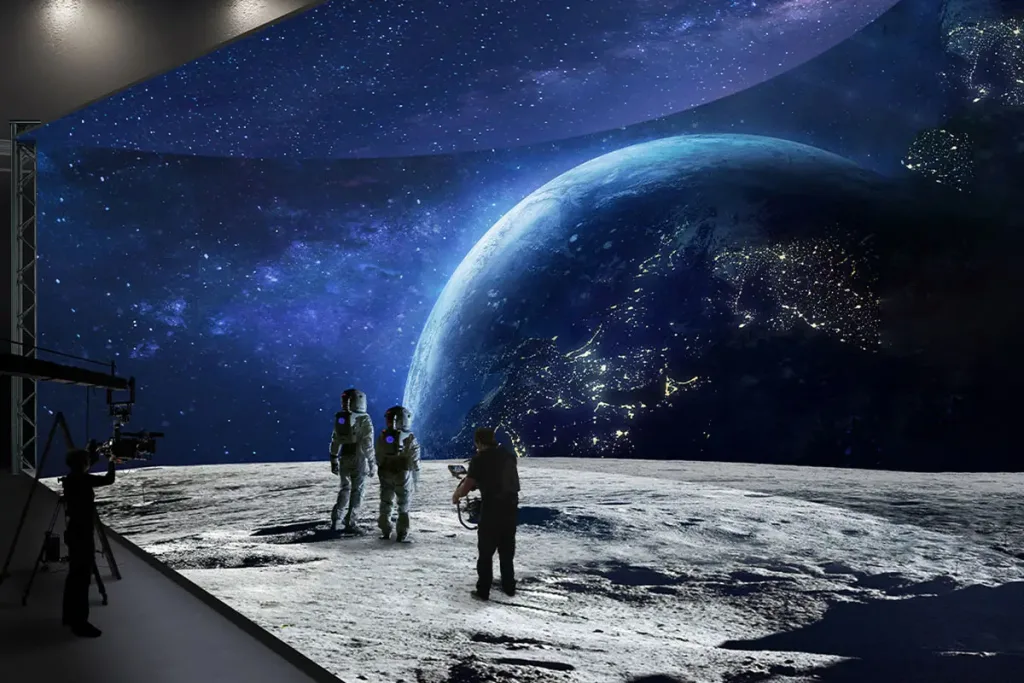 Virtual Production LED Wall: Cost, Specs and Setup Guide (2026)