
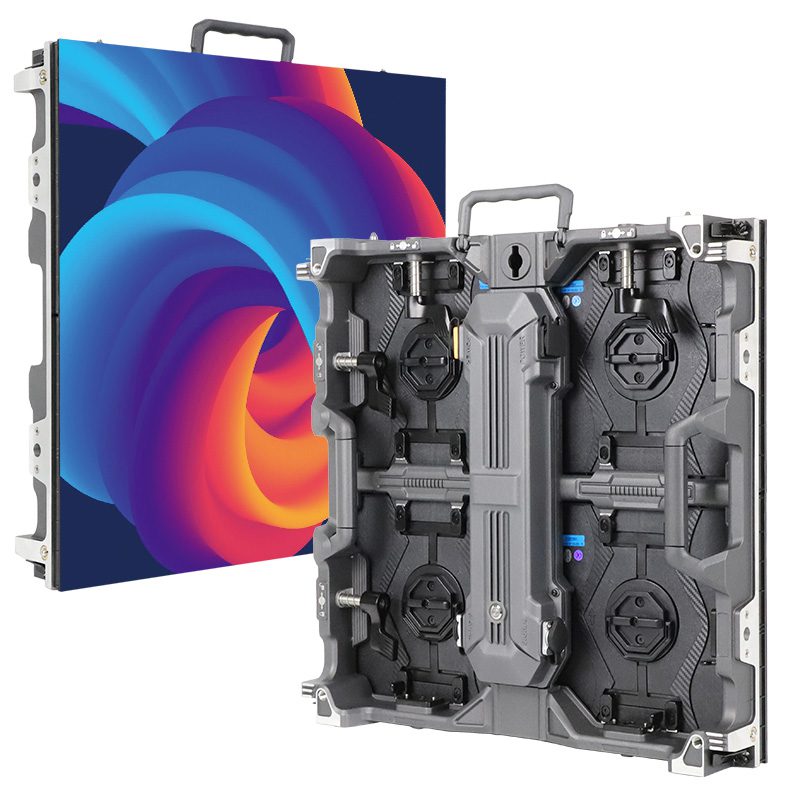
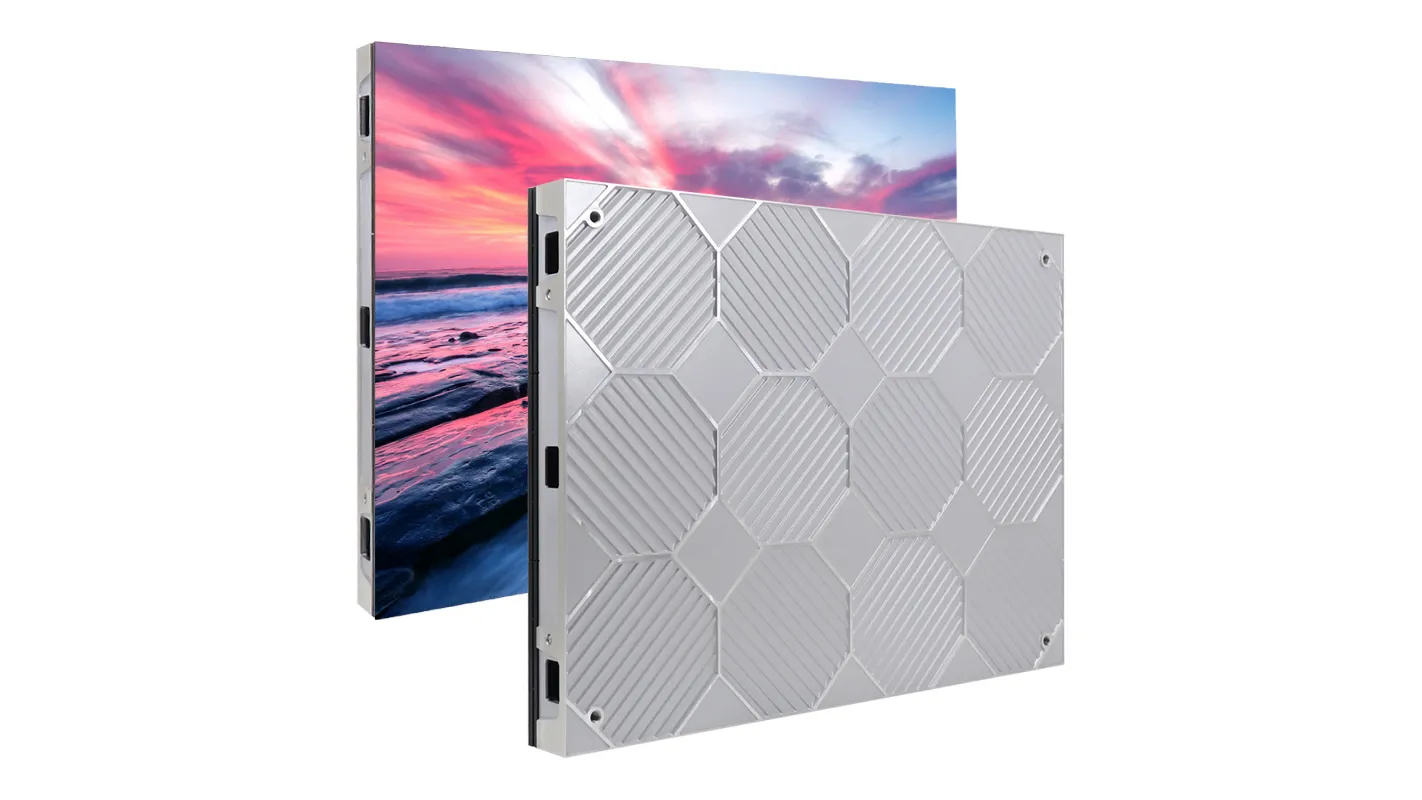
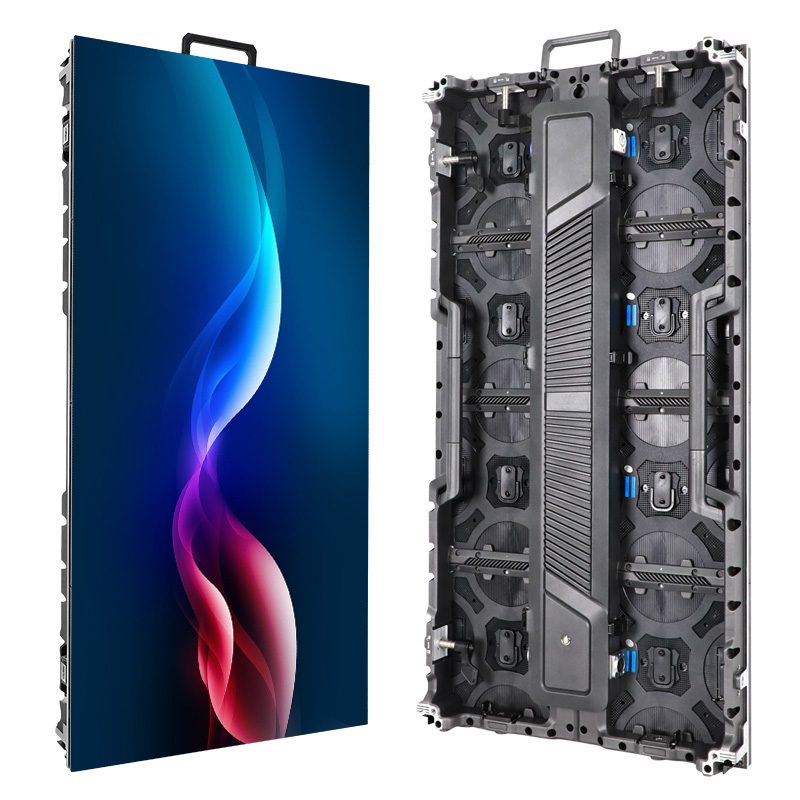
SMD vs COB LED modules is the single comparison that decides how much you pay per square metre, how good the picture looks from the front row, and how often a technician has to visit the wall. Get it wrong and you either overspend on resolution you cannot see, or you save money and then fight pixel failures and camera moire for five years. This guide gives you a decision framework instead of marketing claims: how to tell the two technologies apart in the field, where the real performance gaps are, how cost behaves over time, and what to ask a supplier before you sign.
Three variables keep deciding the SMD vs COB LED modules question: viewing distance, content type, and cost of downtime. Everything else is a detail. The comparison tables below let you argue your specification competently in a supplier meeting.
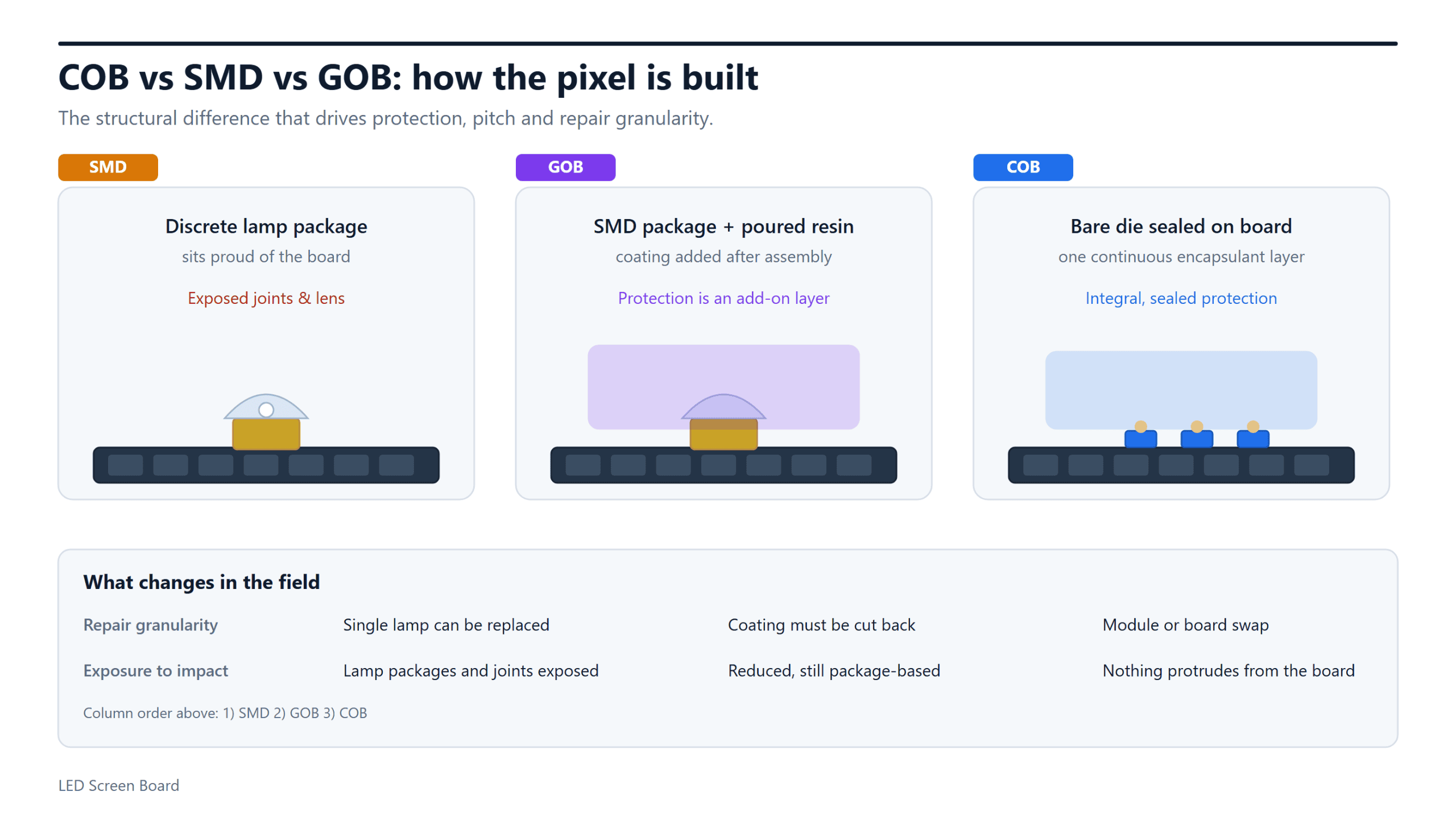
Quick definitions: SMD (surface-mount device) modules are built from individually packaged RGB LEDs soldered onto a printed circuit board. COB (chip-on-board) modules bond bare LED dies straight onto the board and encapsulate them under a thin protective resin. That one structural difference drives nearly every practical trade-off between SMD vs COB LED modules.
1. What Are SMD vs COB LED Modules?
Before you compare price lists, be precise about what is being compared. SMD vs COB LED modules are two manufacturing routes to the same end product: a pixel that emits red, green and blue light on demand. The difference is how the light-emitting die is mounted and protected.
01. SMD LED Modules: Packaged LEDs Soldered to the Board
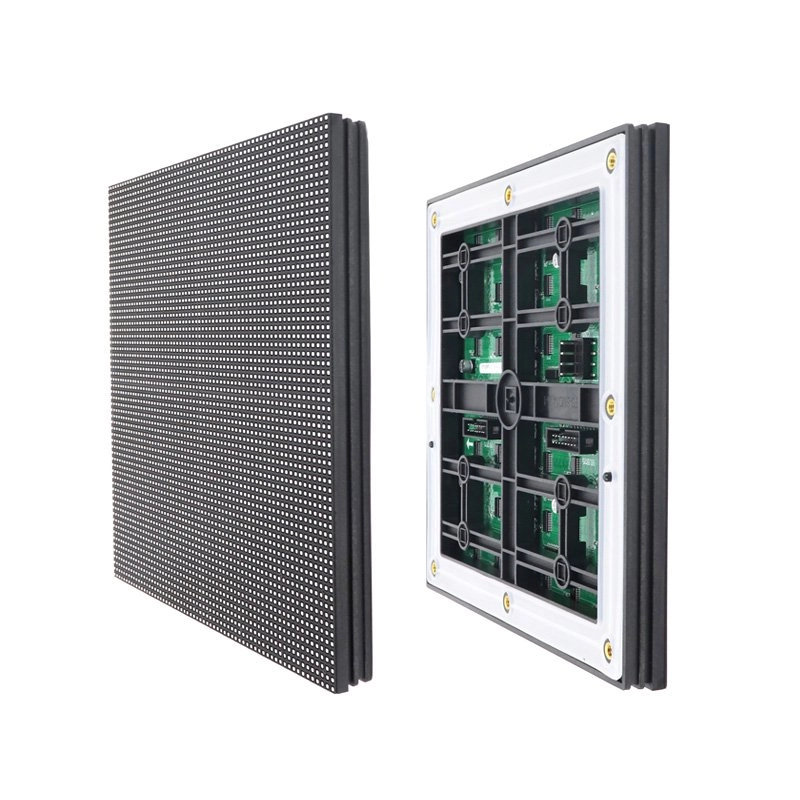
An SMD LED module uses small plastic-bodied packages, each containing one red, one green and one blue die with a shared lens. Those packages are reflow-soldered onto the module PCB in a precise grid. A P2.5 SMD module contains thousands of discrete packages, each with its own solder joints and lens. Because the packages are standardised, the supply chain is deep: lamp packages, driver ICs and complete modules are available from many vendors at competitive prices.
The visible consequence is texture. At close range you see a tidy grid of tiny lenses, and each lens can catch light from an off-axis source. That is what creates the faint sparkle that video cameras sometimes exaggerate. See our indoor LED screen module range for representative products.
02. COB LED Modules: Bare Dies Encapsulated on the Board
A COB LED module skips the package entirely. The bare die is die-bonded and wire-bonded directly to the module PCB, then covered with a thin layer of epoxy or silicone resin that acts as lens, seal and diffuser at once. There is no discrete package to solder, no separate lens, and no gap for dust to collect in. The result is a flat, matte, continuous surface.
Because there is no package wall between adjacent pixels, COB LED modules can be built at far finer pitch, with P0.4 to P0.9 products now routine. The trade-off is manufacturing complexity: die placement, wire bonding and encapsulation all demand tighter process control, which shows up in the price per square metre. That is the structural trade-off at the heart of SMD vs COB LED modules. For indoor builds, see our indoor LED screen overview.
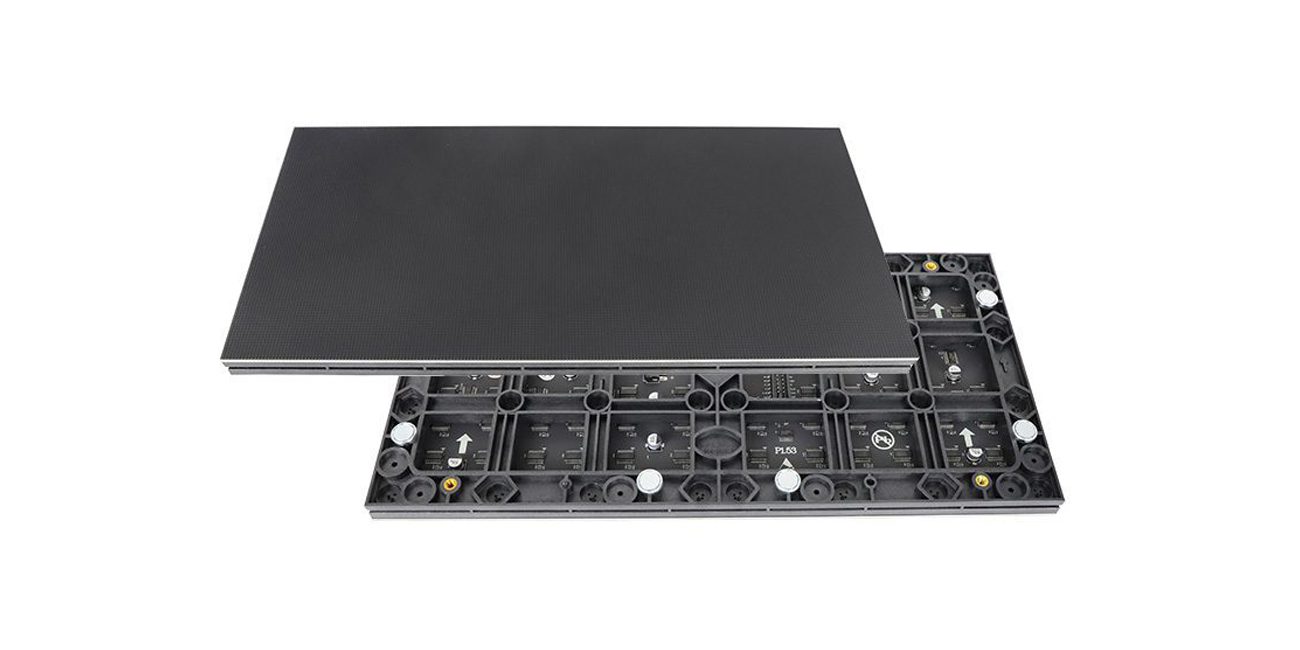
03. Table 1: SMD vs COB LED Modules at a Glance
| Attribute | SMD LED module | COB LED module |
|---|---|---|
| Pixel construction | Individually packaged RGB LEDs reflow-soldered to the PCB | Bare RGB dies bonded directly to the PCB and sealed under resin |
| Typical pixel pitch range | P1.9 to P10 | P0.4 to P1.8 |
| Surface finish | Visible lens grid with slight texture | Smooth, matte, seamless plane |
| Contrast and black level | Good; depends on mask and coating quality | Excellent; the dark encapsulation absorbs stray light |
| Repair granularity | Lamp, module or driver level | Full-module replacement |
| Relative upfront cost per m2 | Lower | Higher |
| Best-fit applications | Outdoor advertising, rental stages, mid-distance indoor walls | Control rooms, broadcast sets, premium retail, fine-pitch indoor walls |
| Spare parts ecosystem | Mature and widely available | Improving, but narrower per model |
2. How to Identify SMD vs COB LED Modules on a Showroom Floor
Sales literature is easy to write and hard to verify. If you are standing in front of two demo walls and need to confirm which technology you are looking at, five minutes of inspection is usually enough. These are the checks AV consultants and rental technicians actually use when they compare SMD vs COB LED modules in person.
01. Surface and Texture Test
Look at the wall from roughly 300 mm away, slightly off-axis so the light rakes across the surface. On an SMD LED module you will see a regular grid of small domed lenses, and the gaps between them read as fine dark texture. On a COB LED module the surface is continuous, like a dark sheet of matte plastic. Run a finger gently across the corner of an unpowered module: SMD feels slightly bumpy, COB feels flat and solid.
02. Reflection, Glare and Camera Test
Shine a phone flashlight across the surface at about 30 degrees. SMD returns small bright specular dots, because every lens has a curved, glossy face. COB returns a soft, broad sheen with no hard points of light. Then point a phone camera at both walls: SMD tends to produce a faint flicker or wavy pattern when the camera shutter and the panel refresh rate interact, while COB usually suppresses that artefact. This is the most useful field test for broadcast or hybrid meeting projects.
03. Pixel Pitch and Label Clues
Check the label on the back of the cabinet and the pitch you have been quoted. As a rule of thumb, a wall finer than P1.8 is almost certainly COB, and one coarser than P1.9 is almost certainly SMD. If a supplier offers a P1.2 SMD wall at an unusually low price, ask what the module-to-module colour tolerance is. For how pitch interacts with resolution, see our guide to digital retail signage.
| What to check | SMD LED module | COB LED module |
|---|---|---|
| Surface at 300 mm | Grid of tiny domed lenses with visible gaps | Continuous flat plane with no visible packages |
| Flashlight at 30 degrees | Sharp specular dots from every lens | Soft, broad, low-glare sheen |
| White text on dark grey | Pixel texture becomes visible early | Edges stay clean at arm length |
| Seams between cabinets | Fine alignment lines can show | Borders are largely hidden |
| Back-label pixel pitch | Usually P1.9 and coarser | Usually P1.8 and finer |
3. Performance: How SMD vs COB LED Modules Compare On Screen
Once you know which panel you are looking at, the useful comparison is measurable behaviour. The gaps between SMD vs COB LED modules are not uniform across every metric, and knowing which metrics matter for your room prevents you from paying for performance you will never see.
01. Contrast, Black Level and Ambient Light
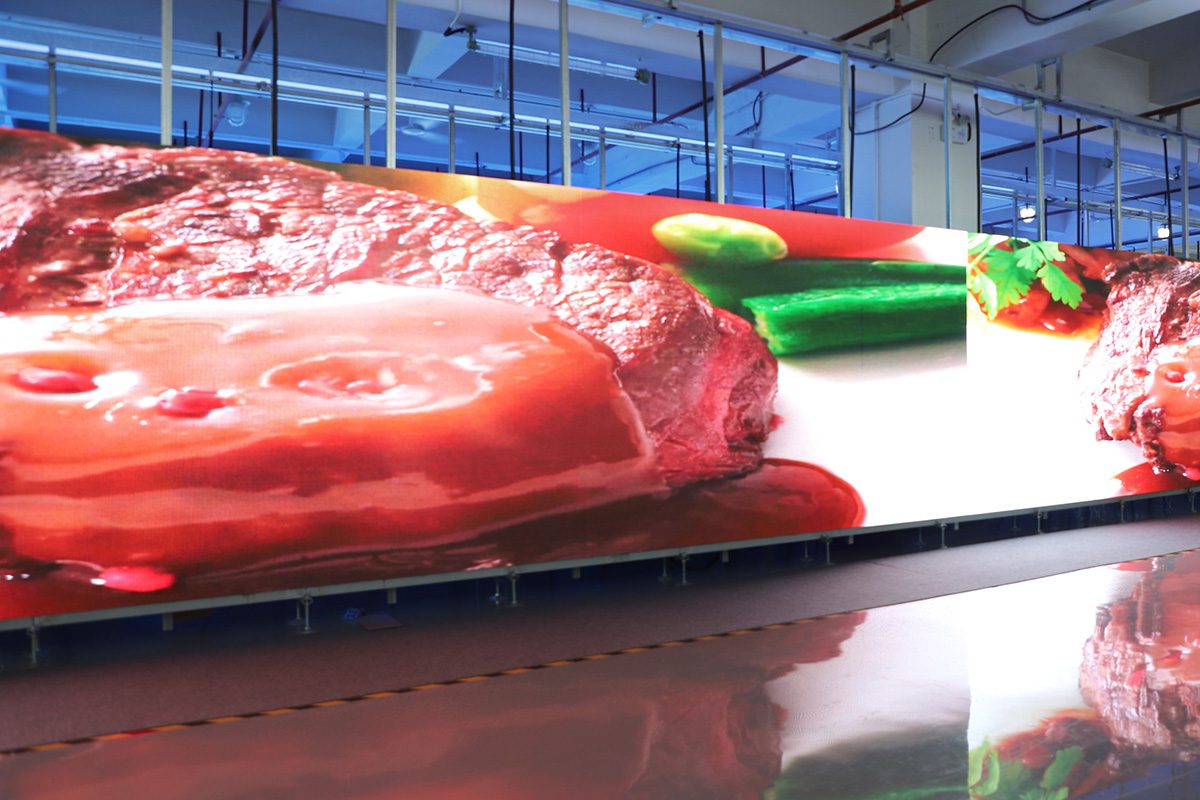
Contrast is where COB LED modules pull ahead most visibly. Because the encapsulation is dark and flat, and because there is no glossy lens to reflect ceiling lights back at the audience, the black floor drops. In a bright retail environment or a boardroom with windows, text stays crisp and dark video does not wash out to grey. SMD modules improve contrast substantially with a matte black mask and a good lamp coating, but the curved lens surface will always return some specular reflection.
02. Colour Uniformity and Calibration Drift
A single SMD module contains thousands of independently soldered packages, and each package has its own bin code for wavelength and brightness. Manufacturers sort and match lamps carefully, but some module-to-module deviation remains, and it grows as the panel ages. COB LED modules encapsulate a whole pixel group under one resin layer, which averages out die-level differences and slows visible drift. In practice, an SMD wall needs more frequent calibration to stay uniform, especially at high brightness.
03. Moire, Scan Lines and On-Camera Rendering
Cameras expose problems the eye forgives. The repeating lens grid of an SMD module interacts with a camera sensor grid to produce moire, the wavy shimmer seen on televised LED backdrops. A smooth COB surface breaks up that interaction, and higher refresh rates and grayscale depth complete the fix. When you compare SMD vs COB LED modules for broadcast work, treat refresh rate, grayscale bit depth and surface uniformity as one specification, not three line items.
04. Brightness and Viewing Distance
Raw brightness is the one metric where SMD wins outright at the top end. Outdoor SMD modules are routinely built to 5,000 to 8,000 nits and above, because a billboard must compete with sunlight. Indoor COB LED modules typically sit in the 600 to 1,200 nit band, plenty at close range but not intended for direct sun. Match brightness to the environment rather than buying the highest number on the datasheet: over-bright indoor walls cause eye strain and force dimming, which wastes the grayscale headroom you paid for.
| Performance factor | SMD LED module | COB LED module |
|---|---|---|
| Indoor peak brightness | 800 to 1,200 nits typical | 600 to 1,200 nits typical |
| Outdoor peak brightness | 5,000 to 8,000+ nits | Not intended for direct-sun outdoor use |
| Native contrast ratio | Around 3,000:1 to 5,000:1 | Around 8,000:1 and higher |
| Module-to-module uniformity | Good, needs periodic calibration | Very high as delivered |
| Calibration drift over time | Faster, especially at high brightness | Slower |
| Moire on camera | Visible at fine pitch | Strongly suppressed |
| Typical refresh rate | 1,920 to 3,840 Hz | 3,840 to 7,680 Hz |
4. Reliability and Maintenance: Failure Modes and Service Windows
Reliability conversations often stop at failure rate, which is the least useful number for planning. What actually determines your operating cost is how a module fails, how long the repair takes, and whether a spare part is on a shelf in your city or on a ship from Shenzhen. SMD vs COB LED modules behave very differently across all three.
01. How Each Technology Fails
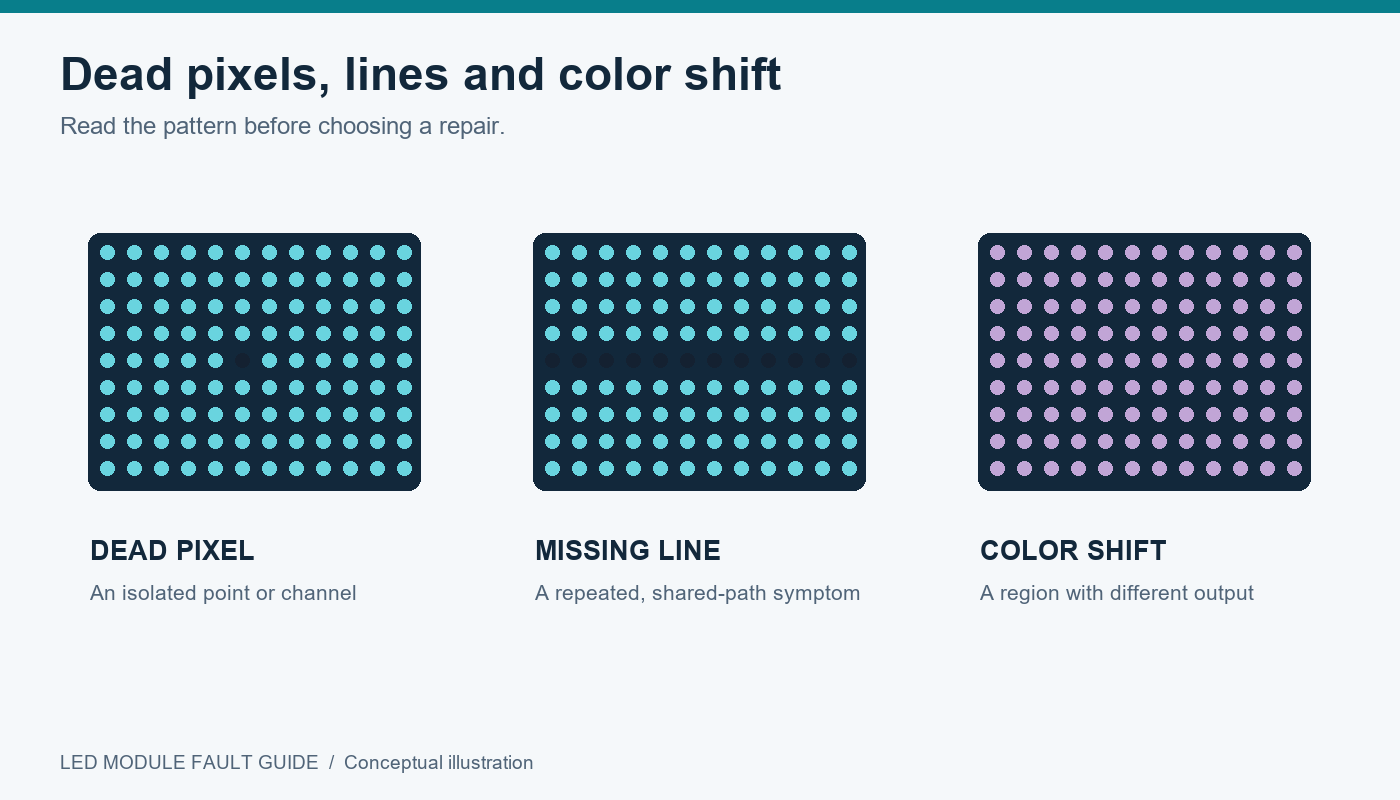
SMD modules fail at the component level. A lamp package can lose one colour channel, a solder joint can crack after thermal cycling, or a driver IC can fail. Most faults affect a small area, so the panel keeps working while you schedule a repair. COB LED modules fail less often at pixel level because there is no solder joint or lens to degrade, but a fault usually involves the encapsulation or the driver, and individual pixels cannot be reworked in the field, so LED screen repair follows a different path.
02. Repair Paths and Spare Parts
Serviceability is where SMD vs COB LED modules diverge most sharply, and SMD wins. A technician can swap a module or lamp package in minutes, and module prices are low because the components are commodity parts. Rental companies rely on this: a cabinet swapped during load-in keeps a show on schedule. COB repairs are module-level swaps too, but modules cost more and are less likely to be held locally. Offset that by specifying spare modules at purchase, at roughly three percent of installed surface area, with a response-time SLA in the contract.
03. IP Ratings, Heat and Environmental Durability
Outdoor deployment is a housing question as much as a technology question. Outdoor SMD modules reach IP65 or IP66 with a sealed front and conformal-coated PCB, and perform well in rain, dust and UV when the cabinet is properly designed. COB surfaces are inherently sealed and wipe clean easily, but an indoor COB panel is still an indoor panel. For both, thermal design determines lifespan, so leave cabinet clearance and plan dust control into the maintenance routine.
| Factor | SMD LED module | COB LED module |
|---|---|---|
| Most common failure mode | Single lamp or colour channel, cold solder joint, driver fault | Encapsulation or driver fault affecting a pixel group |
| Repairable at pixel level in the field | Yes, in many cases | No |
| Typical module swap time | 5 to 15 minutes | 15 to 30 minutes |
| Spare module cost | Lower, widely stocked | Moderate, often made to order |
| Handling durability (rental) | Good with flight cases and care | Excellent, sealed and impact tolerant |
| Recommended service cadence | Monthly visual check, quarterly calibration | Quarterly visual check, semi-annual calibration |

5. Cost: Upfront Price versus Five-Year Total Cost of Ownership
Cost is the requirement most often misread. SMD vs COB LED modules differ less on purchase price than on what happens after installation, and the gap narrows or widens depending on how expensive downtime is for you.
01. Upfront Price per Square Metre
At the same nominal pixel pitch, SMD LED modules usually cost less. At the fine pitches where COB competes the comparison becomes less fair, because many of those pitches simply are not available in SMD. The honest version: SMD gives you more screen per dollar at P1.9 and coarser, while COB is the only realistic option below P1.8. That is why SMD vs COB LED modules rarely compete head to head at an identical pitch.
02. Five-Year Total Cost of Ownership
Build the model yourself rather than trusting a single ROI figure. The table below shows the structure to use, expressed as index points so you can substitute your own quotes. COB front-loads cost and reduces recurring labour; SMD trades a lower capital outlay for more frequent interventions.
| Cost line | SMD index | COB index | Notes |
|---|---|---|---|
| Capital cost | 100 | 125 | Replace with your own quoted prices |
| Initial spare modules (3% of area) | 3.0 | 4.0 | Higher unit cost for COB modules |
| Calibration over 5 years | 5.0 | 3.0 | SMD drifts faster and needs more visits |
| Field repair labour | 6.0 | 3.5 | More events, lower cost per event for SMD |
| Downtime exposure | Higher | Lower | Weight by your own cost per hour offline |
| Five-year total (index) | 114 | 135.5 | COB costs more overall, but is more predictable |
03. Warranty, SLA and Spare-Part Lead Times
Three contract terms change the arithmetic more than any technical specification: warranty length and whether it covers parts and labour, the SLA response window, and spare-part lead time. A four-hour response on a trading floor is worth real money, and a two-week wait for a COB module can cost more than the module itself. Get all three in writing before comparing prices.
6. Applications: Where Each Technology Wins
Technology arguments are usually settled by the room. The same SMD vs COB LED modules specification that is wasteful in a highway billboard is essential in a broadcast studio, because the two rooms punish different failures. That is the whole point of comparing SMD vs COB LED modules: the room decides.
01. SMD LED Module Applications
Choose SMD when surface area, brightness and serviceability dominate. Outdoor boards and highway billboards use SMD because cost scales with square metres and brightness demands are high. Rental stages use SMD because modules are light, cheap to replace and forgiving of handling. Mid-distance indoor walls beyond four metres look excellent in SMD, because the lens grid disappears at that distance. Stadium perimeter advertising also favours SMD, and our LED displays for sports guide covers those requirements in detail. Browse the outdoor LED video wall module range for specifications.
02. COB LED Module Applications
Choose COB when the audience stands close and notices everything. Control rooms and trading floors need low-glare surfaces and reliable small text. Broadcast studios and virtual sets need camera-friendly panels with high refresh and no moire. Luxury retail flagships want a seamless surface that survives daily contact. Museums and galleries need uniform planes for captions and gradients. Boardrooms, auditoriums and medical teaching theatres sit in the same band: viewers within two to three metres and mostly text content. See the COB LED display module range for options.
03. Selection Matrix by Viewing Distance and Content
| Application | Recommended module | Why it wins |
|---|---|---|
| Highway billboard, large outdoor board | SMD | Lowest cost per square metre, high brightness, mature spares |
| Stadium perimeter, rental touring stage | SMD | Light modules, fast cabinet swaps, tolerant of handling |
| Indoor video wall viewed beyond 4 m | SMD | Lens grid is invisible at that distance, best value |
| Control room, trading floor at 2 to 3 m | COB | No moire, high contrast, low glare for long shifts |
| Broadcast studio and virtual set | COB | Camera-friendly surface with high refresh and grayscale depth |
| Luxury retail flagship and showroom | COB | Seamless premium finish, resistant to daily contact |
| Museum, gallery and exhibition captioning | COB | Uniform surface, no shimmer on fine text |
| Airport and transit wayfinding | COB indoors, SMD outdoors | Readability and uptime are the deciding factors |
| Boardroom and corporate auditorium | COB, or fine-pitch SMD if budget-led | Depends on the closest seated distance |
7. How to Specify and Buy SMD vs COB LED Modules
A well-written specification protects you more than a brand name. The checklist below works whether you are buying SMD vs COB LED modules for a single boardroom panel or for a national signage rollout.
01. Questions to Ask Every Supplier
Ask for measured values rather than adjectives, and per batch rather than per product family. If a supplier cannot quote a brightness uniformity figure or a colour tolerance, that is itself the answer. Confirm the driver IC model, the refresh rate at your working grayscale depth, and whether the price includes receiving-card and power-supply spares.
02. Sample Evaluation and Acceptance Testing
Always evaluate SMD vs COB LED modules at the real viewing distance with your own content, not the supplier demo reel. Bring a slide with small white text on a dark background, a slow camera pan, and a skin-tone close-up. Ask for a dead-pixel policy in writing, and confirm front or rear service access, because that affects whether a module swap takes five minutes or an hour.
| Specification item | Ask the supplier | Accept if |
|---|---|---|
| Pixel pitch tolerance | What tolerance is held across the delivered batch? | Plus or minus 0.05 mm or tighter |
| Brightness uniformity | What is the module-to-module deviation? | 3% or less |
| Colour tolerance | What colour deviation is guaranteed? | Delta u prime v prime of 0.003 or less |
| Refresh rate | What rate is achieved at 14-bit grayscale? | 3,840 Hz or higher |
| IP rating (outdoor) | Is there a third-party test report? | IP65 or IP66 documented |
| Spare parts | Price and lead time for 3% spare modules? | Quoted lead time of four weeks or less |
| Warranty | What is covered, and for how long? | Three years or more, parts and labour |
| Dead pixel policy | What is the maximum allowable rate? | One per 10,000 pixels or better |
8. Common Myths About SMD vs COB LED Modules
01. Myth: COB Is Always the Better Technology
COB is better at some things and worse at others. It has no answer for an outdoor billboard needing 8,000 nits at low cost, and offers no advantage at distances where the lens grid of SMD is already invisible. Buying COB for a mid-distance wall means paying a premium for a difference nobody can see.
02. Myth: SMD Is Becoming Obsolete
SMD volumes continue to dwarf COB in outdoor, rental and large-format indoor work, and the component ecosystem keeps those prices falling. The two technologies are settling into different niches: fine pitch is drifting toward COB, while everything driven by cost per square metre stays with SMD.
03. Myth: COB Cannot Be Used Outdoors
COB panels can be used outdoors when the housing is properly engineered, but the resin layer is not a substitute for an IP-rated enclosure, and indoor COB brightness is usually too low to fight direct sunlight. Treat outdoor COB as a housing and brightness question, not a module-technology question.
04. Myth: A Higher Refresh Rate Fixes Camera Issues
Refresh rate is necessary but not sufficient. Moire comes from the interaction between surface geometry and the camera sensor, so a glossy lens grid still produces artefacts at high refresh. Surface uniformity, grayscale depth and shutter-speed matching also contribute.
9. FAQs About SMD vs COB LED Modules
10. Conclusion: Choosing Between SMD vs COB LED Modules
Decide with the room, not with the brochure. If viewers stand within three metres, or a camera will ever point at the wall, COB LED modules justify their premium through higher contrast, a seamless surface and fewer on-camera artefacts. If the project spans hundreds of square metres, is driven by cost per square metre, or is handled roughly on tour, SMD LED modules remain the practical workhorse with the deeper spare-parts supply.
The decision framework is short. Measure the closest viewing distance, identify the content type, and place a value on an hour of downtime. Those three inputs usually resolve the SMD vs COB LED modules question before price is even discussed. Then hold the supplier to measured values: brightness uniformity, colour tolerance, refresh rate at your working grayscale, IP certification and a written dead-pixel policy.
Finally, model five years rather than one when you compare SMD vs COB LED modules. Capital cost is the smallest part of the story. Calibration cadence, spare-part lead time and service response windows decide what the wall actually costs you, and they are all negotiable before you sign. For a deeper look at the technology itself, read our explainer on COB LED technology, or compare specifications across our COB LED screen range.
 Top 10 LED Display Screen Manufacturers in the USA (2026)
 NovaStar VX600: Software, Manual, Setup & Specs